Pounds to Dollars: What Your GBP Is Really Worth in USD
Converting pounds to dollars is one multiplication — but the rate on your screen is not the number that reaches the other side. Two costs eat into it: a percentage spread and, on many bank transfers, a flat fee of around £20. Which one hurts more depends entirely on how much you're moving. Send £250 and the flat fee is the villain; send £25,000 and the percentage spread is. This guide shows what your pounds are genuinely worth in dollars, why the cheapest route flips with the amount, and a few UK-specific traps — VAT and US sales tax among them — that quietly reshape the final figure.
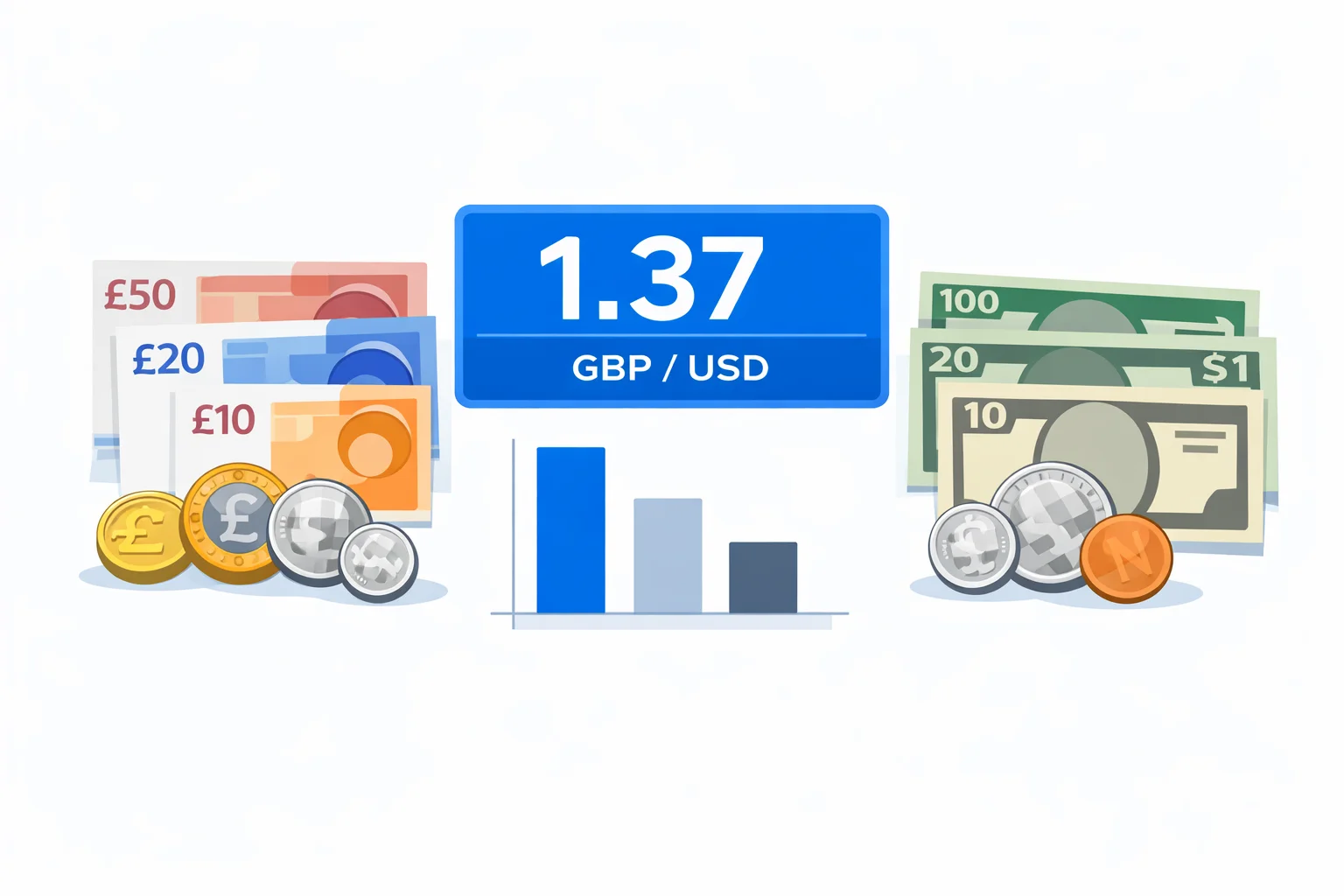
How Much Is £100 in Dollars Today?
At the current rate of about 1.2715 dollars per pound, £100 is worth $127.15. That mid-market rate — the midpoint banks trade at — is the only honest baseline for any pounds-to-dollars conversion. Every rate you're actually offered is this number minus a cut. Since the pound sits at roughly a 27% premium to the dollar, a quick mental shortcut is to add a quarter and a bit: £80 becomes about $102, £400 lands near $508. For a tighter check, add a quarter then nudge up 2% — close enough to sanity-test a price without reaching for your phone.
The live figure in the converter refreshes from a daily feed. For an official benchmark, the Bank of England publishes daily spot rates, and the US Federal Reserve records the pound in its H.10 exchange-rate release — handy when you want a rate nobody can accuse of being marked up.
Why a £20 Wire Fee Changes the Cheapest Route
Here's the part most converters ignore. A bank SWIFT wire usually charges two things: a spread of around 3.5% and a fixed fee near £20. That flat fee is a percentage in disguise, and the percentage shrinks as the amount grows. On a £300 transfer, £20 is a hidden 6.7% before the spread even applies. On a £30,000 transfer, the same £20 is 0.07% — practically a rounding error.
Compare two real routes on £5,000 (mid-market $6,357.50):
- Wise / specialist (0.4% spread, £0 fee): you receive about $6,332, losing roughly $25.
- Bank SWIFT wire (3.5% spread + £20 fee): the £20 comes off first (£4,980 left), then the spread — you receive about $6,110, losing about $247.
That's a $222 gap on the same £5,000, the same day. The tool's comparison bars run this math on whatever you type, and the red effective-percentage label shows the true all-in cost of each route at that amount. Type £200, then £20,000, and watch the wire's cost slide from brutal to negligible.
Doing the Pound-to-Dollar Math Yourself
To convert pounds to dollars by hand, multiply by the rate; to reverse it, divide. At 1.2715:
- £100 → USD: 100 × 1.2715 = $127.15.
- £1,000 → USD: 1,000 × 1.2715 = $1,271.50.
- $1,000 → GBP: 1,000 ÷ 1.2715 = £786.47 — not £1,000, because a pound is worth more than a dollar.
Rounding bites hardest on big sums. Round 1.2715 down to a flat 1.27 and your £40,000 estimate comes out $600 light ($50,800 instead of $50,860). Fine for a holiday budget — but on a US property deposit or a term's tuition, $600 is real money to whoever is wiring it. Keep four decimal places for anything above a few thousand pounds.
The VAT Refund Myth British Shoppers Still Believe
Plenty of UK travelers still assume they can reclaim the 20% VAT on British purchases when they fly out. You can't. The UK abolished tax-free shopping for overseas visitors in January 2021, so unlike most of the EU — where a tourist can claim VAT back at the airport — Britain gives no refund on goods bought in England, Scotland, or Wales. On a £600 watch, that's £100 of VAT baked in for good (£600 ÷ 1.20 = £500 net, so £100 tax), which is about $127 at today's rate.
Why does this matter for a pounds-to-dollars budget? Because it kills a bit of arbitrage people still count on. Some assume a strong pound plus a VAT refund makes UK luxury goods a bargain to carry back and sell or gift in dollars. Post-2021, the refund is gone, so compare the full pound price — VAT included — against the US dollar price before deciding where to buy. Sometimes the US price still wins.
Why $40 in America Costs More Than the Sticker
British visitors get caught by this one constantly: US prices exclude sales tax and tips. That $40 dinner menu isn't $40. Add roughly 8% sales tax (it varies by state — Oregon charges 0%, parts of Louisiana top 10%) and a 20% tip, and you settle around $50. In pounds that's the gap between about £31 and £39 — a quarter more than the number on the menu, and nothing to do with the exchange rate.
One more spending trap works in any currency but stings Brits abroad: at a US card terminal or ATM, if you're asked to pay "in pounds" or "in dollars," always choose dollars. Picking pounds triggers dynamic currency conversion, which lets the merchant's processor set the rate and bolt on a 3-12% markup over your own bank's. On a $300 hotel night, that's up to $36 of pure waste for a worse rate. Read the prompt, tap USD, every time.
Sending Pounds to a US Bank Account
Unlike euro or yen conversions, a big share of pounds-to-dollars traffic isn't tourists at all — it's people wiring money: UK parents paying US college tuition, buyers closing on Florida property, or freelancers settling dollar invoices. For these, the flat-fee effect from earlier is the whole game. A high-street bank might advertise a "free" transfer while hiding a 3-4% spread; a specialist shows the fee openly and keeps the spread near 0.4%.
Two habits save the most. First, ask for the mid-market rate and the all-in fee as separate numbers — if a provider won't split them, the markup is hiding in the rate. Second, batch transfers where you can: one £12,000 wire beats four £3,000 wires when each carries a £20 fee. If you need to move dollars back to sterling later, our dollars to pounds converter applies the same fee logic in reverse, and the multi-currency converter lets you compare markups across 160+ currencies before you send.
Has the Pound Ever Been Worth Just a Dollar?
Almost — but never quite. The pound has traded above the dollar for its entire modern history, yet the cushion has thinned dramatically. Under the Bretton Woods system the rate was pinned near $2.80, cut to $2.40 in the 1967 devaluation. Sterling still touched $2.00 as recently as 2007, then fell hard: after the 2016 Brexit vote it dropped toward $1.20, and on 26 September 2022 it hit an all-time intraday low of about $1.035 — its closest brush with parity ever, though it never actually crossed.
The lesson for anyone converting pounds to dollars: there's no rate the market owes you. Sterling has swung from $2.00 to nearly $1.00 within living memory, and forecasters miss those turns by 10-15 cents a year. So don't sit on a transfer waiting for the pound to "recover" to a number you saw last spring. Control the part you can — convert through a sub-1% provider — and you'll bank within a cent or two of the real rate whatever the market does that week.