CAD to USD: What Actually Drives the Canadian Dollar
Convert CAD to USD before a shopping run across the border, and the exchange rate quietly decides whether the trip pays off. Right now a Canadian dollar buys roughly 73 US cents, so your CA$100 comes back as about US$73 — before a single fee. That gap isn't a rip-off or a weak economy; it's the normal state of a currency tied to oil, interest rates, and a neighbour that buys three-quarters of everything Canada sells. Here's what actually sets the number, and how to keep more of it.
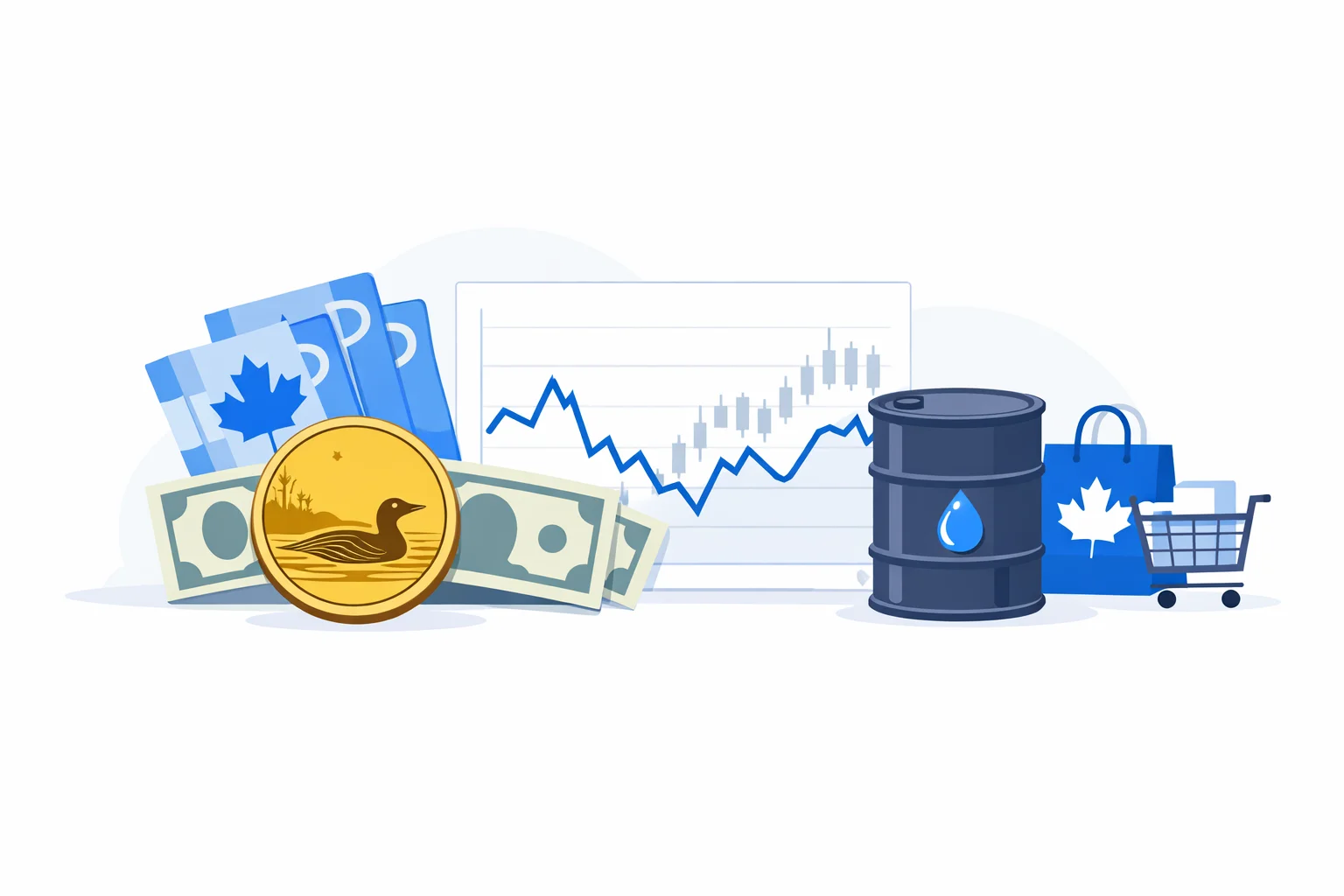
Two Decades Below the Greenback
The loonie has spent most of the last twenty years worth less than one US dollar. Today's rate near US$0.73 sounds low until you check the history: the Canadian dollar hit a modern low of about US$0.62 in January 2002, then rocketed all the way up to US$1.10 in November 2007when oil and commodities were booming. It floated near parity from 2011 to 2013, then drifted back down. So a dollar fetching 73 cents isn't a crash — it's the middle of a range the loonie has bounced around for a generation.
The nickname helps explain the mood around it. The one-dollar coin, introduced in 1987 with a loon on the back, gave Canadians the "loonie," and the two-dollar coin naturally became the "toonie." Traders use those names too — and they watch the loonie as shorthand for how the whole commodity-heavy Canadian economy is holding up against the US.
Converting CA$100, CA$1,500, and CA$5,000
Going from Canadian to US dollars is a single multiplication. Take your amount and multiply by the CAD/USD rate. At 0.7300:
- CA$100 to USD: 100 × 0.73 = US$73.00.
- CA$1,500 to USD: 1,500 × 0.73 = US$1,095.00.
- CA$5,000 to USD: 5,000 × 0.73 = US$3,650.00.
Notice you multiply here because the rate is below 1.00 — the mirror image of the USD to CAD conversion, where you divide (or multiply by 1.37 instead). If you want to double-check any day's official figure, the US Federal Reserve H.10 release publishes the Canada/US rate every business day. For anything beyond this one pair, our multi-currency converter lets you set a provider markup and watch the take-home change live.
Why Oil Prices Move Your Loonie
Here's the fact most converters skip: the Canadian dollar is a petrocurrency, and crude oil is the single biggest lever on the CAD to USD rate. Canada pumps out roughly 4 million barrels a day for export, and almost all of it flows south to US refineries. When oil is expensive, buyers need more US dollars to pay for Canadian crude, and that demand — plus the optimism around a resource economy — lifts the loonie.
The clearest proof is the 2014–2016 oil crash. West Texas Intermediate crude fell from about US$100 a barrel to under US$30, and the loonie fell right alongside it, sliding from roughly US$0.94 to US$0.68 in the same window. No other major currency tracks oil this tightly. It's why a barrel price on the news can tell you which way your Canadian dollars are heading before the forex quote even updates.
The Bank of Canada–Fed Gap
After oil, the biggest driver is the interest-rate spread between the Bank of Canada and the US Federal Reserve. Money chases yield. When the Fed's policy rate sits above the Bank of Canada's, holding US dollars simply pays more, so investors sell loonies for greenbacks and the CAD to USD rate drifts lower. A one-point gap in favour of the Fed can shave a couple of cents off the loonie over a few months.
This is why rate-decision days matter more for CAD than a random economic report. If the Bank of Canada cuts while the Fed holds, the widening gap pushes the loonie down almost immediately. You can watch the official daily numbers on the Bank of Canada's exchange-rate page, which posts a single reference rate each afternoon.
The 75% Problem: When US Trade News Hits CAD
Roughly 75% of Canadian merchandise exports go to the United States— no other advanced economy leans on a single trade partner that heavily. That dependence is a double-edged sword for the exchange rate. When the US economy is strong and buying, Canadian factories and oil fields hum, and the loonie firms up. But a US tariff threat, a stalled trade deal, or a whiff of American recession can knock two or three cents off CAD in a single session, even when oil hasn't budged.
That's the part travellers underestimate. You can do everything right — watch oil, track the rate gap — and still get blindsided by a headline out of Washington. It's the main reason the CAD to USD rate can feel jumpier than steadier pairs like EUR to USD, where no single trade relationship dominates the picture.
Cross-Border Shopping: What Loonies Really Buy
This is where the rate meets your wallet. Say you spot a US$400 gadget in a Buffalo store. At 0.73 that's CA$548 — but your Canadian credit card tacks on its standard 2.5% foreign-transaction fee, so you actually pay about CA$561.70. Then comes the border. On a same-day trip your personal exemption is CA$0, so that gadget is fully subject to GST/HST, and in most provinces that's another 13% or so.
Add it up and a US$400 "deal" can land near CA$635 once the card fee and sales tax are in. The exemptions reward longer trips: CA$200 of goods come home duty-free after 24 hours, and CA$800 after 48 hours, per the Canada Border Services Agency rules. The duty-free strip in the tool above lays out all three windows so you can plan the trip around them.
Mistakes That Quietly Cost Canadians
- Dividing when you should multiply. Applying 0.73 to CA$1,000 by dividing gives US$1,370 — a US$640 fantasy. Canadian to US dollars is a multiplication: 1,000 × 0.73 = US$730.
- Letting the terminal charge you in Canadian dollars. When a US checkout offers to bill your card "in CAD," that's dynamic currency conversion, and it hides a 3–12% markup. Always choose to pay in US dollars and let your own bank convert.
- Using the airport kiosk.Exchange desks often skim 8% or more. On CA$1,000 that's roughly US$58 gone versus a decent card — enough for a tank of gas and lunch.
- Eyeballing prices as if a dollar equals a dollar.A US$50 tag isn't CA$50 — it's about CA$68.50 before fees. One-for-one math understates every US price by roughly 37%.
When Holding Canadian Dollars Beats Converting
Converting the instant you think of it isn't always smart. For small amounts, don't bother shopping around: on CA$80 of spending, the gap between the best and worst rate is a couple of dollars — not worth the effort. And if you're paying a US invoice that isn't due for weeks, holding your loonies and letting a no-FX-fee card convert at settlement often beats locking a marked-up transfer rate today.
Skip the panic conversion too. Trying to time CAD to USD at exactly the right cent because a forecast said so is a losing game — major banks routinely miss their year-end targets for this pair by three to five cents. Convert on your own schedule, use a sub-1% provider, and treat the rate like weather rather than a target. When you're heading the other way and need Canadian cash for a trip north, our USD to CAD converter runs the same math in reverse.