GBP to USD: What Moves the Pound-Dollar Rate, and Why It's Called Cable
The GBP to USD rate has a nickname older than the telephone. Currency desks have called it "Cable" since the 1860s, and the pound- dollar pair is still one of the busiest, twitchiest prices in global markets. One pound buys about $1.27 right now, but that single number is the product of two central banks, a smaller open economy, and more political drama than any other major pair carries. This guide is the markets-eye view: what actually pushes Cable up and down, how to read and convert a quote yourself, and why the pound can lurch further in a day than the euro does in a week.
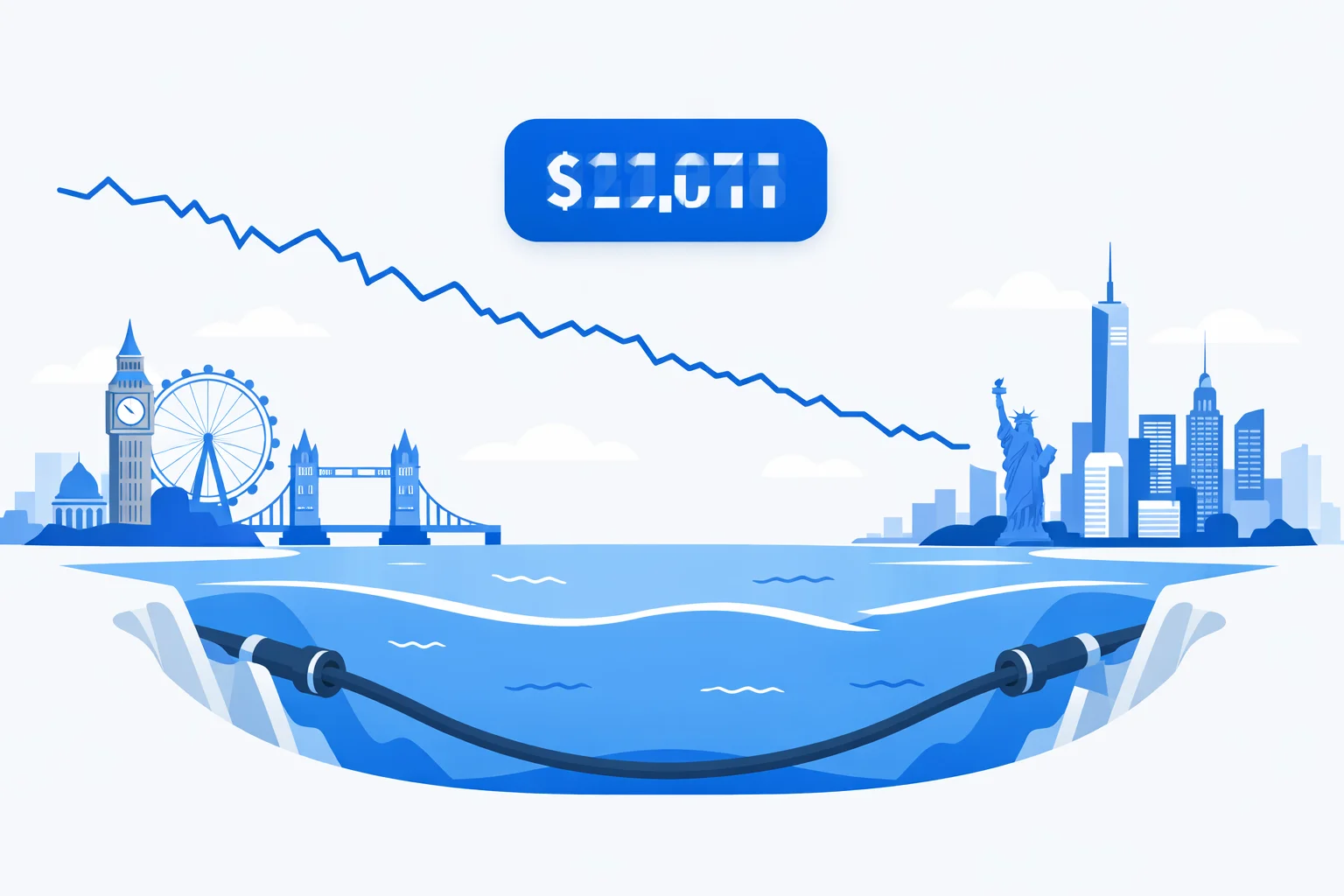
Why Traders Call GBP/USD 'Cable'
Back in 1866, the first reliable transatlantic telegraph cable was laid across the ocean floor between Britain and North America. For the first time, the pound-dollar exchange rate could be sent between the London and New York markets in minutes instead of the ten days a ship took. Dealers started quoting the rate "down the cable," and the name has outlived the technology by more than a century and a half. It applies to exactly one pair — GBP/USD — so if a trader says "Cable is bid at 1.28," they mean the pound, never the euro or yen.
It is a small piece of trivia with a real payoff: it tells you this pair has been a benchmark of transatlantic finance since Victorian times. That heritage is why GBP/USD is still a headline rate quoted on every news ticker, watched by tourists, importers, and the many UK firms that price contracts in dollars.
The Bank of England–Fed Gap Behind Every Move
Strip away the noise and the biggest lever on GBP/USD is the interest- rate difference between the Bank of England and the US Federal Reserve. Money chases yield. When the Fed's policy rate sits at 4.5% and the BoE's at 4.0%, holding dollars pays half a percentage point more per year, so capital drifts toward the dollar and the pound softens. Close that gap — or flip it so the BoE pays more — and sterling tends to firm.
This is why every BoE Monetary Policy Committee vote and every Fed meeting can jolt the rate. A surprise quarter-point decision, or even a shift in tone about future cuts, routinely moves Cable half a cent within minutes. Three other forces matter: relative inflation (faster UK inflation erodes the pound's buying power), the growth gap between the two economies, and global risk mood — in a scare, traders pile into the dollar as the reserve currency and the pound slips even when nothing changed in Britain. You can sanity-check any day's official figure against the Federal Reserve's H.10 release.
Reading a GBP/USD Quote and Its Pips
When you see "GBP/USD 1.2715," the pound is the base and the dollar is the quote. The number is simply how many dollars one pound buys. A rising quote means the pound is gaining: if Cable climbs from 1.27 to 1.30, your £1,000 jumps from $1,270 to $1,300 — a $30 swing on a 2.4% move. Flip the rate to read it the other way: at 1.2715, one dollar buys 1 ÷ 1.2715 = £0.786, which is exactly what our USD to GBP converter shows on the dollar side.
That fourth decimal place has a name: a pip. One pip is 0.0001, so 100 pips equals a full cent of movement. Pips are how the market measures Cable's moves, and they translate straight into money. On a £10,000 conversion, every 100-pip move is worth exactly $100 — the rate-move panel in the tool above runs this on whatever amount you type. It is the difference between a quote you glance at and one you understand.
Converting £500 and £10,000 Step by Step
The arithmetic is one operation: to go from pounds to dollars, multiply by the rate; to reverse it, divide. At 1.2715:
- £500 → USD: 500 × 1.2715 = $635.75.
- £10,000 → USD: 10,000 × 1.2715 = $12,715.
- $10,000 → GBP: 10,000 ÷ 1.2715 = £7,864.73 — not £10,000, because a pound is worth more than a dollar.
Precision matters more than people expect on large sums. Round 1.2715 down to a flat 1.27 and your £50,000 estimate lands $750 light ($63,500 instead of $63,575). Nobody notices ten pips on a £500 holiday budget, but on a US property deposit or a term's tuition, those pips are real money to whoever is wiring it. Keep four decimal places above a few thousand pounds.
How Deep Is the Pound-Dollar Market?
Cable is huge. It makes up roughly 9-11% of all global foreign-exchange turnover, which puts it third behind EUR/USD and USD/JPY. With worldwide FX volume running near $7.5 trillion a day per the Bank for International Settlements Triennial Survey, even a single-digit share is an ocean of liquidity. That depth is good news for anyone converting: on the wholesale market the gap between buy and sell prices is a fraction of a cent.
The catch is that you rarely touch the wholesale rate. A no-fee card or specialist transfer service converts pounds to dollars at 0-1% over mid-market, a high-street bank takes 2-4%, and an airport bureau 8-12%. On £2,000, that is the gap between losing about $20 and losing $200 — same pair, same second, tenfold the cost. The deep market hands you a great raw price; the provider decides how much of it you keep. For the full fee breakdown on this exact pair, our pounds to dollars converter runs the take-home math across every route.
From $2.80 to $1.03: Cable's Long Slide
Sterling has never been worth the same as the dollar, but its cushion has collapsed over 75 years. Under the Bretton Woods system the pound was pinned at $2.80, then devalued to $2.40 in November 1967. After it floated freely in 1972 the rate roamed widely, touching about $2.11 as recently as November 2007. Then came the falls: near $1.05 in early 1985, toward $1.20 after the 2016 Brexit vote, and an all-time intraday low of about $1.035on 26 September 2022 — its closest brush with parity ever, though it never crossed. The range bar in the tool plots today's rate inside that band.
| Period | GBP/USD | What was happening |
|---|---|---|
| 1949-1967 | $2.80 (pegged) | Bretton Woods fixed rate |
| Nov 2007 | ~$2.11 (high) | Weak dollar, pre-crisis peak |
| Feb 1985 | ~$1.05 | Peak dollar strength under Reagan/Volcker |
| Sep 2022 | ~$1.035 (low) | "Mini-budget" crisis, aggressive Fed hikes |
The lesson buried in those rows: there is no rate the market owes you. Parity (1.00) is not a magic floor, and $2.00 is not a ceiling sterling will drift back to. Anyone promising Cable "has" to bounce to a number you saw a few years ago is guessing.
The Two-Minute Crash That Wiped 6% Off Sterling
Cable's defining trait is that it moves. A typical session covers 0.6-0.9% between its high and low, noticeably wider than EUR/USD's 0.4-0.6%, because the UK is a smaller, more open economy whose currency reacts sharply to Bank of England surprises and political headlines. The extreme example is burned into trading lore: in the early hours of 7 October 2016, during thin Asian trading, the pound plunged roughly 6% in about two minutes, briefly printing near $1.14 before recovering — a "flash crash" blamed on automated selling into vanishing liquidity.
For a converter, the takeaway is practical, not dramatic. If a 1-cent move shifts a £10,000 transfer by $100, and Cable can travel several cents in a rough session, then the timingof your conversion is a genuine variable — not worth obsessing over on a £200 spend, but worth a moment's thought on a five-figure transfer. Trying to catch the exact top is a fool's errand; moving your money through a low-markup provider is the part you can actually control.
When the Live Rate Isn't the Rate You'll Get
Treat this converter as a planning baseline, not a receipt. Three things pull your real charge away from the mid-market number. First, spread: unless you are quoted the exact mid-market rate (rare outside specialist apps), expect a 0.5-4% markup baked into the price. Second, timing: a card payment settles one to three days after you tap, so the posted rate is the settlement-day rate, not today's. Third, dynamic currency conversion— if a US terminal offers to charge your UK card "in pounds," decline and pay in dollars, or you hand the merchant a 3-12% markup.
Use the mid-market figure above as your honest benchmark, pick a provider under 1%, and you will land within a cent or two of the real rate. When you need to compare providers, the multi-currency converter lets you pressure-test markups across 160+ currencies, and the pounds to dollars page drills into the fee traps British travelers and transfer-senders hit most.