EUR to USD: What Actually Moves the Euro-Dollar Rate
One euro buys about $1.08 right now — but a year of that single number tells the story of two central banks pulling in opposite directions. The EUR to USD rate is the price tag the world's most-traded currency pair wears, changing thousands of times a minute as roughly $1.7 trillion moves through it every day. This guide skips the fluff and shows you what actually pushes the euro-dollar rate up and down, how to convert any amount by hand, and the cheapest way to turn euros into dollars.
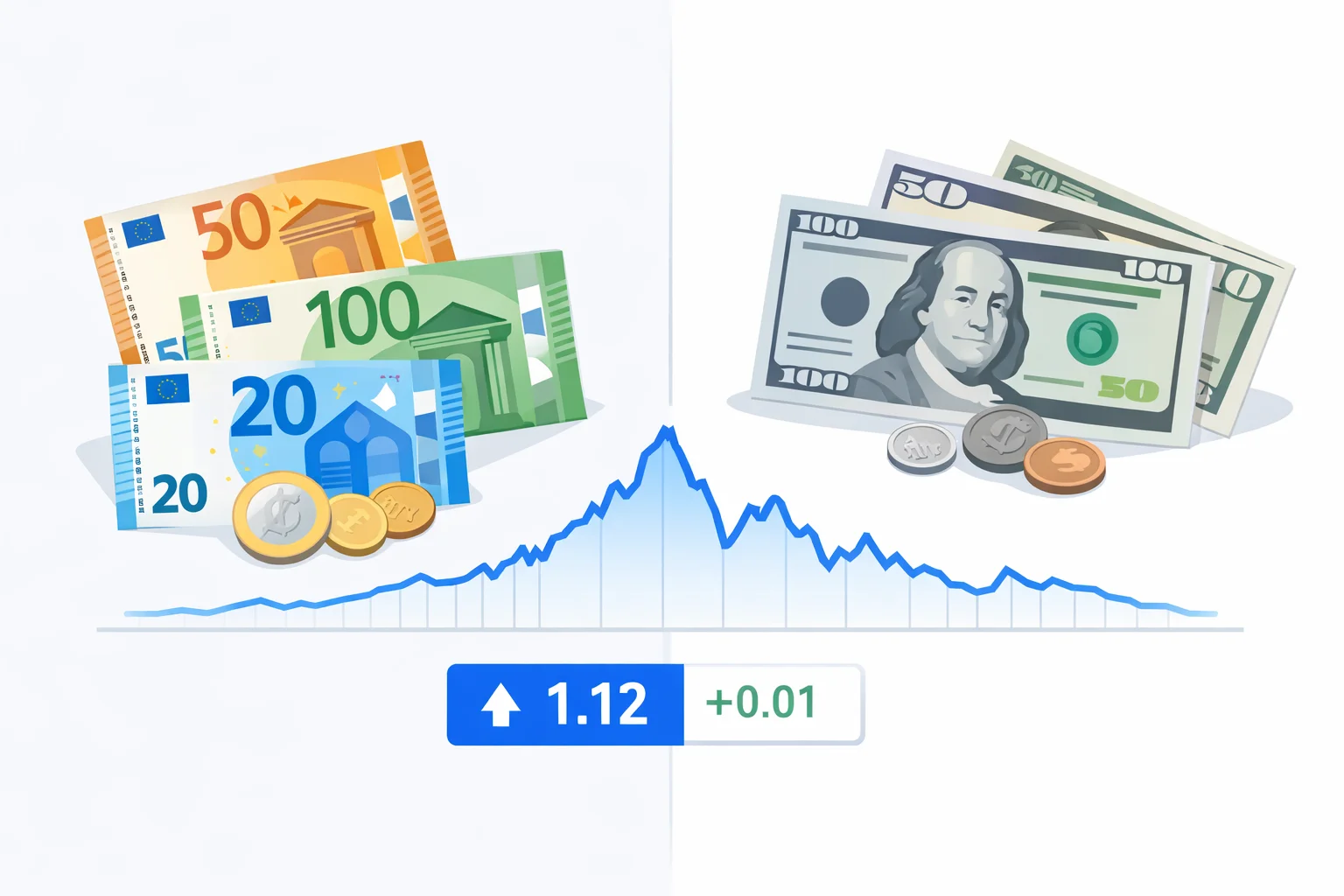
Reading the EUR/USD Quote
When you see "EUR/USD 1.0834," the euro is the base and the dollar is the quote. The number tells you how many dollars one euro buys — here, $1.0834. The order is not random: there's a fixed market hierarchy (EUR ranks above GBP, which ranks above USD), so professionals always write the pair this way, never USD/EUR.
A rising quote means the euro is gaining. If EUR/USD climbs from 1.08 to 1.12, your €1,000 is suddenly worth $1,120 instead of $1,080 — a $40 swing on a 3.7% move. Flip the rate to read it the other way: at 1.0834, one dollar buys 1 ÷ 1.0834 = €0.923. That inverse is exactly what our USD to EUR converter shows on the dollar side.
The ECB-Fed Rate Gap That Steers the Pair
The single biggest force behind EUR/USD is the interest-rate difference between the European Central Bank and the US Federal Reserve. Money chases yield. When the Fed's policy rate sits at 4.5% while the ECB's is 2.5%, holding dollars pays two percentage points more per year, so capital flows toward the dollar and the euro softens. Narrow that gap and the euro tends to recover.
This is why traders hang on every ECB and Fed meeting. A surprise quarter- point hike can move EUR/USD half a cent in minutes. Beyond rates, three forces matter: relative inflation (higher eurozone inflation erodes the euro's buying power), growth gaps (a stronger US economy pulls in investment), and risk sentiment — in a global scare, traders pile into dollars as the world's reserve currency, and the euro slips even when nothing changed in Europe. You can sanity-check any day's rate against the Federal Reserve's official H.10 release.
Converting €100 and €5,000 Step by Step
The math is one multiplication. To go from euros to dollars, multiply by the rate; to go the other way, divide. At 1.0834:
- €100 to USD: 100 × 1.0834 = $108.34.
- €5,000 to USD: 5,000 × 1.0834 = $5,417.00.
- $5,000 back to EUR: 5,000 ÷ 1.0834 = €4,615.10— note it's not €5,000, because the rate isn't exactly 1.
Now the part the headline number hides. Run that €5,000 through a bank adding a 2.5% spread and the rate you actually get drops to about 1.0563, so you receive $5,281 — roughly $136 less than the mid-market $5,417. The conversion is trivial; the spread is what decides how much lands in your account. For a full breakdown of those provider markups across every method, our multi-currency converter lets you toggle the markup and watch the take-home figure change.
From $0.82 to $1.60: the Euro's Wild Range
The euro launched on 1 January 1999 at about $1.18, and almost immediately sank. By October 2000 it touched an all-time low near $0.825, well below parity — one euro bought less than one dollar. It then roared back to a record $1.60in July 2008 before the financial crisis, a near-doubling in eight years. The range bar in the tool above plots today's rate inside that 1999-to-now band so you can see at a glance whether the euro is historically cheap or dear.
| Period | EUR/USD | What was happening |
|---|---|---|
| Oct 2000 | ~0.825 (low) | Dot-com dollar strength, young euro distrust |
| Jul 2008 | ~1.60 (high) | Weak dollar, pre-crisis commodity boom |
| Sep 2022 | ~0.96 | Fed hiking fast, energy shock in Europe |
| 2026 (now) | ~1.08 | Rate gap narrowing as both banks ease |
The lesson hidden in those rows: parity (1.00) is not a floor or a magic line. The euro has spent years both above and below it. Anyone telling you the rate "has" to bounce off 1.00 is guessing.
Why EUR/USD Is the Cheapest Pair to Convert
EUR/USD is the most liquid currency pair on Earth, making up roughly 22-24% of all foreign-exchange turnover — more than the next two pairs combined. That depth squeezes the bid-ask spread to a fraction of a cent on the wholesale market. For you, it means EUR/USD is usually the cheapest major pair to exchange, provided you use a low-markup route.
A no-foreign-transaction-fee card or a specialist transfer service will convert euros to dollars at 0-1% over the mid-market rate. A high-street bank takes 2-4%, and an airport kiosk 7-12%. On €2,000, that's the difference between losing about $20 and losing $200 — same pair, same day, tenfold the cost. If you also need pounds on a Europe trip, the same logic applies to our multi-currency converter.
Euro-Dollar Mistakes That Quietly Cost You
- Reading the rate upside down. At 1.0834, a €400 hotel bill is $433, not $369. Dividing instead of multiplying flips a 60-dollar error onto a single booking.
- Accepting dynamic currency conversion.When a US terminal offers to charge your euro card "in EUR," it bakes in a 3-12% markup. Always choose to pay in dollars and let your bank use the real EUR/USD rate.
- Assuming the weekend rate is current.The forex market closes Friday evening to Sunday, so a Saturday conversion uses Friday's close, and some cards add a 0.5-1% buffer for the gap risk.
- Trying to time parity.Waiting for EUR/USD to "come back to 1.00" before you exchange can cost you months of needed funds — the rate may never revisit it.
When the Screen Rate Won't Match Your Statement
Treat this converter as a planning baseline, not a receipt. Three things pull your real charge away from the on-screen figure. First, timing: a card payment settles one to three days after you tap, so the posted rate is the settlement-day rate, not today's. Second, spread: unless you're quoted the exact mid-market rate (rare outside specialist apps), expect a 0.5-4% markup. Third, flat fees: a $20 wire fee on a €300 transfer is a hidden 6% cost that no percentage captures.
Use the mid-market number above as your honest benchmark, pick a provider with a sub-1% spread, and you'll know within a dollar or two what you'll actually receive. When you're heading the other way and need euros from dollars, the GBP to USD converter gives the same treatment for the pound-dollar route.