Euros to Dollars: Turning Euros Into Real US Spending Money
Converting euros to dollars sounds like one tap on a calculator — and the math is. The catch is the gap between the rate on your screen and the dollars that actually land in your hand. Picture flying from Madrid to New York with €800 in your pocket. At today's rate that's about $866, but change it at the airport desk and you might walk away with closer to $785. This guide shows what your euros are really worth, the cheapest way to swap them, and the small decisions that quietly add or shave 10% off the result.
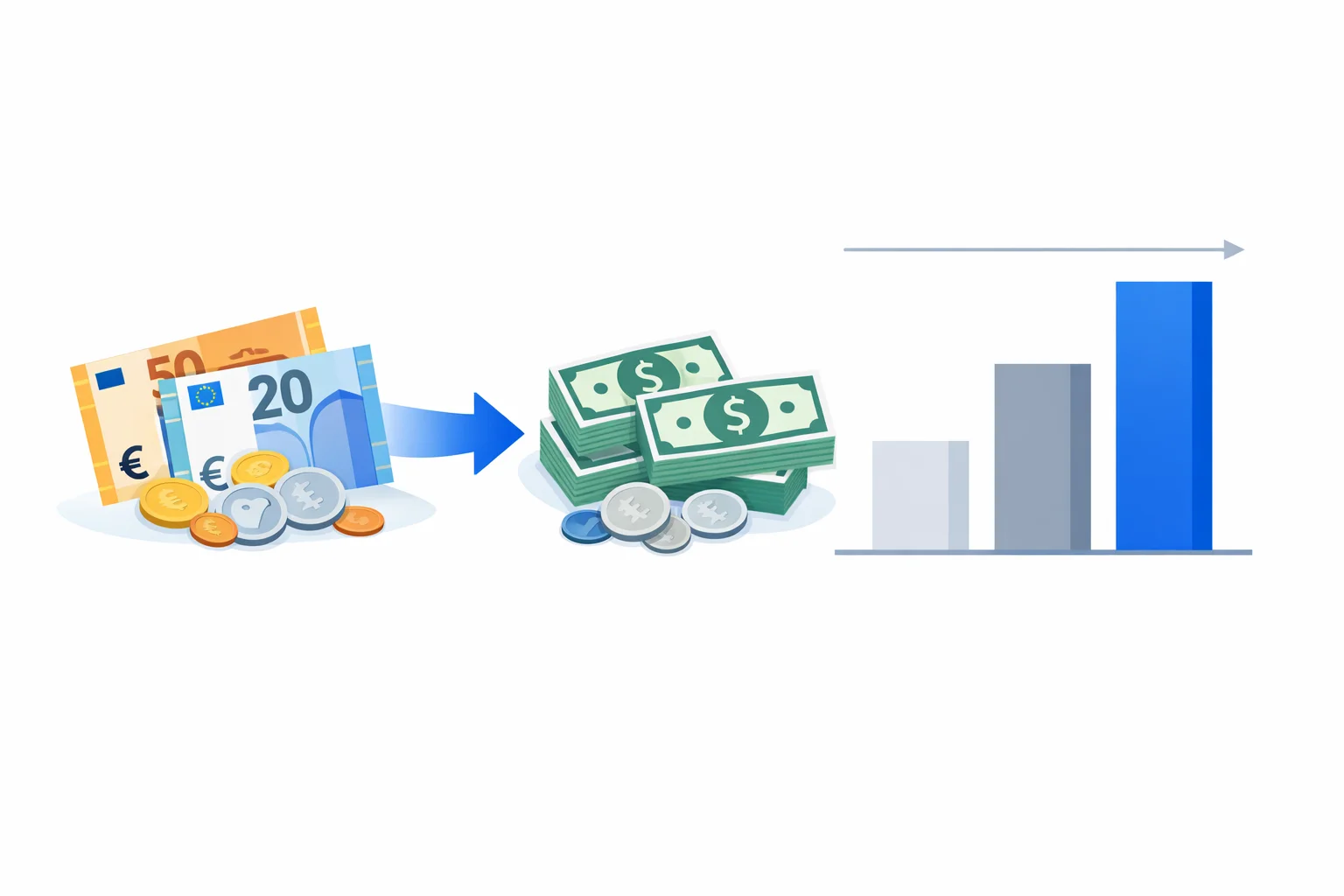
How Much Are 100 Euros in Dollars?
At the current rate of about 1.0834 dollars per euro, 100 euros is worth $108.34. That single number — the mid-market rate — is the midpoint banks trade at, and it's the honest benchmark for any euros-to-dollars conversion. Every other rate you'll be quoted is this number minus a cut. The euro currently sits at roughly an 8% premium to the dollar, so a fast mental check is to take your euro figure and add about a twelfth (1/12 = 8.3%): €60 becomes around $65, €240 lands near $260.
The live figure in the converter refreshes from a daily feed. For the official benchmark, the European Central Bank publishes its euro foreign-exchange reference rates every working day at 16:00 CET — useful when you want a number nobody can accuse of being marked up.
The Cheapest Way to Change Euros Into Dollars
The conversion math never changes, but the markup does — and on a €1,000 swap the spread between the best and worst route is about $95. Here's what €1,000 (mid-market $1,083) actually becomes:
- No-fee travel card or Wise (~0.5%): about $1,078, losing roughly $5.
- Standard bank or debit card abroad (~3%): about $1,051, losing $32.
- Airport or hotel exchange desk (9-12%): about $953-985, losing $98-130 — sometimes plus a flat €5 fee.
Same euros, same day, and a tenfold difference in cost. The tool's comparison bars run these percentages on whatever amount you type. For other pairs, our multi-currency converter applies the same markup logic across 160+ currencies, so you can pressure- test any exchange before you commit.
Working Out €500 and €2,000 by Hand
To convert euros to dollars yourself, multiply by the rate; to go the other way, divide. At 1.0834:
- €500 → USD: 500 × 1.0834 = $541.70.
- €2,000 → USD: 2,000 × 1.0834 = $2,166.80.
- $2,000 → EUR: 2,000 ÷ 1.0834 = €1,846.04 — not €2,000, because one euro is worth more than one dollar.
Watch your rounding on big amounts. Round 1.0834 down to a flat 1.08 and your €2,000 estimate comes out $6.80 light ($2,160 instead of $2,166.80). Harmless for a coffee budget — but apply that same lazy rounding to a €50,000 apartment deposit and your figure is off by $170, enough to matter to whoever's wiring the money.
Stuck With Leftover Euros? Your Options, Ranked
Came home from Europe with a fistful of euros? Rank your exits by how much you keep:
- Spend them before you leave the eurozone. €1 spent is €1 of value; €1 exchanged is 90-99 cents.
- Hold them in a multi-currency app (Wise, Revolut) and convert to dollars at ~0.5% when you actually need them.
- Deposit notes to a euro account if your bank offers one, then convert when the rate suits you.
- Keep small notes for the next trip— euros don't expire.
- Last resort: an airport kiosk, which takes 9-12% and may refuse anything under €5.
One trap catches almost everyone: coins. Nearly no exchange desk or bank takes foreign coins, so €18 in loose euro change is effectively $0 the moment you leave the eurozone. Spend the coins on snacks or a bottle of water before you board.
Euro Card or Dollar Cash When You Land?
Here's a fact that surprises first-time visitors: you can't spend euros in the United States. Unlike tourist-heavy spots in Mexico or the Caribbean, US shops, restaurants, and taxis price and accept only dollars. So the practical question isn't "where do I change my euros" — it's "how do I get dollars at the best rate."
For most travelers the answer is a card with no foreign-transaction fee, billed in dollars, backed by US-ATM withdrawals when you need cash. Carry about $50-100 in small bills for the first taxi, tips (15-20% is standard at sit-down restaurants), and the occasional cash-only food truck. Skip the euro cash entirely if you can — every dollar you pull from a US ATM with a fee-free card lands near the mid-market rate. Heading home with dollars left over? The reverse dollars to euros conversion follows the exact same fee logic in the opposite direction.
Say No to “Pay in Euros”: the DCC Trap
When a US card terminal or ATM asks whether to charge your euro card "in EUR" or "in USD," it's offering dynamic currency conversion (DCC). It sounds helpful — see the price in your home currency! — but it isn't. Choosing EUR hands the conversion to the merchant's processor, which bakes a 3-12% markup on top of whatever your own bank would charge. Always pick dollars (USD) and let your card issuer use the real euros-to-dollars rate.
The numbers make it obvious. On a $300 restaurant bill, a 7% DCC markup is $21 of pure waste for a worse rate than your bank's. Across a two-week trip with a dozen card taps, mindlessly tapping "EUR" can quietly cost $80-150. The fix is free: read the prompt, choose USD, every time.
Quick Euro Amounts Worth Memorizing
If you travel often, three anchors cover most situations at the current ~1.08 rate: €50 ≈ $54, €100 ≈ $108, and €500 ≈ $542. Memorize the middle one and scale from it — €350 is three-and-a-half hundreds, so about $379. When the rate drifts to 1.10 or 1.05, just nudge each anchor a dollar or two. That's accurate enough to sanity-check a menu price or a market stall without pulling out your phone.
Should You Wait for a Better Rate?
Probably not. EUR/USD moves on the interest-rate gap between the US Federal Reserve and the European Central Bank, plus growth and risk swings — forces even bank analysts read wrong by 5-10 cents a year. Waiting for the euro to "come back" to a number you saw last summer can mean missing the trip you needed the money for. The rate has ranged from $0.82 in 2000 to $1.60 in 2008 and slipped below parity as recently as 2022, so there's no fixed level it owes you; the Fed's own H.10 exchange-rate release records just how wide those swings get.
Control the part you can. Convert through a sub-1% provider and you'll bank within a dollar or two of the real rate, whatever the market does that week. If you'd rather understand what actually drives the pair than what you'll pocket, our EUR to USD rate guide breaks down the ECB-versus-Fed tug-of-war in detail.