USD to GBP: How Far Your Dollars Really Go in Britain
A USD to GBP converter answers a question that quietly trips up most Americans on their first trip to Britain: why does $100 turn into only about £79, not £127? The pound is worth more than the dollar, so you divide rather than multiply — and once that clicks, the more interesting story is how much your dollars actually buy over there. Right now the dollar is fairly strong, which means Britain is cheaper for US visitors and buyers than it's been through most of the last twenty years. This guide covers the math, what pushes the rate around, and how a strong or weak dollar reshapes everything from a pub lunch to a London flat.
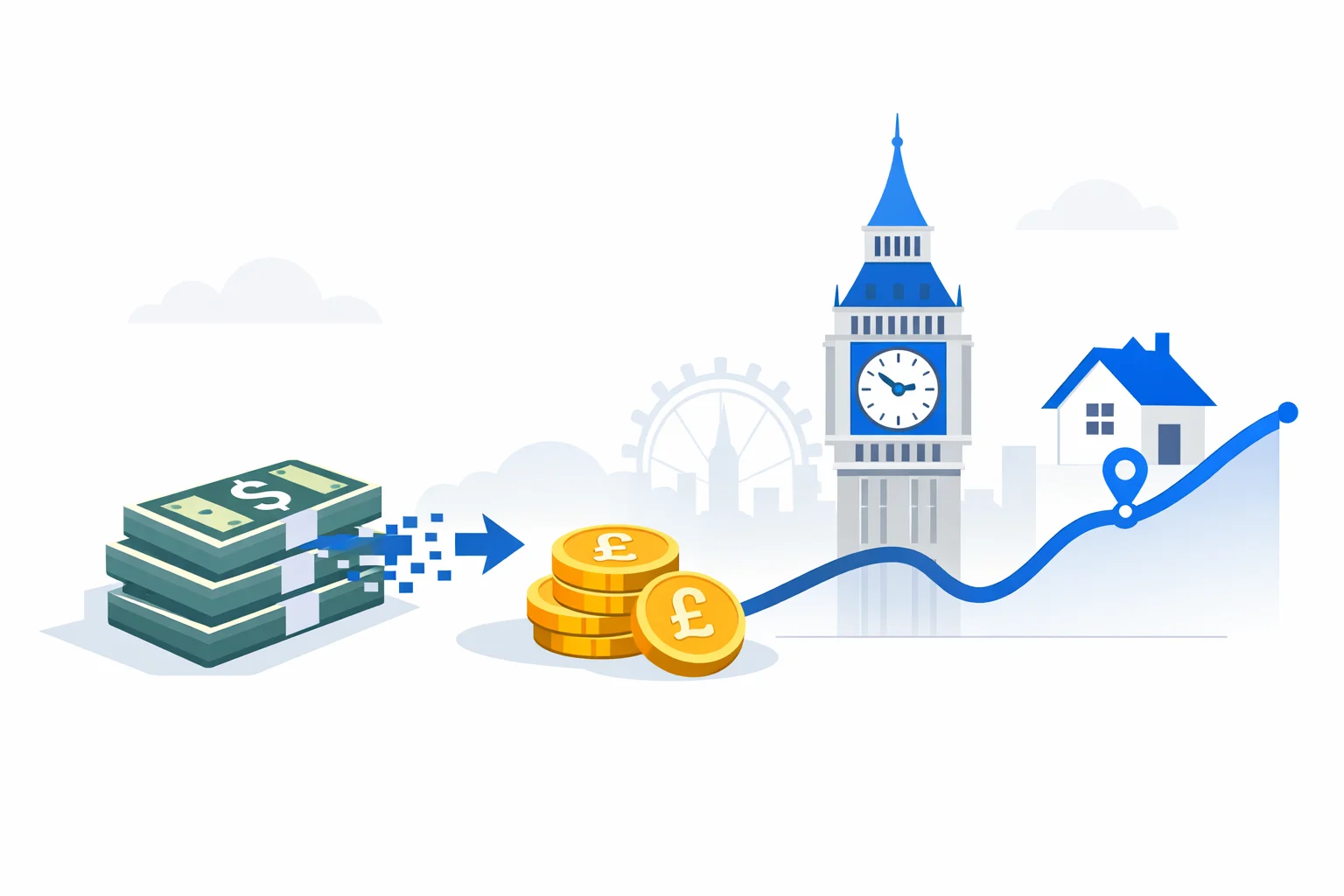
Why $100 Becomes £79, Not £127
The exchange rate is almost always quoted as GBP/USD — dollars per pound. At 1.2715, that number says one pound costs $1.2715. To go the other way and find pounds, you invert it: divide your dollars by the rate.
- $100 → GBP: 100 ÷ 1.2715 = £78.65
- $1,000 → GBP: 1,000 ÷ 1.2715 = £786.47
- $100,000 → GBP: 100,000 ÷ 1.2715 = £78,647.27
The trap is muscle memory. Most currencies you meet as a tourist — pesos, yen, rupees, baht — are worth less than a dollar, so you multiply and the number gets bigger. Sterling flips that instinct. Multiply $1,000 by 1.2715 and you get $1,271, a figure that means nothing. The pound answer is smaller, not larger, because each pound is a bigger unit of money. When you want the dollar cost of a pound price instead, that's the job of our GBP to USD converter, which multiplies rather than divides.
What Makes the Dollar Strong or Weak Against Sterling
From the dollar's side, the rate is really a contest of central banks. The Federal Reserve and the Bank of England each set a policy interest rate, and money flows toward whichever pays more. When the Fed holds at 4.5% while the Bank of England sits at 4.0%, holding dollars earns an extra half point a year, so capital drifts to the dollar and USD/GBP firms — you get more pounds per dollar. Narrow that gap and the effect reverses.
There's a broader gauge worth knowing: the US Dollar Index (DXY), which measures the dollar against a basket of six currencies. Sterling carries an 11.9% weight in that basket, behind only the euro (57.6%) and the yen (13.6%). So when a headline says "the dollar is strong," it usually means DXY is up — and because the pound is a big slice of the index, that almost always means more pounds for your money. The dollar also tends to strengthen during global stress, as investors park cash in US Treasuries as a safe haven. A scary week in markets, oddly, is often a good week to be an American converting money for Britain. You can sanity-check any day's official figure against the Federal Reserve's H.10 release.
Your Dollars Have Bought Wildly Different Amounts of Britain
Here's where the dollar-holder's view gets vivid. The pound's value has swung enormously over the decades, and every swing changes how far your dollars go. Take a fixed $10,000 and watch what it converts to at different moments in history:
| When | USD/GBP rate | $10,000 buys | Dollar was… |
|---|---|---|---|
| Nov 2007 | ~$2.00 | £5,000 | weak |
| Jun 2016 (pre-Brexit) | ~$1.48 | £6,757 | middling |
| Today | ~$1.2715 | £7,865 | fairly strong |
| Sep 2022 | ~$1.035 | £9,662 | very strong |
Read the distance between the top and bottom rows. At the 2007 dollar low your $10,000 bought just £5,000; near the September 2022 record low for the pound, the same money bought almost double. Today sits comfortably in the strong-dollar half — roughly 57% more British spending power than 2007. The bars in the tool above run this on whatever amount you enter, so you can see your own trip or transfer budget stacked across the eras.
The takeaway isn't to chase the exact bottom — nobody catches that. It's that a strong dollar is a real, quantifiable discount on Britain, and a weak-dollar year is a genuine premium. On a £3,000 holiday budget a one-cent rate move is only about £19 either way, so don't sweat the daily wiggle. On a five-figure transfer, though, the era you convert in matters far more than any provider's fee.
Buying UK Property or Paying Invoices in Dollars
USD to GBP isn't mostly a tourist rate — by volume it's a big-ticket one. Americans buy UK property, pay British university fees, and settle invoices to UK suppliers, and on those sums the exchange rate does the heavy lifting. A £500,000 London flat costs $635,750 at 1.2715. The same flat would have cost a full $1,000,000 when the pound traded near $2.00 in 2007 — a $364,250 swing driven purely by FX, before a single negotiation.
Two extra costs catch dollar buyers off guard. First, precision on the rate suddenly matters: rounding 1.2715 down to a flat 1.27 on a $200,000 deposit overstates your pounds by about £248, and the error scales with the amount. Second, overseas buyers pay a 2% non-resident Stamp Duty Land Tax surcharge on residential property in England and Northern Ireland, introduced in April 2021. On a £500,000 home that surcharge alone adds £10,000 — about $12,715 — on top of standard stamp duty. Budget the FX rate and the tax together, because both land in pounds and both hit at completion.
The UK Price You See Is the Price You Pay
One thing works firmly in a US visitor's favour: British prices are quoted all-in. The 20% VAT is already baked into the shelf or menu price, so the pound figure you convert is the final total. A £50 dinner is exactly £50 — about $63.58 at today's rate — with no tax bolted on at the till and no expectation of a 20% tip on top.
That's the mirror image of American pricing, where a $50 menu can settle near $64 once roughly 8% sales tax and a customary 20% tip get added. So when you convert a UK price and it looks a touch higher than a US one, remember you're comparing a finished number against an unfinished one. The green and amber cards in the tool make that side-by-side explicit. For a fuller walk through everyday spending in Britain, the dollars to pounds guide breaks down cards, cash, and the fee traps on the ground.
Four Dollar-to-Pound Mistakes That Cost Real Money
- Multiplying instead of dividing.Turning $1,000 into "£1,271" by multiplying is off by £485 — the right answer is £786.47. This is the number-one error, and it always inflates the pounds.
- Reading a small pound price as cheap.A £4 coffee looks less than a $4 one, but it's actually $5.09. Every pound price is about 27% more in dollars than the digits suggest.
- Accepting "charge in USD" at a UK terminal. If a card machine or website offers to bill your US card in dollars, that dynamic currency conversion hides a 3-12% markup. Always choose pounds and let your own bank convert.
- Using a bank wire for a small payment.A $30-45 SWIFT fee is trivial on a $50,000 property deposit but brutal on a $400 invoice — there it's a 7-11% hit before the spread. Match the method to the size.
When the Converter's Rate Isn't the Rate You'll Get
Treat the figure above as a planning baseline, not a receipt. Three things pull your real charge away from mid-market. Spread: unless you're quoted the exact mid-market rate — rare outside specialist apps — expect a 0.5-4% markup baked in, so budget a couple of percent below what the tool shows. Timing: a card payment settles one to three days after you tap, so you get the settlement-day rate, not today's. And dynamic currency conversion— the "pay in dollars" trap — which can quietly cost more than the exchange itself.
Use the mid-market number as your honest benchmark, pick a provider under 1%, and you'll land within a cent or two of fair value. To compare providers across more currencies, the multi-currency converter lets you pressure-test any markup, and the GBP to USD page covers what moves this pair from the market's side.