Tablespoons to Grams: It Depends on the Ingredient AND the Country
Converting tablespoons to grams has a catch most charts skip: the answer changes twice. First with the ingredient — one tablespoon of honey weighs 21 grams while the same spoon of flour weighs under 8. And second with the spoon itself, because the tablespoon isn't the same size everywhere. A US tablespoon holds 14.79 mL, but an Australian one holds 20 mL. Follow an Aussie recipe with an American spoon and every measured tablespoon lands about 35% short. The tool above handles both variables; this guide explains the numbers behind it.
Why One Tablespoon Has No Single Gram Weight
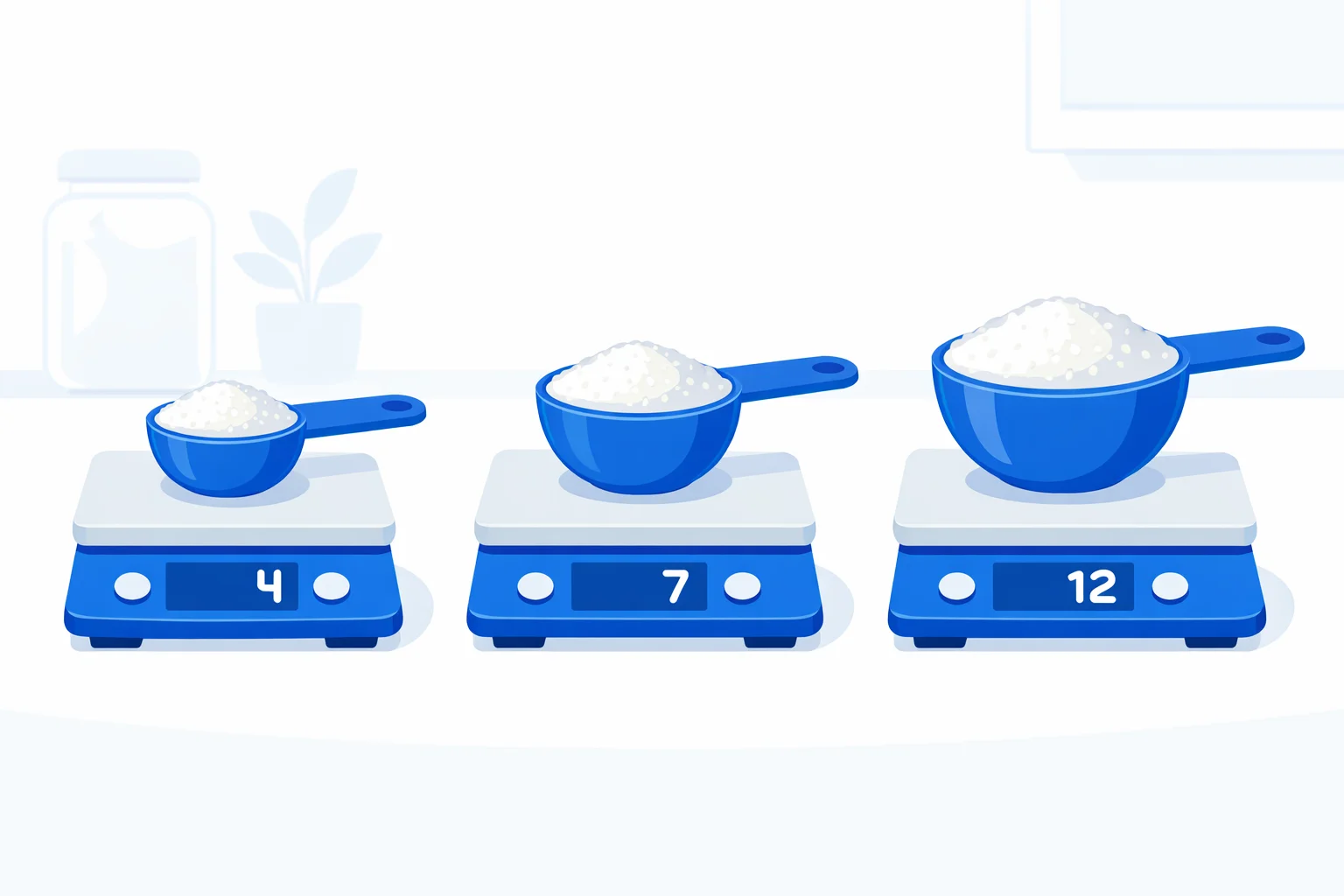
A tablespoon measures volume, not weight. The US tablespoon is defined as exactly 14.7868 mL — the same as three US teaspoons. What you scoop into that fixed space decides the grams. Density is the bridge: grams equal millilitres times density (g/mL). Water sits at 1.0 g/mL, so a US tablespoon of water weighs 14.79 grams. Honey is far denser at about 1.42 g/mL, pushing one tablespoon to 21 grams. Flour is the opposite — at roughly 0.53 g/mL, a tablespoon holds only 7.8 grams because the fine particles trap air. That's a near-threefold spread between the heaviest and lightest common ingredients, all in an identical spoon.
Tablespoon Weights for Common Ingredients
These are level US tablespoon weights — the spoon scraped flat, not heaped. Pack a soft fat or damp brown sugar and you'll push 10-15% past these figures, so for baking, weigh rather than trust the spoon.
| Ingredient | Grams per US tbsp | Quick note |
|---|---|---|
| Honey | 21.0 g | heaviest common spoon |
| Maple syrup | 20.0 g | dense liquid sugar |
| Table salt (fine) | 18.0 g | kosher salt weighs less |
| Peanut butter | 16.0 g | label serving is 2 tbsp = 32 g |
| Milk (whole) | 15.3 g | just above water |
| Water | 14.8 g | the reference point |
| Butter | 14.2 g | one stick = 8 tbsp = 113 g |
| Brown sugar (packed) | 13.8 g | compresses in the spoon |
| Granulated sugar | 12.5 g | ≈ 48 calories |
| All-purpose flour | 7.8 g | spooned and leveled |
| Powdered sugar | 7.5 g | airy — half of granulated |
| Cocoa powder | 7.5 g | sifted, unsweetened |
Need the journey in the other direction — a gram weight off a scale turned back into spoons? Our grams to tablespoons converter runs the same density table in reverse. For amounts under a tablespoon, like a pinch of salt or a dash of baking soda, the teaspoons to grams tool is the finer instrument — there are three teaspoons in every tablespoon.
The Density Formula That Replaces the Chart
You don't need to memorize a dozen numbers. One formula covers every ingredient:
grams = tablespoons × 14.79 × density (g/mL)
Work an example. You want 3 tablespoons of granulated sugar, density 0.845. That's 3 × 14.79 × 0.845 = 37.5 grams. Swap to olive oil at 0.913 g/mL and the same 3 tablespoons weigh 3 × 14.79 × 0.913 = 40.5 grams. The only number that changes is density. If you ever know an ingredient's density — it's often in a food database like USDA FoodData Central — you can convert any spoon amount without a lookup chart.
The 20 mL Spoon: Australia's Hidden Recipe Trap
Here's the variable almost every tablespoon chart ignores. The tablespoon is not internationally standardized:
- United States: 14.79 mL — three US teaspoons. This is what US recipes and FDA nutrition labels assume.
- UK, Canada, New Zealand, Europe:15 mL — the rounded "metric" tablespoon, close enough to the US spoon that the 0.2 mL gap rarely matters.
- Australia: 20 mL — four teaspoons, not three. This is the outlier that breaks recipes.
The Australian spoon is 35% bigger than the US one. So "2 tablespoons of flour" is 15.6 grams in an American kitchen but about 21.2 grams in an Australian one — a 5.6-gram gap that compounds across a recipe. For a cake calling for 4 tablespoons of cocoa, the spoon difference is nearly a full extra tablespoon of cocoa. The fix is simple: identify where the recipe came from, set the spoon selector to match, and the tool corrects the volume before applying density. The NIST Office of Weights and Measures documents these spoon definitions, which is why weighing in grams sidesteps the whole mess.
Butter: The One Ingredient You Can Eyeball
Butter is the friendliest ingredient for tablespoon work because it ships pre-marked. A US stick of butter weighs 4 ounces — exactly 113 grams — and equals 8 tablespoons. Divide 113 by 8 and you get 14.2 grams per tablespoon, with each cut-line on the wrapper marking one tablespoon. So if a recipe asks for 6 tablespoons, you slice at the 6 mark and you've got 85 grams without a scale. European butter blocks are sold by weight instead, usually 250 grams, which works out to about 17.6 US tablespoons. To turn a block weight into sticks or tablespoons, the butter sticks to grams converter handles the wrapper math.
Where Tablespoon Conversions Go Wrong
Three errors cause most of the trouble. The first is heaping instead of leveling — a heaped tablespoon of flour can hold 12 grams instead of 7.8, a 50% overshoot that turns a tender crumb dense. The second is assuming all spoons are equal; an American baker using an Australian recipe's "tablespoon" of baking soda adds 35% too much leavening, and the cake tastes soapy. The third is treating brown sugar like granulated — packed brown sugar is 13.8 grams a tablespoon versus 12.5 for white, and it compresses differently depending on how hard you press. When precision matters, the spoon is a starting point and the scale is the final word.
When NOT to Trust a Tablespoon
Tablespoons are fine for forgiving jobs — a spoon of oil in a pan, sugar in coffee, mixing a marinade. They fall apart for precision baking, where a 15% measuring error on flour or leavener changes the chemistry. They're also unreliable for sticky ingredients like honey or peanut butter that cling to the spoon and leave 1-2 grams behind each scoop. And they're useless for nutrition tracking across spoon standards: a "tablespoon" of peanut butter logged from an Australian app is 20 mL, not the 14.79 mL a US label assumes — about 6 extra grams and 35 extra calories per spoon. For any of those cases, weigh in grams. When you're scaling whole recipes up or down, the recipe scaler keeps every ingredient in proportion so spoon rounding doesn't snowball.