Tablespoons to mL: Why the Australian Spoon Breaks the Rule
Converting tablespoons to mL is simple until you cross a border. A US tablespoon is 14.7868 mL, the metric tablespoon used across the UK, Canada and Europe is 15 mL, and the Australian tablespoon is a full 20 mL. That last one isn't a rounding quirk — it's 35% bigger than the American spoon and holds fourteaspoons instead of three. Reach for the wrong spoon and a dressing turns oily, a sauce won't thicken, or a cake refuses to rise. The converter above lets you lock in the right standard so the milliliters match the recipe.
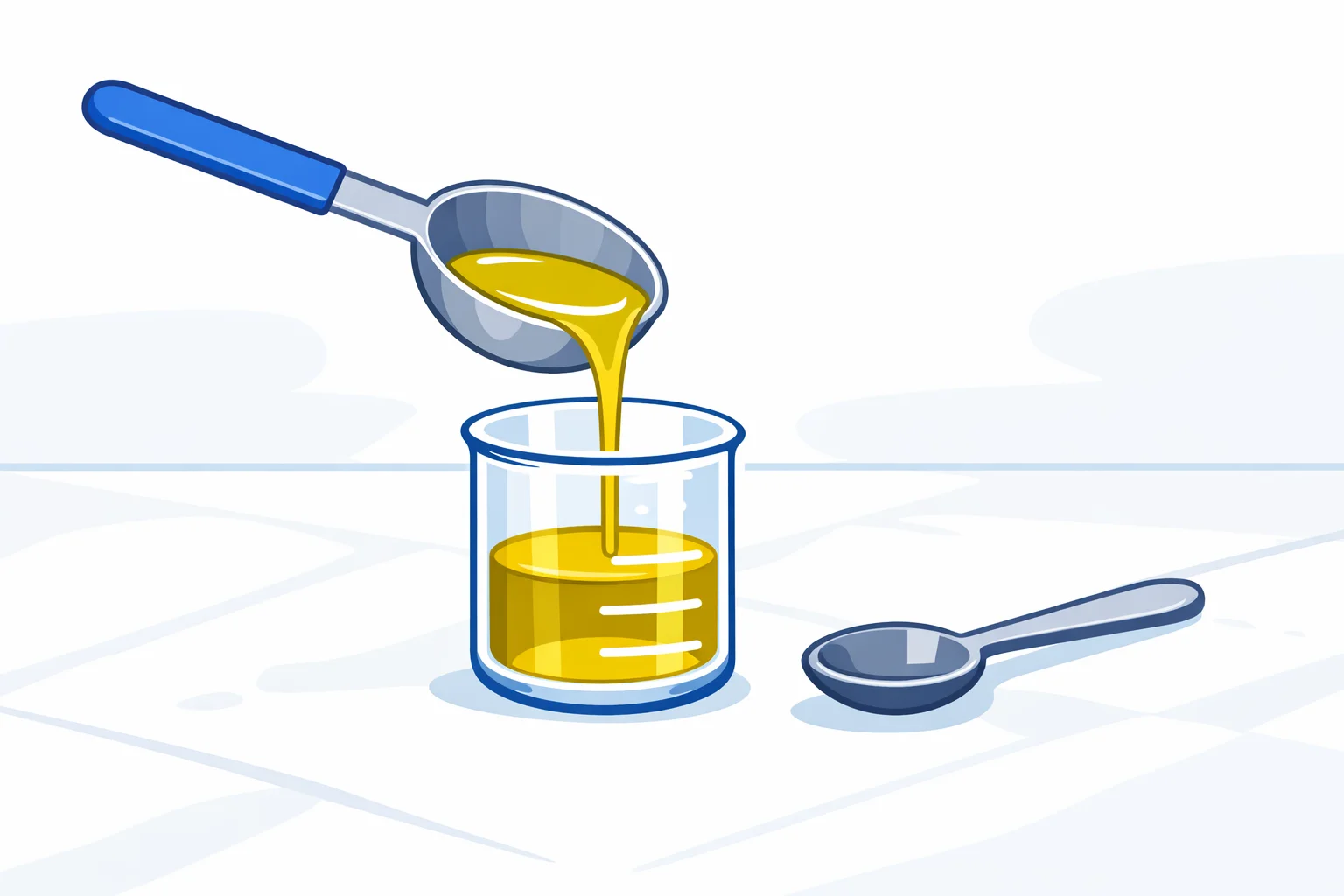
Why 1 Tablespoon Isn't Always 15 mL
Most of the planet agrees a tablespoon is about 15 mL, so people treat it as a fixed fact. It isn't. The US tablespoon is defined as exactly half a US fluid ounce — that's 14.7868 mL, just shy of 15. The 15 mL figure is the clean metric spoon adopted by the UK, Canada, New Zealand and the EU. The 0.21 mL gap between 14.79 and 15 is invisible in real cooking, which is why nearly everyone rounds the US spoon up to 15 and never thinks about it again.
Then there's Australia, which decided a tablespoon should be 20 mL. That single decision is responsible for most of the confusion in this conversion, and it's the reason a one-size number doesn't exist. Whose spoon is the only question that changes the answer — the ingredient never does, because a tablespoon measures pure volume.
The Australian 20 mL Tablespoon (4 Teaspoons, Not 3)
When Australia went metric in the 1970s, it set the tablespoon at a round 20 mL while keeping the teaspoon at 5 mL. The arithmetic falls out immediately: 20 ÷ 5 = 4. So an Australian tablespoon is fourteaspoons, breaking the "3 teaspoons = 1 tablespoon" rule that holds everywhere else. An Australian cook who reads "1 tbsp" in a US recipe and measures their 20 mL spoon is pouring 35% too much.
This is the single most useful fact on this page. If you ever convert an Australian recipe with a standard 15 mL spoon, add one teaspoon for every tablespoon listed — or just switch the converter to the Australian standard and read the real mL. Going the other way, an American baking with an Aussie tablespoon needs to scrape it back to 3 teaspoons.
The Number Behind Each Tablespoon
Here's every tablespoon standard you're likely to meet, side by side. Notice that the teaspoon stays a near-constant 5 mL across all of them — it's only the tablespoon that stretches.
| Standard | 1 tbsp (mL) | Teaspoons | Used in |
|---|---|---|---|
| US tablespoon | 14.7868 | 3 | United States (recipes) |
| US legal (labels) | 15 | 3 | US nutrition panels, medicine |
| Metric | 15 | 3 | UK, Canada, NZ, EU |
| Imperial (old UK) | 17.7582 | 3 | Pre-metric British recipes |
| Australian | 20 | 4 | Australia |
The US tablespoon ladders up neatly into bigger volumes: 2 tablespoons make exactly 1 US fluid ounce (29.57 mL), and 16 tablespoons make 1 US cup (236.6 mL). That second one powers the kitchen shortcuts everyone half-remembers — 4 tbsp is ¼ cup, 8 tbsp is ½ cup. If you're working up at cup scale, our cups to milliliters converter carries the same country-by-country logic to the cup, which itself ranges from 237 mL to 250 mL.
The 15 mL Medicine Spoon Is a Different Animal
A tablespoon of liquid medicine is standardized at 15 mL, and a teaspoon at 5 mL — the same metric figures used on US nutrition labels. But pharmacists and the US FDA actively discourage dosing medicine with kitchen spoons. The reason is exactly the spread this page is about: a "tablespoon" pulled from a drawer can be anywhere from 7 mL to 22 mL depending on the spoon's design and how full you fill it.
For a child's 15 mL dose, grabbing an Australian 20 mL measure would deliver a third too much active ingredient. That's why liquid medicines now ship with a marked syringe or dosing cup in milliliters. The lesson carries back to the kitchen: when 5 mL of a potent ingredient matters — vanilla extract, food coloring, almond essence — measure the mL, don't trust the spoon's name.
Worked Example: An Aussie Dressing in a US Kitchen
Say you've found an Australian salad dressing that calls for 3 tablespoons of olive oil and 1 tablespoon of vinegar. You're in the US with a standard 15 mL spoon set. Walk it through:
- The recipe means Aussie spoons: oil = 3 × 20 = 60 mL, vinegar = 1 × 20 = 20 mL. Ratio 3:1.
- Your US spoons deliver: oil = 3 × 14.79 = 44.4 mL, vinegar = 1 × 14.79 = 14.8 mL.
- You're short 15.6 mL of oil and 5.2 mL of vinegar — about a quarter of the whole dressing missing.
The ratio survives because both ingredients shrink together, so the dressing still tastes balanced — you just end up with three-quarters of the volume. That's fine for a vinaigrette. It is not fine when the under-measured ingredient is baking powder or gelatin, where the absolute amount drives the chemistry. For those, set the converter to Australian, read 20 mL per tablespoon, and measure it in a graduated jug.
Tablespoons to mL Reference Table
These are US tablespoon values (14.7868 mL each) — the numbers most readers need. The collapsible table inside the tool does the same for the metric, Australian and imperial spoons.
| Tablespoons | Milliliters (US) | Handy equivalent |
|---|---|---|
| ½ tbsp | 7.39 mL | 1½ teaspoons |
| 1 tbsp | 14.79 mL | 3 teaspoons |
| 2 tbsp | 29.57 mL | 1 fl oz · ⅛ cup |
| 3 tbsp | 44.36 mL | 9 teaspoons |
| 4 tbsp | 59.15 mL | ¼ cup |
| 6 tbsp | 88.72 mL | ⅜ cup |
| 8 tbsp | 118.29 mL | ½ cup |
| 16 tbsp | 236.59 mL | 1 cup |
Worth memorizing: 2 tablespoons is 1 fluid ounce, and 16 tablespoons is a cup. If your recipe instead gives weight in grams and you want spoonfuls, the conversion depends on the ingredient — our grams to teaspoons converter handles the density side for sugar, salt, flour and more.
Spoon Swaps That Throw Off a Recipe
Tablespoon errors are rarely arithmetic. They're almost always the wrong spoon or the wrong abbreviation. The three that do real damage:
- Reading "tbsp" as "tsp."The classic disaster: a tablespoon is three times a teaspoon. Use a tablespoon of baking soda where the recipe wanted a teaspoon and you've tripled the leavener — 15 mL instead of 5 mL — and the result tastes soapy and bitter.
- Treating the Australian spoon as 15 mL.Convert 4 Aussie tablespoons as if they were metric and you're 20 mL short — a full tablespoon of missing ingredient across the recipe.
- Heaping instead of leveling. A heaped tablespoon of flour can hold 50–100% more than a level one. Recipes assume level spoons unless they say otherwise, so scrape the top flush with a knife.
When the 5 mL Difference Actually Counts
Be honest about the stakes. Stirring a tablespoon of soy sauce into a stir-fry, or oil into a pan? The 5 mL gap between a 15 mL and a 20 mL spoon vanishes — eyeball it. Cooking is forgiving, and a teaspoon either way won't register on the plate.
Where it bites is small, potent, ratio-driven ingredients. Leaveners (baking soda and powder), gelatin, yeast, salt in a brine, and extracts all do their job in tiny amounts, so a 5 mL error is a 33% error. Medicine is the extreme case — there, measure in mL with a syringe, full stop. For everything in between, the rule is simple: if the recipe crossed a border, set the spoon standard before you measure. For multi-unit recipes, the all-in-one cooking converter handles cups, grams and spoons together so you never juggle two tools.