Grams to Teaspoons: There's No Single Answer (and Why That's Normal)
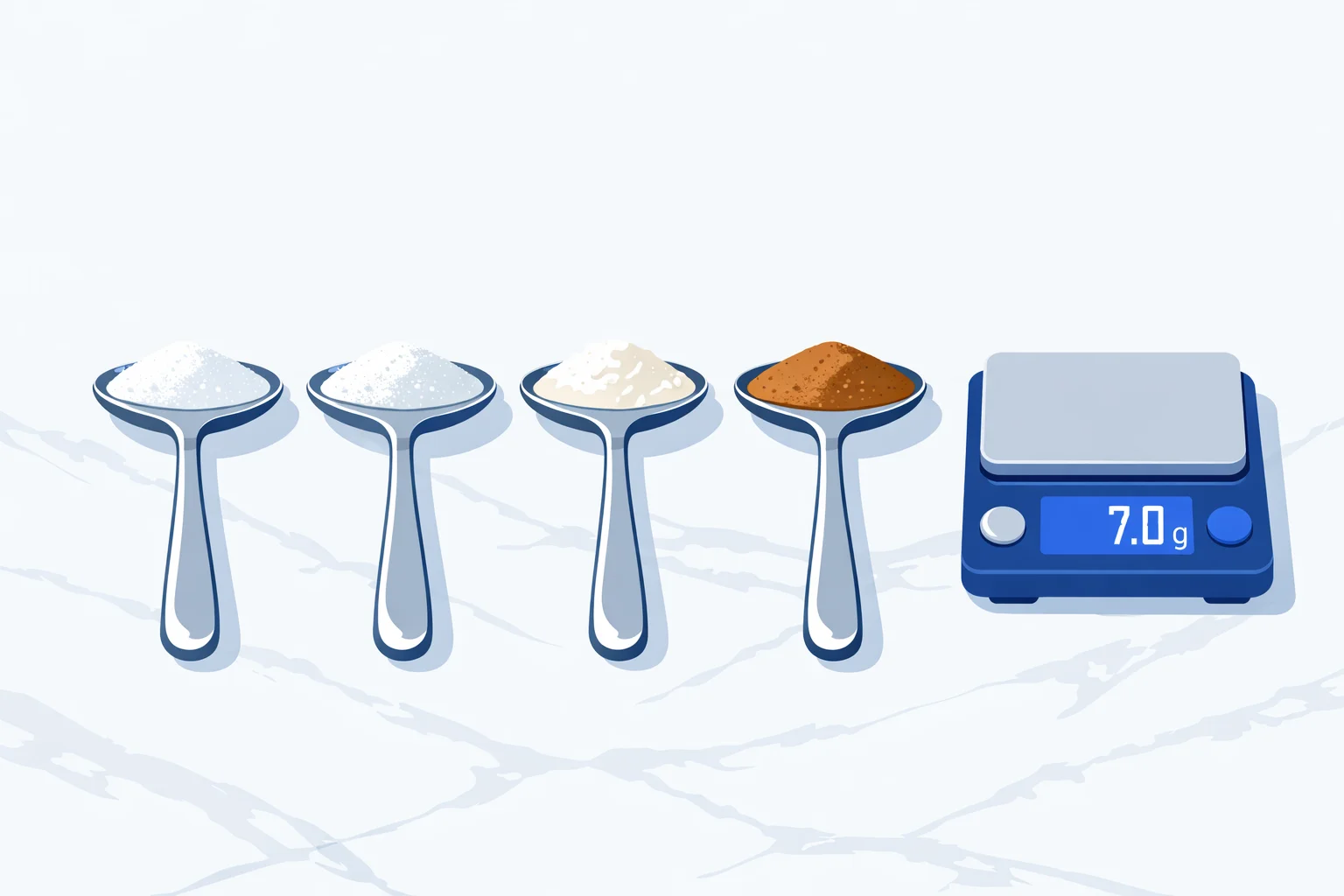
Converting grams to teaspoons has no single answer, and anyone who hands you one number is guessing. Five grams of sugar fills about 1.2 teaspoons. Five grams of salt fills only 0.83. Five grams of flour spreads across nearly 1.9 teaspoons. Same weight, three very different spoon counts — because a teaspoon measures volume (4.93 mL) and a gram measures weight. The bridge between them is density, and density changes the moment you switch ingredients. The converter above bakes that in: choose what you're actually measuring and the teaspoon count follows.
Why One Gram Number Can't Cover Every Spoon
Picture a teaspoon as a tiny 4.93 mL bucket. Fill it with table salt and you've packed in about 6 grams, because fine salt crystals are heavy and sit tightly — a density near 1.22 g/mL. Fill the same bucket with all-purpose flour and you get only 2.6 grams, since flour is fluffy and full of air at roughly 0.53 g/mL. That's a 2.3-fold spread between the lightest and heaviest dry staples most kitchens keep on the shelf.
So when a European recipe says "8 g baking powder" and your measuring set only speaks teaspoons, there's no shortcut that works for everything. You have to route the number through the specific ingredient. Get the density wrong and you don't get a small rounding error — you get the wrong amount of a chemical leavener, which is the difference between a risen cake and a dense brick.
The Density Math Behind the Conversion
The formula is short. Teaspoons equal grams divided by the grams-per-teaspoon for your ingredient:
teaspoons = grams ÷ (g per teaspoon)
Where does the "g per teaspoon" come from? Multiply the ingredient's density (in g/mL) by 4.92892, the volume of a US teaspoon. Granulated sugar sits around 0.85 g/mL, so 0.85 × 4.93 = 4.2 g per teaspoon. Salt at 1.22 g/mL gives 1.22 × 4.93 = 6.0 g. Once you have that per-spoon weight, every conversion is one division. The US teaspoon itself is legally defined as exactly 4.92892159375 mL, anchored to the gallon in the NIST volume standards, which is why the same spoon means the same thing across US recipes.
Grams Per Teaspoon for 18 Common Ingredients
This is the reference most searches are really after — the per-teaspoon weight that lets you convert any gram amount. Liquids cluster near water (4.9 g), dense crystals like salt and honey run heavy, and airy powders like flour and cocoa come in light.
| Ingredient | Grams per tsp | 5 g equals |
|---|---|---|
| Honey | 7.0 g | 0.71 tsp |
| Table salt (fine) | 6.0 g | 0.83 tsp |
| Water | 4.93 g | 1.01 tsp |
| Butter (softened) | 4.7 g | 1.06 tsp |
| Baking soda | 4.6 g | 1.09 tsp |
| Brown sugar (packed) | 4.6 g | 1.09 tsp |
| Olive oil | 4.6 g | 1.09 tsp |
| Granulated sugar | 4.2 g | 1.19 tsp |
| Vanilla extract | 4.2 g | 1.19 tsp |
| Baking powder | 4.0 g | 1.25 tsp |
| Active dry yeast | 3.1 g | 1.61 tsp |
| All-purpose flour | 2.6 g | 1.92 tsp |
| Ground cinnamon | 2.6 g | 1.92 tsp |
| Powdered sugar | 2.5 g | 2.00 tsp |
| Cornstarch | 2.5 g | 2.00 tsp |
| Cocoa powder | 2.5 g | 2.00 tsp |
| Black pepper (ground) | 2.3 g | 2.17 tsp |
| Paprika | 2.3 g | 2.17 tsp |
Notice honey and flour sit at opposite ends: a teaspoon of honey outweighs a teaspoon of flour by nearly three to one. If you want to scale these spoon-sized amounts up to cup quantities, our cups to grams ingredient chart carries the same density logic into larger volumes.
The Salt Trap: Table vs Kosher vs Flaky
Salt is where grams-to-teaspoons quietly wrecks dinner. The 6 g/tsp figure is for fine iodized table salt. Diamond Crystal kosher salt, with its big hollow flakes, weighs barely 2.8 g per teaspoon — less than half. Morton kosher lands in the middle near 4.8 g. So when a recipe lists "10 g salt" and you measure 1.7 level teaspoons of table salt, you're correct; measure that same 1.7 teaspoons in Diamond Crystal and you've added under 5 grams — a dish that tastes flat and under-seasoned.
This is exactly why serious recipe writers have moved to grams for salt. Weight removes the crystal-size variable entirely. If your recipe gives a teaspoon amount of one salt and you stock another, convert through grams: find the gram weight of the called-for salt, then divide by your salt's per-teaspoon weight to get the right spoon count.
Worked Example: 5 Grams of Three Ingredients
Say a recipe gives you three small weights — 5 g sugar, 5 g salt, 5 g flour — and you only own measuring spoons. Run each through the formula:
- Sugar: 5 ÷ 4.2 = 1.19 tsp → round to 1¼ tsp.
- Salt: 5 ÷ 6.0 = 0.83 tsp → round to ¾ tsp (a hair over).
- Flour: 5 ÷ 2.6 = 1.92 tsp → round to 2 tsp.
Three identical weights, three different spoonfuls — 1¼, ¾, and 2 teaspoons. If you'd grabbed a single "5 grams ≈ 1 teaspoon" rule of thumb (the kind plenty of sites print), you'd have under-measured the flour by half a teaspoon and over-measured the salt by 20 percent. For a vinaigrette that's survivable; for a cookie dough it shifts both spread and seasoning. When you're working the other direction, the all-in-one cooking converter runs the same density table in reverse.
When a Scale Beats a Measuring Spoon
Here's the honest take: for some ingredients, converting grams to teaspoons at all is the wrong move. A teaspoon of baking powder can swing 15 percent — roughly 3.4 g scooped loose versus 4 g tapped level — and on a single-layer cake that's the margin between a good rise and a sunken middle. The same goes for yeast, baking soda, and gelatin, where the chemistry is unforgiving.
A $12 digital pocket scale reading to 0.1 g erases all of it. If you bake more than occasionally, weigh the leaveners, salt, and spices directly and skip the spoon conversion. Save teaspoons for the forgiving stuff: vanilla, oil, a splash of soy sauce — places where a few tenths of a gram never changed anyone's dinner. For the bigger dry staples there's a related shortcut in our sugar cups-to-grams guide, which shows how packing method alone moves the weight.
Small-Measurement Mistakes That Ruin a Bake
The errors that bite hardest in grams-to-teaspoons conversions aren't arithmetic — they're assumptions:
- Using one conversion for everything."5 g = 1 tsp" is only true for water-like liquids. Apply it to flour and you're 0.9 tsp short on every 5 grams.
- Heaped instead of level spoons. A heaped teaspoon of flour holds nearly double a level one — about 4.8 g versus 2.6 g. Recipe gram figures always assume a leveled spoon.
- Swapping baking soda and powder by spoon.They're close in weight (4.6 vs 4.0 g/tsp) but baking soda is three to four times stronger. Matching the gram weight without matching the leavener gives a soapy, metallic taste.
- Ignoring salt crystal size. The same teaspoon of kosher flakes weighs half what table salt does. Convert through grams, not spoon-for-spoon.
The throughline is simple: a teaspoon is a fixed volume, but grams answer to density. Tell the converter what ingredient you're holding and the spoon count comes out right — then trust a scale whenever the rise, set, or seasoning of the dish depends on it.