Butter Sticks to Grams: Weighing for Precision in US & European Recipes
You're halfway through an American cookie recipe in a kitchen with a metric scale and no sticks of butter in sight. Converting sticks of butter to grams is the fix, and the number you need is 113 — one US stick weighs 113 grams. Punch 113 into your scale, slice a 250 g block to match, and the recipe works. But that flat answer hides a few details serious bakers care about: the figure is really 113.4 g, butter loses weight when you cook it, and the "same" stick of European butter is a different animal. The converter above handles the arithmetic; this guide tells you when the gram on the label and the gram in the bowl part ways.
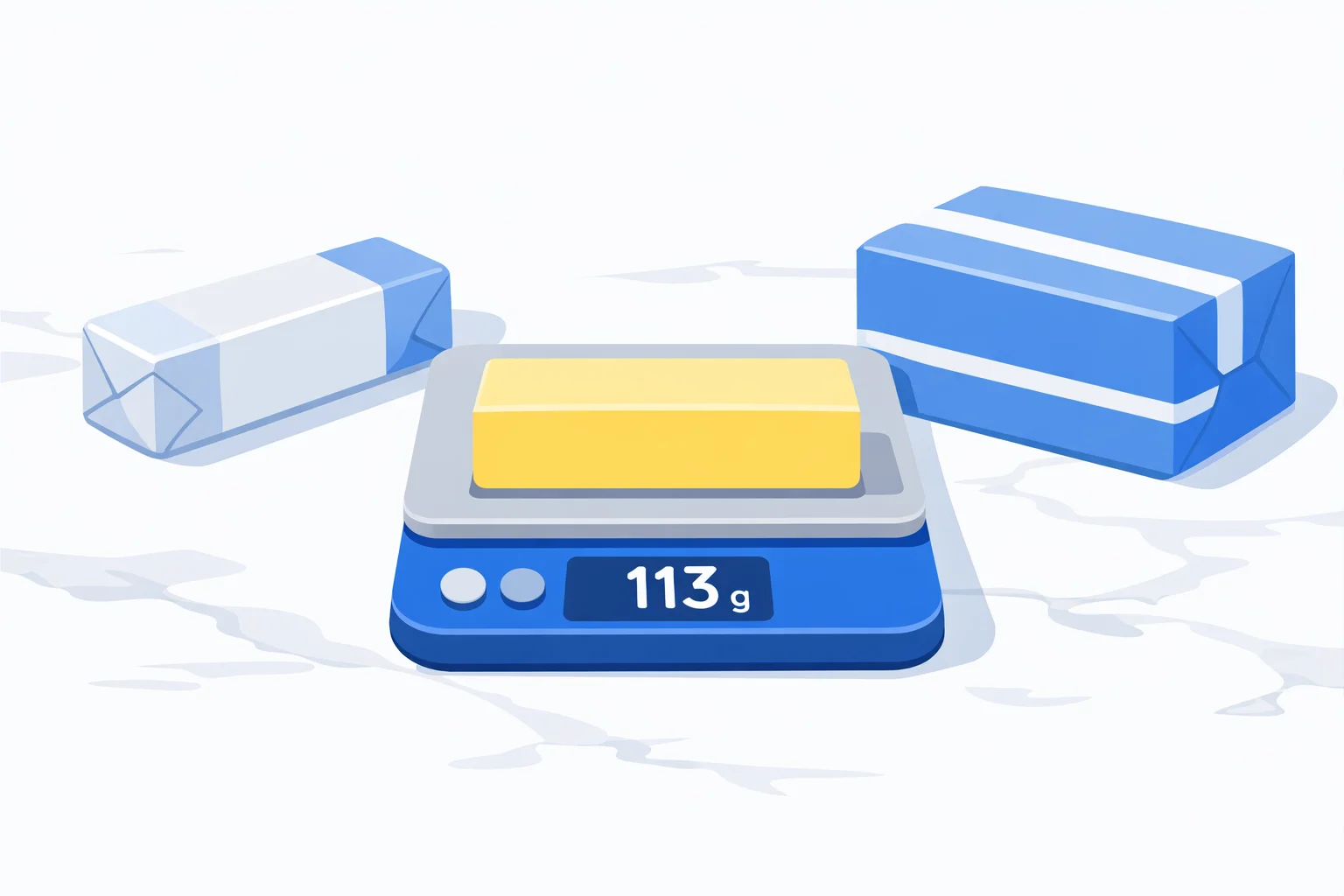
1 Stick = 113 Grams, to the Decimal
A US stick of butter is a quarter pound, which is 4 ounces. Multiply 4 by 28.35 grams per ounce and you get 113.4 g. That is the weight every other butter figure is built from: 2 sticks is 226.8 g (rounded to 227 g, one cup), 4 sticks is 453.6 g (the one-pound box), and half a stick is 56.7 g. Because butter is sold pre-weighed in molded prints, there's no scoop-versus-spoon density error the way there is with flour or brown sugar — a stick is a stick whether it's soft or fridge-cold.
Why Bakers Trust a Scale Over the Wrapper
Here's the thing about those tidy tablespoon lines on the wrapper: they assume a perfectly molded, perfectly full print. A stick that softened and slumped on the counter, or a budget brand that ran a gram or two short, shifts every line. Weigh that same stick and the scale tells the truth — 113 g or it isn't. For laminated dough or a tight cake crumb, where the butter-to-flour ratio is the whole game, a 5 g miss across three sticks is enough to change how the dough sheets. Professional pastry kitchens weigh butter for exactly this reason, and it's why the gram figure beats the printed lines once precision matters. If you usually think in cups, the cups to grams butter converter maps every cup fraction onto the same scale.
The 113 vs 114 Gram Question
Search around and you'll see a stick listed as both 113 g and 114 g. The honest answer is 113.4 g, so 113 rounds correctly and 114 is a slightly lazy round-up. Where does it matter? Almost never for a single stick — 0.4 g is a few grains of rice. But stack it up. A shortbread built on baker's percentages that calls for 8 sticks is 907.2 g of butter. Round each stick to 114 g and you'd weigh 912 g — nearly 5 g heavy, about a full extra teaspoon of fat. Round to 113 g and you're only 3 g light. Neither will wreck a cookie, but if you're dialing in a formula, anchor on 113.4 g and let the scale carry the decimals.
American vs European Butter: Same Weight, More Fat
This one quietly ruins more recipes than rounding ever will. A US stick and a sliced 113 g portion of European butter weigh the same, but they are not the same ingredient. Standard American butter is about 80% butterfat by law; European-style butter runs 82–85%. So a 113 g portion of European butter carries roughly 3–6 g more fat and that much less water than its American cousin. In a pie crust or croissant, more fat and less water makes a flakier, richer result — and sometimes a wetter dough than the recipe planned for. The weight matches; the behavior doesn't.
| Butter type | Butterfat | Fat in a 113 g stick |
|---|---|---|
| US standard (supermarket) | ~80% | ~90 g |
| European-style (cultured) | ~82–85% | ~93–96 g |
| Clarified / ghee | ~99–100% | ~113 g (water removed) |
Worked Example: A 2-Stick Recipe in a Metric Kitchen
Say a US pound cake calls for 2 sticks of butter and you only have a 250 g block from the shop. Work it step by step:
- 2 sticks = 2 × 113.4 = 226.8 g, which the recipe rounds to 227 g (1 cup).
- Your block is 250 g. Cut off 250 − 227 = 23 g and weigh the rest.
- No scale handy? 23 g is about 1.6 tablespoons, so slice a hair under 2 tbsp from the end of the block.
That leftover 23 g sliver is real butter — stash it for greasing the pan rather than tossing it. If the same recipe also lists flour and sugar in cups, run the whole ingredient list through the all-ingredient cups to grams chart instead of converting each line by hand.
What a Stick Weighs After Browning or Clarifying
A surprising number of recipes specify a finished weight of butter afteryou've cooked it, and that's where people get caught out. Butter is roughly 16% water. Brown a 113 g stick and that water hisses off as steam, so you're left with about 96 g of nutty browned butter — a loss of around 17 g. Push further and clarify it into ghee, and the milk solids strain out too, dropping a stick to roughly 90 g. So if a recipe asks for "100 g browned butter," start with more than one stick: figure on about 118 g of raw butter (a stick plus a tablespoon) to land at 100 g once it's browned. Always weigh before you melt, because the scale can't give back the water that already left the pan.
Does Salted Butter Weigh More?
A common kitchen myth says salted butter is heavier than unsalted. It isn't — both sticks weigh 113 g. Salt makes up only about 1.6% of the weight, roughly 1.8 g per stick, and that salt is folded inside the 113 g, not piled on top. Both are molded to the same 4-ounce standard, so you can swap them gram-for-gram. What changes isn't the weight, it's the seasoning: if you sub salted for unsalted, cut about ¼ teaspoon of added salt per stick from the recipe to keep the flavor in balance. To work out that salt swap in spoons, the grams to tablespoons converter turns the 1.8 g of salt into a measurable amount.
Where Stick-to-Gram Conversions Slip
Three traps catch people most often. First, measuring melted butter by the old half-cup-equals-a-stick habit: once butter melts the air gaps close, so a pool poured to a line weighs more than the 113 g stick it came from. Weigh the solid stick, then melt it. Second, trusting whipped butter from a tub — it has air beaten in, so a tub marked "1 cup" can hold 30% less actual butterfat than two 113 g sticks, which throws the fat ratio off in anything baked. Third, assuming every block on the shelf is 250 g; plenty of European and Australian butter comes in 200 g or 227 g blocks, so read the label before you slice.
For the gram weights behind any of this, the USDA FoodData Central database lists butter at about 227 g per cup and 14.2 g per tablespoon — the same numbers the converter and every figure here are built on. Get the stick weight right and the rest of the recipe falls into line. To carry that same precision across flour, sugar, and the rest of your ingredients, keep the all-in-one cooking converter open in the next tab.