Grams to Tablespoons: The Butter-Block Conversion Nobody Warns You About
Grams to tablespoons sounds simple until you're holding a 250-gram European butter block and an American recipe that calmly asks for "4 tablespoons." The US stick is scored into neat tablespoon marks; the European block is a smooth brick with nothing to guide your knife. That single mismatch sends millions of cooks searching for this conversion every year. The answer for butter is 14.2 grams per tablespoon — so 4 tablespoons is 57 grams — but the number changes the instant you swap butter for sugar, flour, or honey. The converter above handles each one; this article explains the why so you can do it in your head.
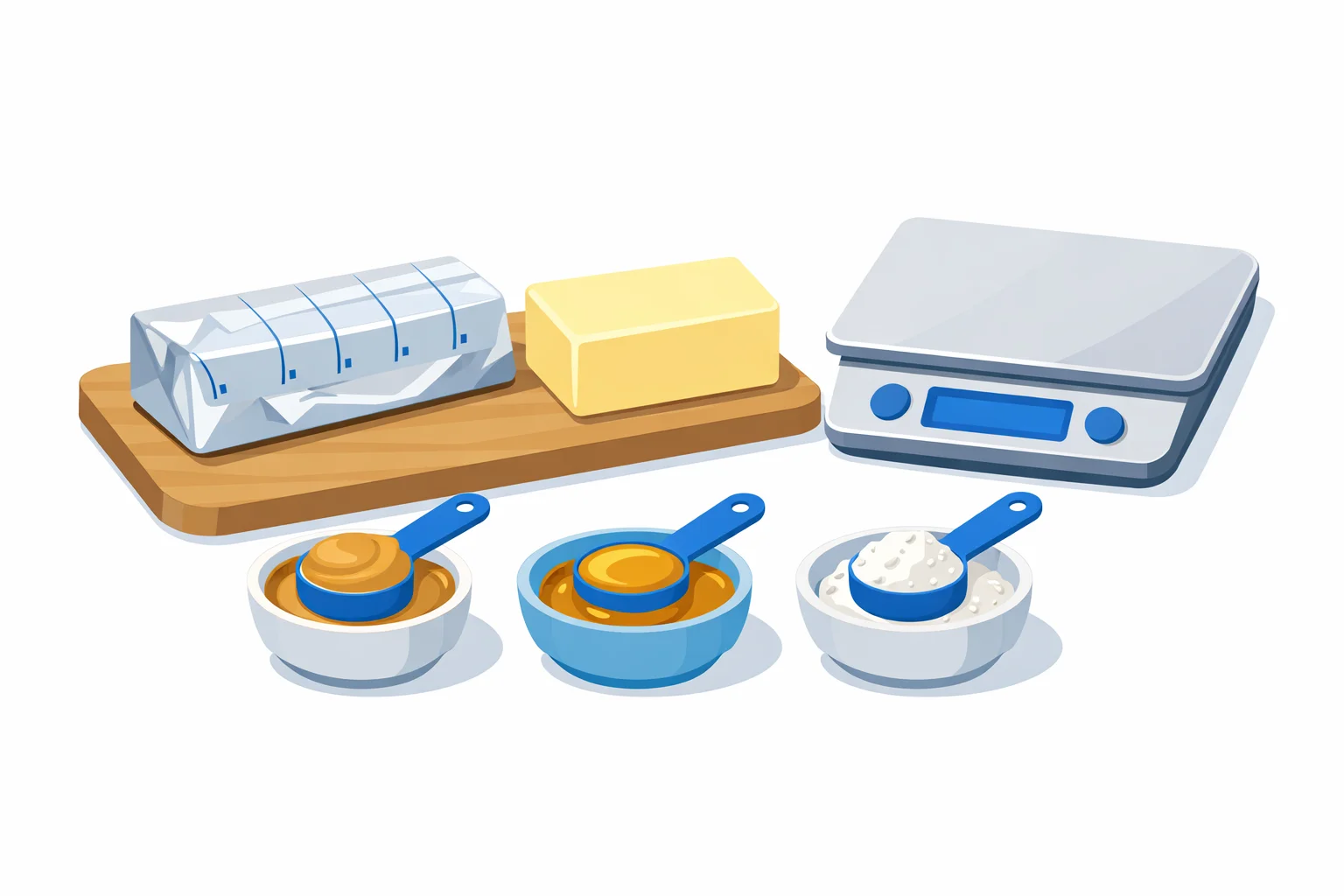
The Butter Block That Started This
Butter is the reason grams-to-tablespoons exists as a search at all. In the US, butter ships in quarter-pound sticks weighing 113 grams, and the wrapper prints tablespoon lines every 14.2 grams. Cooks barely think about it — they slice at the "4 Tbsp" mark and move on. Step outside North America and butter comes in 250-gram or 200-gram blocks with no markings at all, so a recipe written in American tablespoons becomes a small math problem at the counter.
The fix is one division. Butter's tablespoon weight is fixed because butter's density barely moves: 113 grams ÷ 8 tablespoons = 14.2 grams each. Need 6 tablespoons? That's 85 grams. Need 2? That's 28 grams. Unlike flour or spices, butter doesn't fluff or pack differently from day to day, which is exactly why this one conversion is reliable enough to trust without a second thought.
The One-Line Formula (and Why It Needs Density)
Every grams-to-tablespoons conversion is the same short equation:
tablespoons = grams ÷ (grams per tablespoon)
The trick is that "grams per tablespoon" isn't a constant — it's the ingredient's density multiplied by 14.7868, the volume of a US tablespoon in milliliters. Granulated sugar runs about 0.85 g/mL, so 0.85 × 14.79 = 12.5 grams per tablespoon. Honey is far denser at 1.42 g/mL, giving 21 grams. Flour, full of trapped air, sits near 0.53 g/mL and weighs just 7.8 grams a spoon. The US tablespoon is defined as exactly 14.7867648 mL under the NIST volume standards, which is what keeps the spoon consistent across every American recipe.
That density spread is dramatic. A tablespoon of honey outweighs a tablespoon of flour by almost three to one. So if you ever see a site claim "1 tablespoon = 15 grams" for everything, treat it as a rough liquid estimate — it's right for water and milk and wrong for nearly everything else on your shelf. If you only need the volume side of this and not the weight, our tablespoons to mL converter covers the US, metric, and Australian spoon sizes.
Butter by the Tablespoon: 14.2 Grams Each
Because butter is the headline case, it earns its own reference. Keep this table in your head and you'll never reach for the converter on butter again:
| Butter amount | Tablespoons | Grams | Cup equivalent |
|---|---|---|---|
| 1 tablespoon | 1 tbsp | 14.2 g | 1/16 cup |
| Quarter stick | 2 tbsp | 28.4 g | 1/8 cup |
| Half stick | 4 tbsp | 56.7 g | 1/4 cup |
| Full stick | 8 tbsp | 113.4 g | 1/2 cup |
| European block | 17.6 tbsp | 250 g | ≈ 1.1 cups |
| Two sticks | 16 tbsp | 226.8 g | 1 cup |
The gram weights come from USDA FoodData Central portion data, where one tablespoon of salted butter is logged at 14.2 grams. Notice the clean landmarks: half a stick is a quarter cup, a full stick is half a cup. If you're scaling past sticks into cups, the cups to grams butter guide carries the same 14.2-gram building block upward.
Reading Tablespoons Off a Nutrition Label
Here's a shortcut almost nobody mentions: packaged spreads already tell you their grams-per-tablespoon, hidden in the serving size. Peanut butter labels list 2 tablespoons as 32 grams — divide and you get exactly 16 grams per tablespoon. Mayonnaise lists 1 tablespoon as about 13 to 14 grams. Honey jars often print 1 tablespoon as 21 grams. The manufacturer did the density math for you; you just have to read the back of the jar.
This matters most when you're counting calories or macros. If your tracking app logs peanut butter in grams but you eat it by the spoon, that 16-grams-per-tablespoon figure turns "one heaping spoonful" into a real number. A level tablespoon is 16 grams and roughly 94 calories; a heaping one can be 24 grams and 140 — a 50% jump that quietly wrecks a daily total. When a label and a recipe disagree, trust the label, because it was measured on the actual product.
Worked Example: A 250 g Block in a US Recipe
Say you're baking American chocolate chip cookies that call for "1 stick plus 2 tablespoons of butter," and all you have is a 250-gram European block. Walk it through:
- 1 stick = 8 tbsp = 8 × 14.2 = 113.6 grams.
- 2 tablespoons = 2 × 14.2 = 28.4 grams.
- Total needed = 113.6 + 28.4 = 142 grams.
- What's left in the block = 250 − 142 = 108 grams (about 7.6 tbsp).
Set the block on a scale, zero it, and slice until it reads 142 grams. No tablespoon marks needed. The same logic runs in reverse when a recipe gives grams and you think in spoons — our tablespoons to grams converter does that direction for every ingredient here. Notice how a scale sidesteps the whole problem: weighing 142 grams is faster and more exact than counting ten separate tablespoon cuts.
When NOT to Convert Flour to Tablespoons
Butter converts cleanly, but flour is the ingredient where grams-to-tablespoons can mislead you. A "level" tablespoon of all-purpose flour is about 7.8 grams when spooned gently and leveled with a knife. Scoop that same spoon straight from the bag and you compress the flour, pushing it to 10 grams or more — a 25 to 30% overshoot. Across 8 tablespoons that's the difference between 62 grams and 80 grams of flour, enough to turn tender cookies tough.
So for flour, cocoa, and powdered sugar in any recipe that depends on texture, skip the tablespoon route entirely and weigh in grams. The reason recipe developers print gram weights for baking is precisely this: a tablespoon of a packable powder isn't a fixed quantity, it's a range. Use tablespoons for flour only when you're thickening a sauce or dusting a pan, where a few grams either way changes nothing.
Grams Per Tablespoon for 19 Ingredients
This is the lookup most searches are really after — the per-tablespoon weight that lets you convert any gram amount. Heavy liquids like honey top the list; airy powders like flour sit at the bottom.
| Ingredient | Grams per tbsp | 30 g equals |
|---|---|---|
| Honey | 21.0 g | 1.43 tbsp |
| Maple syrup | 20.0 g | 1.50 tbsp |
| Table salt (fine) | 18.0 g | 1.67 tbsp |
| Peanut butter | 16.0 g | 1.88 tbsp |
| Milk (whole) | 15.3 g | 1.96 tbsp |
| Greek yogurt | 15.0 g | 2.00 tbsp |
| Water | 14.79 g | 2.03 tbsp |
| Cream cheese | 14.5 g | 2.07 tbsp |
| Butter | 14.2 g | 2.11 tbsp |
| Brown sugar (packed) | 13.8 g | 2.17 tbsp |
| Mayonnaise | 13.8 g | 2.17 tbsp |
| Baking soda | 13.8 g | 2.17 tbsp |
| Olive oil | 13.5 g | 2.22 tbsp |
| Granulated sugar | 12.5 g | 2.40 tbsp |
| Baking powder | 12.0 g | 2.50 tbsp |
| All-purpose flour | 7.8 g | 3.85 tbsp |
| Cornstarch | 7.5 g | 4.00 tbsp |
| Powdered sugar | 7.5 g | 4.00 tbsp |
| Cocoa powder | 7.4 g | 4.05 tbsp |
The honey-to-flour spread is the headline: 30 grams fills 1.43 tablespoons of honey but 3.85 tablespoons of flour — nearly a 2.7-fold gap from the same weight. Working at the teaspoon scale instead? Each tablespoon here is three teaspoons, and our grams to teaspoons converter breaks the smaller amounts down further.
Conversion Slips That Cost You a Recipe
The errors that bite hardest here aren't arithmetic — they're assumptions baked into how you measure:
- Using one number for everything."15 grams = 1 tablespoon" works for water, but apply it to honey and you're 6 grams over per spoon; apply it to flour and you're nearly 2 tablespoons short on 15 grams.
- Heaped instead of level spoons. A heaped tablespoon of flour can hold 50 to 100% more than a level one. Recipe gram figures always assume the spoon is leveled flush with a straight edge.
- Forgetting butter melts the math away.Melted butter measures by volume the same as solid, but if a recipe says "3 tablespoons melted butter," measure 43 grams solid first — melting after pouring loses some to the pan.
- Trusting an Australian recipe's tablespoon.Australia's tablespoon is 20 mL, not 14.79, so its tablespoon of butter is about 19 grams. A grams-to-tablespoons chart built on the US spoon will read 30% low for Aussie recipes.
The throughline never changes: a tablespoon is a fixed volume, but grams answer to density. Tell the converter what you're holding — butter, honey, flour, or a spoonful of peanut butter straight off the label — and the tablespoon count comes out right. For anything where rise, set, or texture is on the line, weigh it instead and skip the spoon entirely.