Cups to Grams by Ingredient: The Complete Kitchen Weight Reference
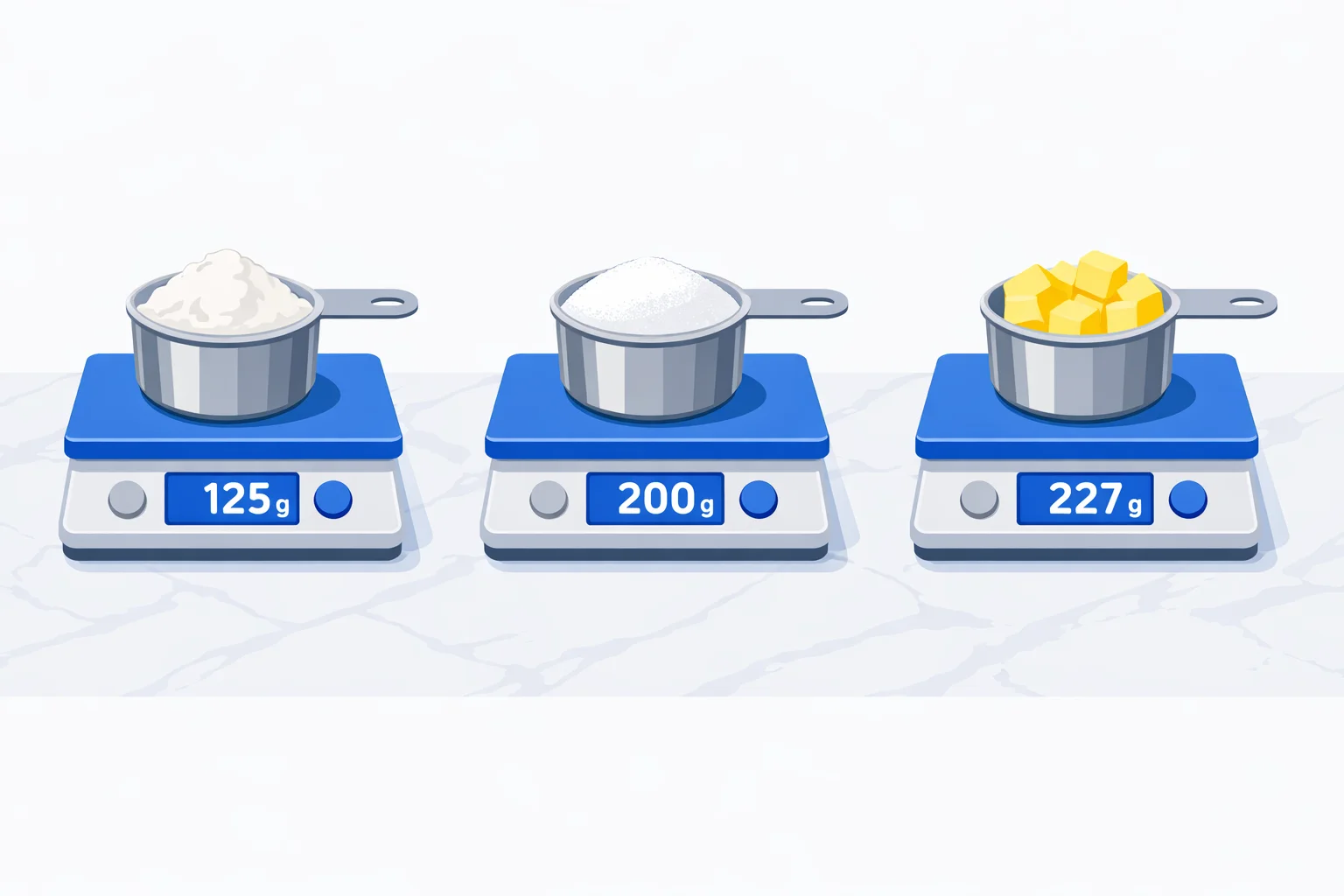
Converting cups to grams sounds simple until you realize a cup of flour and a cup of honey weigh wildly different amounts — 125g versus 340g. That's the whole problem with volume measuring: a cup is a fixed amount of space, not weight. Fill that space with something fluffy and you get a small number; fill it with something dense and the number nearly triples. The converter above already knows the density of 50+ kitchen staples, so you can skip the math. This guide explains the "why" behind those numbers so your bakes come out the same every single time.
Why One Cup Never Weighs the Same
A US cup is exactly 236.588 milliliters of volume. Weight depends on density — how much mass packs into that volume. Cocoa powder is full of air and tips the scale at just 85g per cup. Honey has almost no air gaps, so it hits 340g. That's a 4x spread for the identical cup.
Here's the rule that explains every conversion: grams = cups × grams-per-cup. The only variable that changes is that grams-per-cup figure, which is set by the ingredient. Water sits in the middle at 237g per cup, which makes it a handy mental benchmark — anything lighter than water (oats, flour, cocoa) is mostly air, and anything heavier (honey, syrup, peanut butter at 258g) is denser stuff with the air squeezed out.
The Flour Trap: 125g or 170g?
Flour is where most recipes go wrong. The accepted standard for all-purpose flour is 125g per cup using the spoon-and-level method: spoon flour loosely into the cup, then scrape the top flat with a knife. But if you dip the cup straight into the bag and scoop, you compress the flour and can pack in 150–170g — up to 35% more than the recipe intended.
That difference is the reason for dry, dense cookies and cakes that don't rise. Picture a chocolate chip cookie recipe calling for 2 cups of flour. Spooned, that's 250g. Scooped, it can be 340g — nearly an extra half-cup of flour you never meant to add. The dough turns stiff and the cookies come out cakey instead of chewy. If you want the gram weights broken down by flour type, our cups to grams flour converter covers all-purpose, bread, cake, and whole wheat separately.
Gram Weights for 50+ Common Ingredients
Below is a quick reference for the ingredients people convert most. The full, searchable chart lives inside the tool above — tap "Show full ingredient weight chart." These are US cup weights using standard measuring methods.
| Ingredient | 1 cup (g) | ½ cup (g) |
|---|---|---|
| All-purpose flour (spooned) | 125 | 62 |
| Granulated sugar | 200 | 100 |
| Brown sugar (packed) | 220 | 110 |
| Powdered sugar | 120 | 60 |
| Butter | 227 | 113 |
| Cocoa powder | 85 | 43 |
| Rolled oats | 90 | 45 |
| Honey | 340 | 170 |
| Chocolate chips | 175 | 88 |
| Whole milk | 240 | 120 |
Notice butter's 113g half-cup — that's no coincidence. One US stick of butter is exactly 113g, or half a cup, which is why American recipes lean on stick measurements. Need just butter or just sugar? The butter cups to grams converter and the sugar cups to grams converter handle every variety of each.
Converting a Whole Recipe: A Worked Example
Say you found a recipe in cups but your scale only does grams. Take a basic vanilla cake: 2 cups flour, 1.5 cups sugar, ¾ cup butter, 1 cup milk. Here's the conversion, step by step:
- Flour: 2 × 125 = 250g
- Sugar: 1.5 × 200 = 300g
- Butter: 0.75 × 227 = 170g
- Milk: 1 × 240 = 240g
Total batter weight before eggs: 960g. Now you can weigh everything into one bowl on a tared scale — zero it between additions — and never wash a measuring cup again. That's the real payoff of weighing: fewer dishes and identical results batch after batch.
US Cup vs Metric Cup vs Imperial Cup
A "cup" isn't universal, and this trips up bakers using recipes from other countries. The volume itself changes:
| Cup type | Volume | Water weight | Used in |
|---|---|---|---|
| US customary cup | 236.6 mL | 237g | United States |
| Metric cup | 250 mL | 250g | Australia, NZ, Canada |
| Imperial cup | 284 mL | 284g | Old UK recipes |
The gap matters. An Australian metric cup of flour is about 6% more than a US cup — roughly 7 extra grams per cup. Across a recipe with 4 cups of flour, that's nearly 30g of difference, enough to change the texture. The converter above uses the US cup (236.588 mL), the most common standard online. For the official definitions, the U.S. National Institute of Standards and Technology publishes the metric cooking reference tables.
Conversion Mistakes That Wreck a Bake
A few specific errors come up again and again:
- Packing flour into the cup.Scooping instead of spooning adds 25–45g per cup. On a two-cup recipe that's a stealth 50–90g of extra flour.
- Treating brown sugar like white. Brown sugar is measured packed at 220g per cup; white sugar is 200g. Swap the weights and your caramel notes and moisture shift.
- Forgetting powdered sugar is light.At 120g per cup it's 40% lighter than granulated. Use the granulated weight by mistake and a glaze turns soupy.
- Mixing up wet and dry cups.A liquid measuring cup filled to the "1 cup" line and a dry cup leveled off hold the same volume, but you can't accurately level a liquid in a dry cup — you'll overfill by a tablespoon or two every time.
When Grams Beat Cups (and When They Don't)
Grams win whenever precision matters: bread, laminated pastry, macarons, and anything with a delicate flour-to-liquid ratio. A 2% error in hydration can change how a sourdough proofs. Weighing also speeds up batch baking — scale up a cookie recipe 3x by multiplying grams, no fraction headaches.
But cups aren't useless. For a quick weeknight soup, a stir-fry, or seasoning to taste, volume is faster and accuracy barely matters — nobody's sourdough fails because a cup of broth was 10g off. The honest answer: weigh your baking, eyeball your cooking. Keep this converter open when you're working from a recipe that mixes the two systems, and you get the best of both.