Butter Cups to Grams: Sticks, Tablespoons & Weight Conversions
Converting cups of butter to grams is refreshingly clean: 1 cup of butter is 227 grams, full stop. There's no spoon-versus-scoop trap like flour has, because butter is sold and packed by weight — a cup is a cup is 227g. The real headache isn't the math, it's the units. American recipes talk in "sticks," European butter comes in 250g blocks with no markings, and somewhere in between a baker is staring at "1½ sticks" with a 250g brick, doing nothing. The converter above turns any of those — cups, sticks, tablespoons, grams — into the rest in one step.
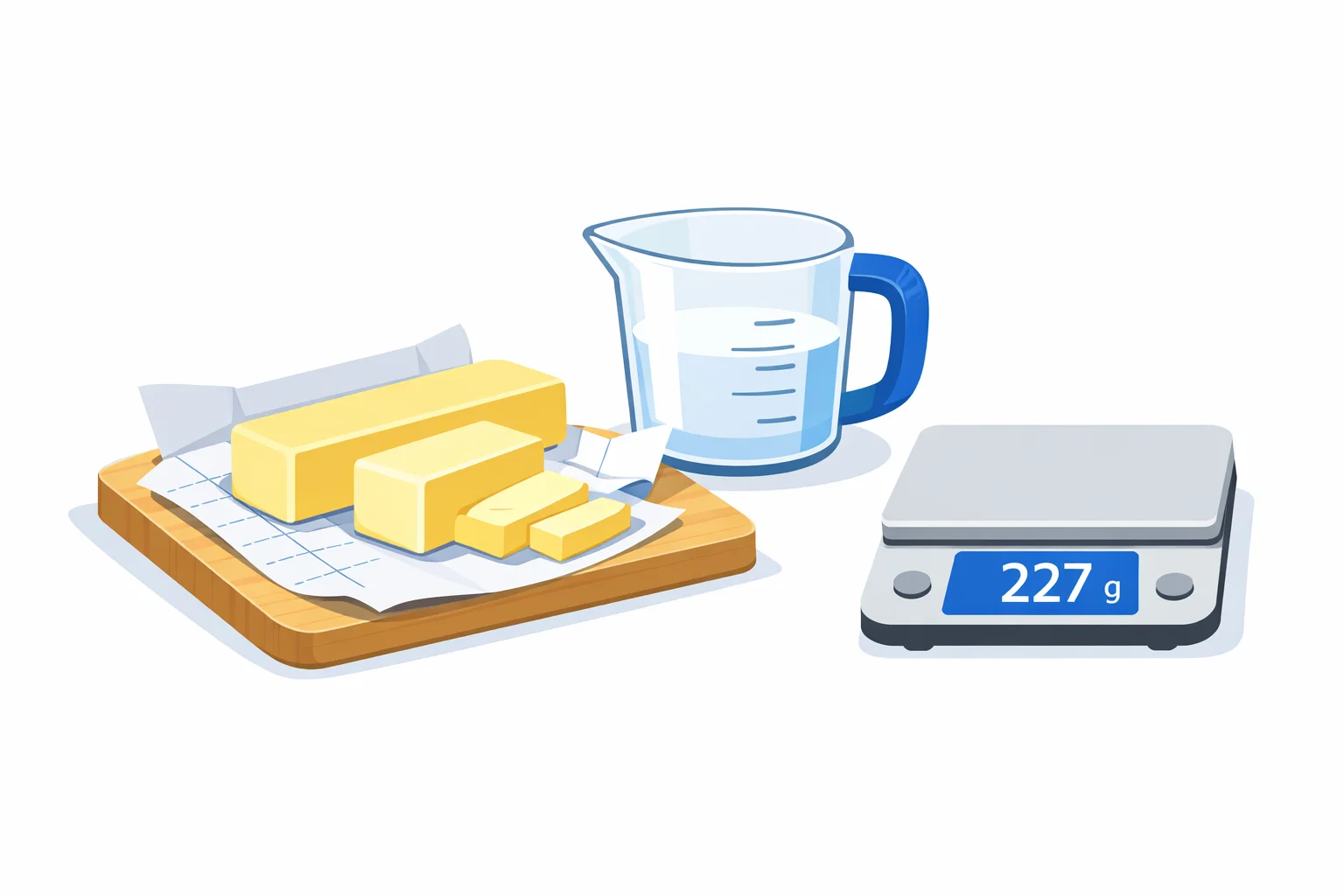
The Transatlantic Butter Problem
Picture this. You found a brownie recipe from a US food blog calling for "2 sticks of butter," but you're standing in a kitchen in Berlin holding a 250-gram block. Sticks don't exist in Europe. The recipe assumes you know that two sticks is 227 grams, which is most — but not all — of your block. Cut the whole 250g in and you've added 23 extra grams of fat, enough to make the brownies greasier and flatter than intended.
It runs the other way too. A British recipe lists "125g butter" and an American cook with a box of sticks has to work out that 125g is a hair over one stick (113g) plus about a tablespoon. The two measuring cultures never agreed on a shared unit, so every cross-border recipe needs a quiet conversion the writer didn't bother to include. Grams are the neutral ground both sides can meet on.
The Four Numbers That Anchor Every Conversion
Memorize four figures and you can do most butter math in your head. Everything else is a multiple or a fraction of these:
| Amount | Grams | Also equals |
|---|---|---|
| 1 tablespoon | 14 g | ½ oz |
| 1 stick | 113 g | ½ cup · 8 tbsp · ¼ lb |
| 1 cup | 227 g | 2 sticks · 16 tbsp · ½ lb |
| 1 pound | 454 g | 4 sticks · 2 cups |
These line up so neatly because the US stick was defined as a quarter pound — 113.4 grams exactly — back when butter started being sold in pre-cut prints. Four quarter-pound sticks make the classic one-pound box. Because each stick is also 8 tablespoons, a cup lands on a tidy 16 tablespoons. That tablespoon, by the way, is the same one used in our grams to teaspoons converter for smaller amounts, where 1 tbsp of softened butter is about 14.2g.
Reading the Tablespoon Marks on the Wrapper
Here's a trick European cooks miss because their butter doesn't have it: the paper wrapper on a US stick is a ruler. It's printed with 8 evenly spaced tablespoon lines, and often with cup fractions too (¼ cup at the 4-tbsp line). You don't need a measuring spoon at all — just slice straight down at the line. Need 3 tablespoons? Cut at the third mark and you've got 42.5 grams without dirtying a single tool.
The catch is that those lines assume a perfectly formed stick. Butter that's been squashed in transit, or an off-brand print that's slightly short, throws the spacing off by a tablespoon's worth — roughly 14g. For baking where the fat ratio matters, the wrapper is a great first cut, but a scale confirms it. If you bake a lot of mixed recipes, the all-ingredient cups to grams chart keeps butter next to your other staples so you're not flipping between pages mid-recipe.
How to Measure Butter When You Have No Sticks
If you're working from a stick-based recipe without sticks, you have three honest options, in order of accuracy:
- Weigh it. The only foolproof method. 1 cup = 227g, 1 stick = 113g, 1 tbsp = 14g. A scale ignores shape entirely.
- Cut a block by proportion. A 250g European block is about 8.8 tablespoons of butter. To get one cup (227g), trim off roughly 23g — about a tablespoon and a half — from a full block.
- Water displacement.No scale at all? Fill a measuring cup to 1 cup with cold water, then push in cold butter until the water rises to the 2-cup line. The submerged butter displaces exactly 1 cup of volume — 227g. It's fiddly but surprisingly accurate for cold, firm butter.
Displacement only works while the butter is cold and solid; soft butter floats and smears, and melted butter mixes with the water. The USDA FoodData Central database lists butter at about 227g per cup, the figure every method here is calibrated to.
Worked Example: An American Cookie Recipe Abroad
Take a standard chocolate chip cookie recipe: "1 cup (2 sticks) butter, softened." You're in a kitchen with a single 250g block and a scale. Here's the conversion, step by step:
- Recipe needs 1 cup = 2 × 113.4 = 227g.
- Your block is 250g, so you trim off 250 − 227 = 23g.
- That 23g leftover is about 1½ tablespoons — save it for greasing the pan.
Now flip it. Say the recipe was European and listed "225g butter," but you only have US sticks. Divide: 225 ÷ 113.4 = 1.98 sticks — call it two sticks, since the 1g difference is invisible in a cookie. This is the same kind of swap the cups to grams flour converter handles for the dry side of that recipe, so the whole dough comes out in one measuring system.
Does Salted vs Unsalted Change the Weight?
No — a cup of salted butter and a cup of unsalted butter both weigh 227 grams. Salt is only about 1.5 to 2 percent of the stick's mass, and it's dissolved into the fat rather than added as bulk, so the density barely moves. You can swap one for the other gram-for-gram on the scale without recalculating anything.
What you do need to adjust is the recipe's salt. A cup of salted butter carries roughly 3 to 4 grams of salt — about ½ to ¾ teaspoon. If you sub salted butter into a recipe written for unsalted, cut the added salt by that much or the bake turns savory. The reverse is the more common fix: bakers keep unsalted butter precisely so they control the salt themselves.
Where Melted and Clarified Butter Trip People Up
Weight never lies, but volume can. Melting butter doesn't change its mass — 113g of solid butter is still 113g once it's liquid. The mistake is measuring by volume after melting: solid butter packed into a cup has tiny air gaps, while melted butter fills the cup completely, so "1 cup melted" and "1 cup, then melted" aren't the same amount of fat. When a recipe says "½ cup butter, melted," it means measure 113g solid first, then melt — not pour a pool to the line.
Clarified butter and ghee are a sharper trap. Making them boils off the water and strains out the milk solids, which together are 15 to 20 percent of regular butter. So 227g of butter yields only about 180–190g of ghee. If a recipe calls for a cup of butter and you substitute a cup of ghee by volume, you're adding pure butterfat with none of the water that normally steams off during baking — richer, but it changes how pastry crisps and how sauces emulsify.
When a Cup Is Fine and When to Reach for the Scale
For everyday cooking, the stick markings are plenty. Sautéing onions in "2 tablespoons of butter," buttering toast, or finishing a pan sauce — slice at the wrapper line and move on, because a 5g wobble disappears into the dish. Butter's big advantage over flour is that it doesn't compress, so even a cup measured by eye is close to 227g.
Pull out the scale when butter is doing structural work and the ratio matters: laminated doughs like croissants and puff pastry, shortbread where fat is half the recipe, and any cake where creaming butter and sugar sets the crumb. A 20g error in a croissant's butter block changes how the layers separate. Keep this converter open while you bake from a foreign recipe — pick the unit it's written in, read the grams, and the transatlantic guesswork is gone. For scaling everything at once, pair it with the all-in-one cooking converter to handle the rest of the ingredient list in the same units.