Sticks of Butter to Cups: The Quarter-Pound Math, Decoded
Converting sticks of butter to cups comes down to a single fact you can memorize in a second: one stick is half a cup. Two sticks make a full cup, three sticks make a cup and a half, four sticks make two cups. That clean doubling isn't a coincidence — it traces back to a 1900s decision to mold butter into quarter-pound prints, and that history is exactly why the numbers line up so neatly today. The converter above does the doubling for you, but the story behind it tells you when to trust the math and when to reach for a scale.
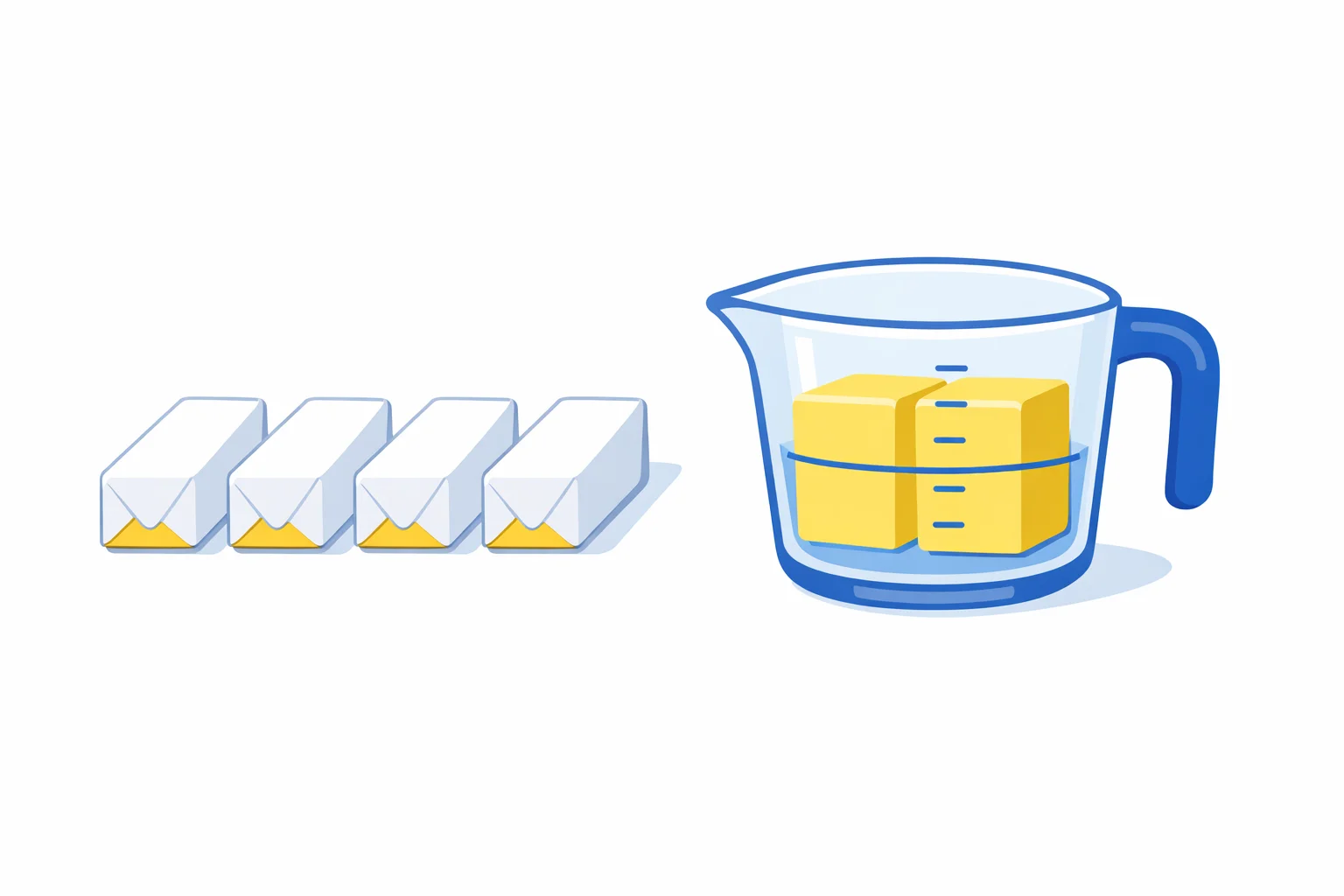
The Half-Cup Rule in One Line
A US stick of butter is 0.5 cup — 8 tablespoons, 4 ounces, or 113 grams. To go from sticks to cups, halve the number of sticks. To go from cups to sticks, double the cups. So 1 stick is ½ cup, 2 sticks is 1 cup, and 1½ cups calls for 3 sticks. The one-pound box you buy at the store holds four sticks, which is exactly 2 cups of butter.
Why a Stick Is Exactly a Quarter Pound
Before 1907, butter was a mess to buy. It came in tubs, crocks, and rough rolls, and a grocer scooped out however much you asked for. Then creameries near Elgin, Illinois — then the butter capital of the country — began pressing butter into uniform 4-ounce prints wrapped in parchment, and the format spread nationwide. Four of those quarter-pound prints made a tidy one-pound package: the same box that still sits in the dairy aisle.
The quarter-pound choice is what makes butter math painless. A pound of butter fills 2 cups, so a quarter pound fills a quarter of that — half a cup. That same quarter pound is 8 tablespoons, since a cup holds 16. Every "nice" number — ½ cup, 8 tbsp, 4 oz, 113g — is just the same chunk of butter wearing a different unit. If you want the gram side spelled out, the cups to grams butter converter breaks every stick fraction down to the gram.
The Long Stick vs the Stubby Stick
Here's the part almost no recipe site mentions: US butter sticks come in two physical shapes, and they trip up people who move between regions. East of the Rockies you mostly find "Elgin" or Eastern-pack sticks — long and slim, roughly 4¾ inches by 1¼ inches. West of the Rockies, butter ships in "Western" or stubby sticks — short and fat, about 3⅛ inches by 1½ inches. Both weigh a quarter pound and both equal half a cup. Only the proportions differ.
Why care? Because the tablespoon lines printed on the wrapper are spaced for that specific shape. On a long Eastern stick the 8 marks are spread out and easy to slice between. On a stubby Western stick the same 8 marks sit crammed together, so eyeballing "3 tablespoons" is harder and a knife slip costs you more. The weight never changes — but your odds of cutting an accurate portion by eye do. If a half-tablespoon swing matters for your recipe, that's your cue to weigh instead of slice.
The Wrapper Is a Ruler — Use It
European cooks miss this trick because their butter blocks are blank: the paper on a US stick is a measuring tool. It carries 8 evenly spaced tablespoon lines and usually cup fractions too — ¼ cup at the 4-tablespoon line, often a ⅓-cup mark as well. Need a quarter cup? That's 4 tablespoons, the exact middle of one stick. Slice straight down at the line and you've measured without touching a cup or a spoon.
The accuracy caveat is real, though. Those lines assume a perfectly molded stick. Butter that softened and slumped in a hot car, or a budget print that ran slightly short, can shift each mark by a tablespoon's worth — about 14 grams. For toast or a pan sauce that drift vanishes into the dish. For pastry it can matter, which is where a scale earns its keep. For the smaller spoon amounts, our grams to teaspoons converter pins down a single tablespoon of butter at roughly 14.2g.
Worked Example: Scaling a 3-Stick Cookie Recipe
Say a brown-butter cookie recipe calls for 3 sticks of butter and you want to make 1.5× the batch for a bake sale. Work it in stages:
- Base recipe: 3 sticks = 3 × 0.5 = 1.5 cups = 24 tablespoons = 340 grams.
- Scale 1.5×: 3 × 1.5 = 4.5 sticks, which is 2.25 cups or about 510 grams.
- Buy smart: 4.5 sticks is one full 4-stick box plus half a stick from a second box — so grab two boxes and you'll have 3.5 sticks left over.
Notice the half-stick. That leftover 0.5 stick is ¼ cup, 4 tablespoons, or 57 grams — handy to know so it doesn't sit forgotten in the fridge. If your recipe mixes butter with cups of flour and sugar, the all-ingredient cups to grams chart lets you scale the whole list at once instead of converting each line by hand.
Converting When Your Butter Has No Sticks
Outside North America, butter comes in solid 200g or 250g blocks with no markings at all, so a stick-based recipe needs translating. The cleanest path is to convert sticks to grams, then weigh:
- 1 stick = 113g — a little under half of a 250g block.
- 2 sticks (1 cup) = 227g — about 91 percent of a 250g block, so trim off roughly 23g.
- 4 sticks (2 cups, 1 lb) = 454g — basically two 250g blocks minus 46g, or four 113g portions.
A 250g block also works out to about 17.6 tablespoons, which is why "just use one block" rarely matches a stick recipe exactly. The USDA FoodData Central database lists butter at about 227g per cup, the same figure the converter and every gram value here is built on.
Where the Half-Cup Rule Goes Wrong
The doubling rule is bulletproof for solid butter, but two situations break it. The first is melted butter measured by volume. The half-cup rule describes a solid stick; once you melt it, the air gaps vanish and a pool of melted butter poured to the ½-cup line is more fat than a stick was. When a recipe says "½ cup butter, melted," measure the solid stick first, then melt it.
The second is whipped butter in tubs. Whipped butter has air beaten into it, so a tub labeled "1 cup" holds far less actual butterfat than two sticks would — sometimes 30 percent less by weight. Never swap whipped butter cup-for-cup into a baking recipe written for sticks; it throws off the fat ratio and the texture. For everything else — buttering a pan, building a sauce, creaming for cookies — the half-cup rule holds, and the converter above turns any stick count into cups, tablespoons, and grams in a single tap. To carry the same precision across the rest of your ingredient list, keep the all-in-one cooking converter open alongside it.