Kitchen Measurement Converter: Master Every Unit in Cooking
A cooking measurement converter exists because the kitchen runs on a patchwork of units that almost — but never quite — line up. Three teaspoons make a tablespoon. Sixteen tablespoons make a cup. Two cups make a pint. The math is clean until a recipe from another country quietly swaps in a bigger spoon, or a number on a nutrition label rounds 236.588 mL up to 240. The tool above handles all nine common volume units in both US and UK sizing, and even bolts on a weight readout. This guide explains the relationships underneath, so you can sanity-check any conversion in your head.
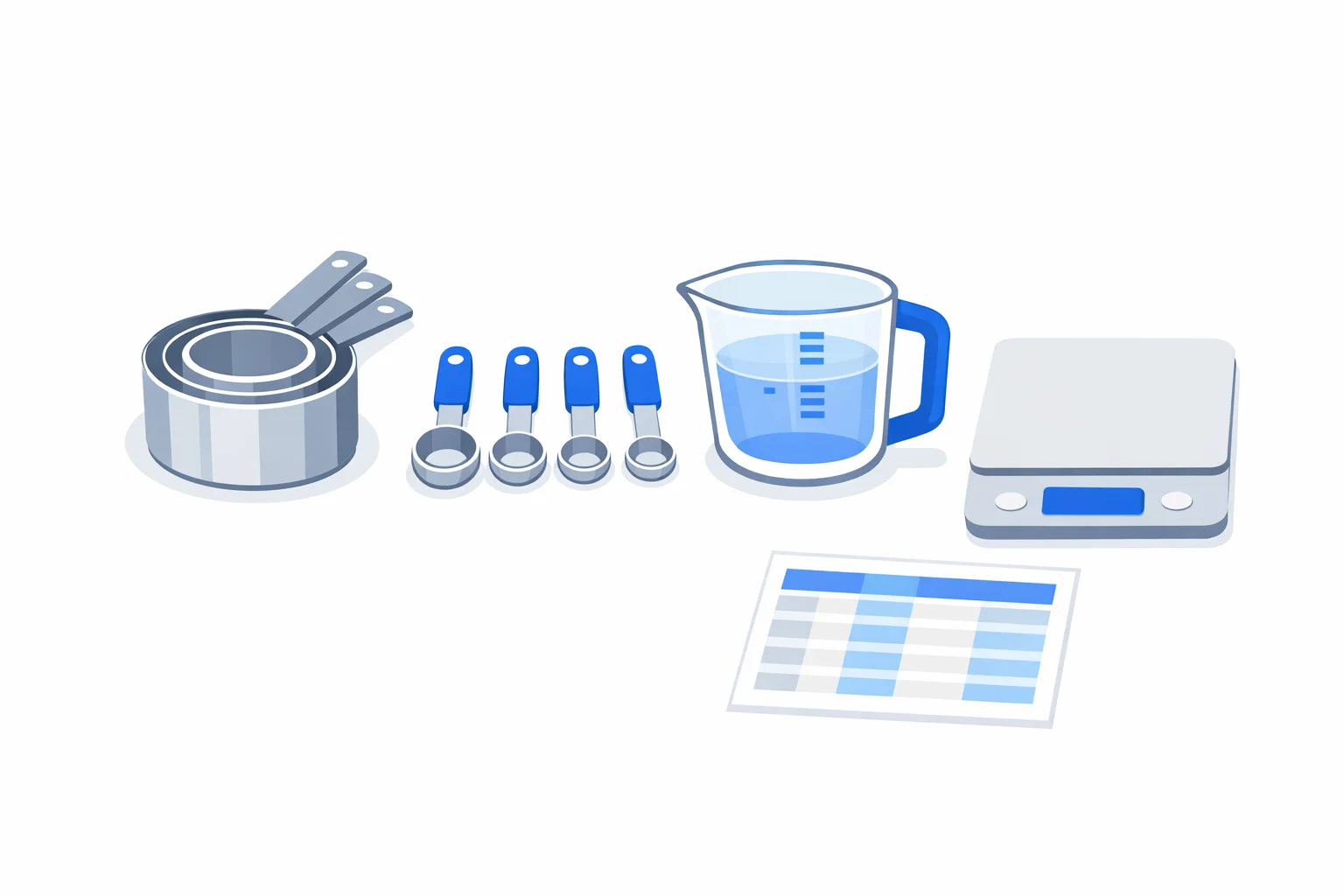
3 Teaspoons, 16 Tablespoons, 1 Cup
Memorize three numbers and you've got 90% of kitchen conversions covered: 3, 16, and 8. A tablespoon is 3 teaspoons. A cup is 16 tablespoons. A cup is 8 fluid ounces. Everything else chains off those. Because a cup is 16 tablespoons and each tablespoon is 3 teaspoons, a cup is also 48 teaspoons — which is how you can hit 3/4 cup with nothing but a tablespoon (12 of them) when the right measuring cup is buried in the dishwasher.
The larger units stack just as neatly. Two cups make a pint, two pints make a quart, and four quarts make a gallon. Run the chain and a US gallon works out to 16 cups or 128 fluid ounces. These ratios are fixed by definition in the US Customary system, so they never drift — the only thing that changes is which systemyou're measuring in.
Why a US Spoon and a UK Spoon Aren't the Same
Here's where converters earn their keep. The word "tablespoon" doesn't describe a single volume. A US tablespoon is 14.79 mL. A UK tablespoon is 17.76 mL — about 20% larger. The cup gap is even wider: a US cup is 236.588 mL while the old imperial cup is 284.131 mL, a difference of nearly 48 mL, or roughly three extra US tablespoons per cup.
Toggle the converter between US Customary and UK Imperial and watch the numbers shift. The same "1 cup" lands on 236.6 mL in US mode and 284.1 mL in UK mode. For a single tablespoon of vanilla the gap is trivial. For 3 cups of stock in a risotto, the imperial version pours in about 142 mL more liquid — call it a generous half-cup — which is enough to leave the rice soupy. If you only ever need the liquid side, our cups to milliliters converter breaks down all three cup standards.
The 20 mL Australian Tablespoon Trap
Australia and New Zealand throw the sharpest curveball in cooking. Their metric tablespoon is 20 mL, which equals 4 teaspoons, not the 3 teaspoons every US and UK cook assumes. Most other units match the international metric system — a 5 mL teaspoon, a 250 mL cup — but that one oversized spoon catches people constantly.
The damage shows up most in leavening and strong flavorings. A recipe written in Sydney calling for "2 tablespoons of baking powder" means 40 mL. Measure it with US tablespoons and you get 29.6 mL — about 26% short. That under-dose is the difference between a cake that domes and one that stays flat. The safe move when a recipe's origin is unclear: measure in teaspoons, where 1 tsp is close enough across all three systems (4.93–5.92 mL) to rarely matter for small amounts.
| Unit | US | UK Imperial | Metric (AU/NZ) |
|---|---|---|---|
| Teaspoon | 4.93 mL | 5.92 mL | 5 mL |
| Tablespoon | 14.79 mL | 17.76 mL | 20 mL |
| Cup | 236.6 mL | 284.1 mL | 250 mL |
The Master Conversion Chart
This is the table people screenshot and stick to the fridge. It's built on US units, the most common standard in online recipes. The full interactive version lives in the tool above — tap "Show full cups–tablespoons–teaspoons chart."
| Cups | Tablespoons | Teaspoons | Fluid oz | mL |
|---|---|---|---|---|
| 1/4 | 4 | 12 | 2 | 59 |
| 1/3 | 5 1/3 | 16 | 2.7 | 79 |
| 1/2 | 8 | 24 | 4 | 118 |
| 2/3 | 10 2/3 | 32 | 5.3 | 158 |
| 3/4 | 12 | 36 | 6 | 177 |
| 1 | 16 | 48 | 8 | 237 |
Note the awkward fractions on 1/3 and 2/3 cup: 5 1/3 and 10 2/3 tablespoons. Those are the values most likely to trip you up mid-recipe, which is exactly why measuring 1/3 cup directly — rather than counting out partial tablespoons — saves both time and accuracy.
When Volume Isn't Enough: Adding Weight
Volume conversions assume the units are interchangeable, but they only tell you how much spacean ingredient fills — not how much it weighs. A cup of all-purpose flour is 125g; a cup of honey is 340g. Same volume, nearly triple the mass. That's why the converter includes a weight readout: pick an ingredient and it multiplies the volume by that ingredient's density.
A single US tablespoon of flour comes out to roughly 8 grams (125g divided by 16), while a tablespoon of granulated sugar is about 12.5 grams. For serious baking, weighing beats measuring every time — a digital scale erases the 10–35% swing you get from how tightly flour packs into a cup. For a full ingredient-by-ingredient breakdown, the cups to grams converter covers 50+ pantry staples, and the flour-specific converter handles each flour type separately.
Converting a Foreign Recipe, Step by Step
Say a British scone recipe lists: 1 cup flour, 4 tablespoons butter, 1/2 cup milk — all in imperial units. You own US measuring cups. Here's the conversion to US volumes, working through milliliters as the common ground:
- Flour: 1 UK cup = 284.1 mL ÷ 236.6 mL = 1.2 US cups
- Butter: 4 UK tbsp = 71 mL ÷ 14.79 mL = 4.8 US tbsp (just shy of 5)
- Milk: 1/2 UK cup = 142 mL ÷ 236.6 mL = 0.6 US cups
Every line nudges upward because imperial units are larger. Ignore the difference and you'd build the scones with roughly 17% less of everything — drier, denser, and smaller than the baker intended. The converter does this arithmetic instantly; the point of walking through it is so you trust the output instead of second-guessing it.
Measuring Slip-Ups That Sink a Dish
A handful of errors cause most kitchen conversion disasters:
- Using a liquid cup for dry ingredients (or vice versa). They hold the same volume, but you can't level flour in a spouted liquid cup — you'll overfill by a tablespoon or more every time.
- Assuming every tablespoon is 15 mL.The US tablespoon is 14.79 mL and the UK one is 17.76 mL. The rounded "15 mL" figure only matches metric measuring spoons, not US ones.
- Halving an egg by volume.One large egg is about 3 tablespoons (46 mL) out of the shell. To halve a recipe with one egg, beat it and measure 1.5 tablespoons — don't eyeball it.
- Confusing fluid ounces with weight ounces. A fluid ounce measures volume (29.57 mL); a weight ounce is 28.35 grams. They only line up for water, where 1 fl oz weighs almost exactly 1 oz.
Cups for Cooking, Scales for Baking
Volume measuring is fast and forgiving for cooking — a stew doesn't care if your cup of stock is 10 mL off. Baking is chemistry, and there the same sloppiness ruins the result. A 2% error in a bread's hydration changes how the dough proofs and the crumb that follows. The honest rule professional kitchens follow: measure by volume when you're cooking to taste, and switch to a scale the moment precision matters. The NIST metric cooking reference backs this up with the official unit definitions if you want to verify any number here. Keep this converter open when a recipe mixes systems, and you'll never under-pour a stock or over-spoon a leavener again.