Sugar Cups to Grams: Why “One Cup” Means Five Different Weights
Converting cups of sugar to grams sounds simple until you realize "sugar" isn't one ingredient. A cup of granulated white sugar is 200g. A cup of sifted powdered sugar is barely 100g. A cup of caster sugar is 225g. Same word, same cup, but the weight more than doubles depending on which jar you reach for. The converter above lets you pick the exact sugar so the number lines up with what's really in your bowl — and this guide explains why the spread is so wide and where it actually bites.
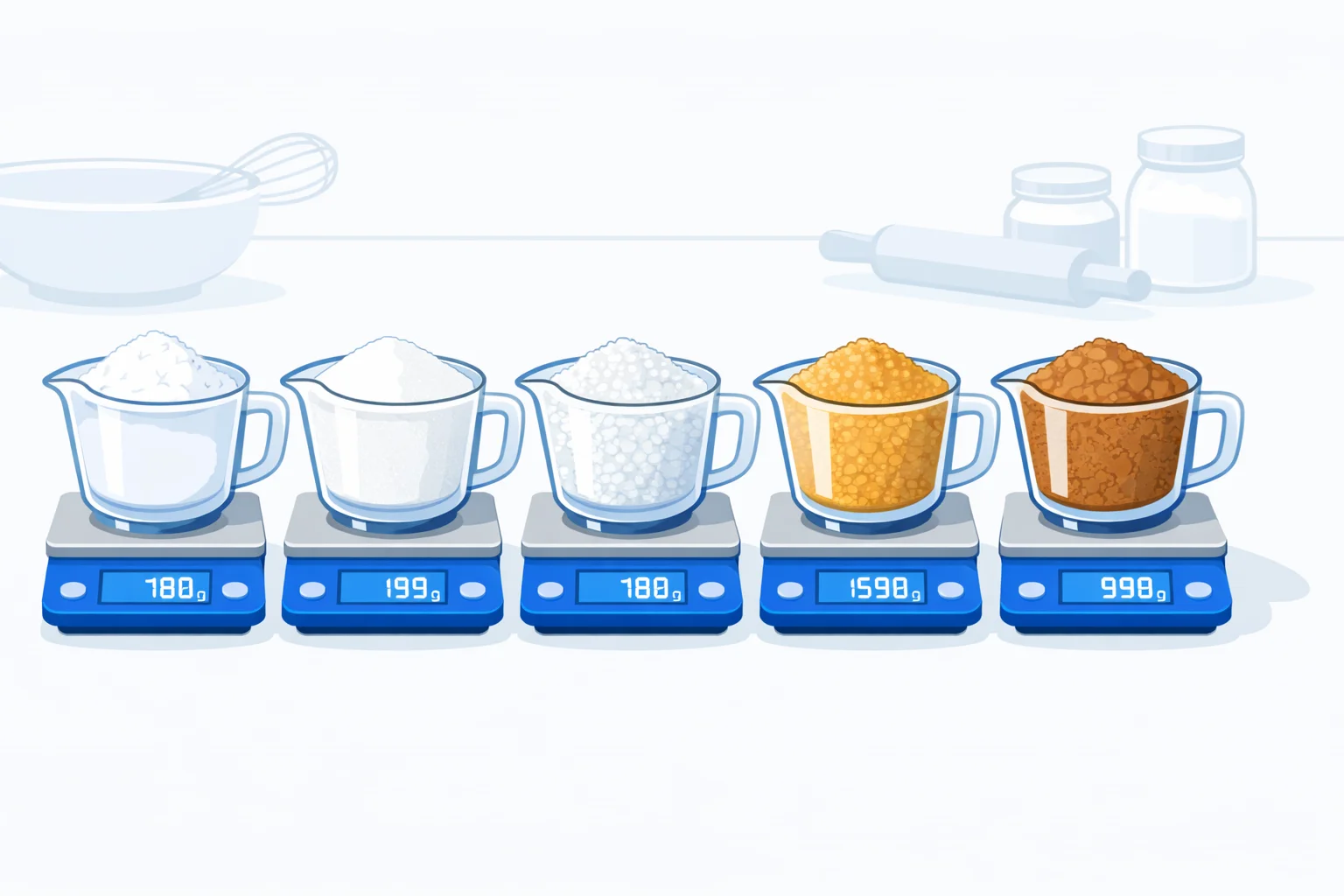
One Cup, Five Different Weights
Here's the spread that catches people out. A single US cup (236.588 mL) of sugar ranges from 100g to 225g — more than double — purely based on type and how it's measured. That's a wider range than flour, where a cup only swings from about 90g to 167g. The reason: sugars differ wildly in crystal size, moisture, and whether you pack them.
| Sugar | 1 cup (g) | ½ cup (g) |
|---|---|---|
| Granulated (white) | 200 | 100 |
| Caster (superfine) | 225 | 113 |
| Powdered (unsifted) | 120 | 60 |
| Powdered (sifted) | 100 | 50 |
| Light/dark brown (packed) | 220 | 110 |
| Brown (loose) | 145 | 73 |
| Turbinado / raw | 200 | 100 |
| Coconut sugar | 154 | 77 |
Notice the two ends. Caster sugar at 225g and sifted powdered sugar at 100g are both "one cup," yet one holds 125g more actual sugar than the other. Swap them blindly and a recipe's sweetness, browning, and structure all shift. This is exactly why serious baking recipes give weights, not cups — and why our full cups-to-grams ingredient chart treats every sugar as its own line.
Why White Sugar Is the Easy One
Granulated sugar is the most forgiving thing in your pantry to measure. Its crystals are hard, uniform, and roughly half a millimeter across, so they don't squash together when you press them. Scoop a cup straight from the bag and you'll get about 202g; spoon it in gently and you'll get 198g. That 2 to 4 gram wobble is nothing — under 2% — and it's why you can trust 200g per cup of white sugar without fussing over technique.
Compare that to flour, where dipping the cup into the bag packs in 28% more. Sugar simply doesn't behave that way. If you bake mostly with white sugar, a scale saves you time but rarely rescues a recipe. The accuracy payoff shows up the moment you switch to a sugar that isn't free-flowing.
Brown Sugar: The Only Sugar You Pack
Brown sugar is the troublemaker, and it's the one reason a sugar converter earns its keep. Its thin molasses coating makes the crystals cling, so a loose cup traps air pockets and weighs only about 145g. Press it down — "packed," the way virtually every recipe assumes — and you force out the air to reach 220g. That's a 75g difference in the same cup, a 34% swing, and it's the single biggest measuring error in sugar.
Get this wrong in the wrong direction and you feel it. Use loose brown sugar where a recipe wanted packed and a batch of chewy cookies loses 75g of sugar per cup — they spread less, brown less, and taste flat. Light and dark brown sugar weigh the same when packed (220g); the only difference is molasses content, which changes color and flavor, not weight. For a closer split between the two, the dedicated brown sugar cups to grams converter breaks out packed and loose side by side.
Powdered Sugar Plays by Its Own Rules
Powdered sugar (confectioners' or icing sugar) is granulated sugar ground to a flour-fine dust, then mixed with about 3% cornstarch to stop it clumping. Because it's so fine and airy, a cup weighs just 120g unsifted — and only 100g if you sift it first. That 20g drop is real, and it's why icing recipes are fussy about word order.
"1 cup powdered sugar, sifted" means measure 120g, then sift. "1 cup sifted powdered sugar" means sift first, then measure — about 100g. In a buttercream that 20g shifts the texture from pipeable to stiff, and in a thin glaze it changes how the sugar dissolves. When a frosting comes out too thick, an over-measured cup of powdered sugar is usually the culprit.
Worked Example: Fixing an Over-Sweet Frosting
Say a buttercream recipe lists "4 cups powdered sugar" and assumes sifted. You measured unsifted, straight from the bag. The math:
- Grams = cups × grams-per-cup
- Recipe intended: 4 × 100 = 400g (sifted)
- What you added: 4 × 120 = 480g (unsifted)
- Overshoot: 80g of extra sugar — about ⅔ of a cup
That 80g is why your frosting turned out grainy and too sweet to pipe. Weighing to 400g would have nailed it on the first try. To rebalance the rest of the batch, the cups to grams butter converter handles the stick-to-gram side, and the recipe scaler adjusts every ingredient at once if you need to stretch it to a bigger cake.
The Bag-to-Cup Cheat Sheet
Most sugar is sold by weight, so it helps to know how far a bag goes before you start. These figures use the standard per-cup weights above:
| Bag size | Granulated | Powdered (unsifted) |
|---|---|---|
| 1 kg (1000g) | 5 cups | 8.3 cups |
| 2 lb (907g) | 4.5 cups | 7.6 cups |
| 4 lb (1814g) | 9 cups | 15.1 cups |
| 5 lb (2268g) | 11.3 cups | 18.9 cups |
The headline: a kilo of granulated sugar is exactly 5 cups, an easy number to keep in your head. The same kilo of powdered sugar gives you over 8 cups because it's so much lighter. The USDA's FoodData Central database lists the reference densities behind these conversions if you want the primary source.
When a Cup Is Good Enough
You don't need a scale for everything. Sweetening coffee, dusting a cake with powdered sugar, or sprinkling demerara on top of muffins — a cup, a spoon, or a handful is completely fine, because a 10g error vanishes. Granulated sugar in most home recipes is forgiving too, since its 200g-per-cup weight barely moves with technique.
Reach for grams when the sugar is doing structural work or when you're using brown or powdered sugar, where the cup is unreliable. Caramel, meringue, candy, and bread all hinge on precise sugar ratios, and brown sugar's 75g packed-versus-loose gap is too big to eyeball. Keep this converter open while you bake: pick your sugar, read the gram weight, and you'll skip the most common reason a sweet recipe comes out wrong.