Cups to Ounces: Reading a Recipe Off Your Measuring Set
Cups to ounces is the conversion you hit the second a recipe says "¾ cup of buttermilk" but the only scale in the drawer reads in ounces. For liquids the math is kind: a US cup is exactly 8 fluid ounces, so ¾ cup is 6 fl oz and you're done. The trouble starts when the ounces you need are weight ounces — the kind a kitchen scale measures — because then a cup of flour and a cup of honey give completely different numbers. The converter above keeps the two apart so you never pour 6 ounces of flour when the recipe wanted six fluid ounces of liquid.
The 8 Fluid Ounces Rule, and Where It Stops
One US cup is defined as 8 US fluid ounces, or 236.588 mL. Because a fluid ounce is a unit of volume, that ratio never changes: cups × 8 = fluid ounces, for water, milk, stock, wine or melted butter alike. Two cups is 16 fl oz — one US pint. Four cups is 32 fl oz — a quart. It's the cleanest conversion in the kitchen, which is exactly why people assume it covers everything.
It doesn't. The 8-ounces-per-cup rule is true only for fluid ounces, the volume measure printed on a glass measuring jug. The instant you switch to weight ounces — what a scale shows, what a bag of flour is labeled with — the rule breaks, because weight depends on what the ingredient is, not just how much space it fills. Hold that distinction and the rest of this page is straightforward.
Reading Ounces Off Your Measuring Cup Set
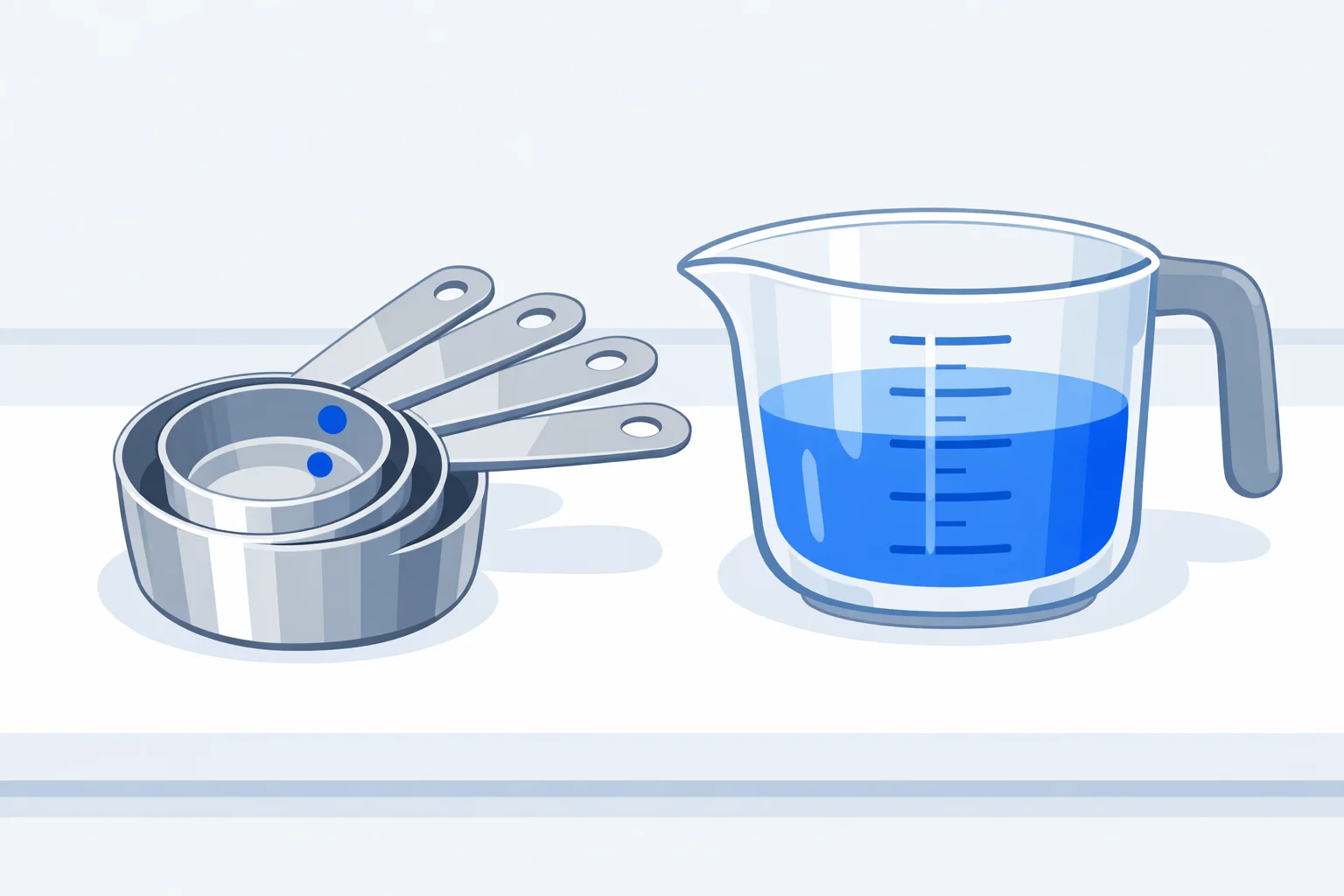
A standard nested measuring set has five cups: ¼, ⅓, ½, ⅔ and 1 cup. Most recipes are written around those exact fractions, so it helps to know each one's fluid-ounce value cold. Multiply the fraction by 8 and you get it:
- ¼ cup = 2 fl oz (4 tablespoons)
- ⅓ cup = 2.67 fl oz (5 tablespoons + 1 teaspoon)
- ½ cup = 4 fl oz (8 tablespoons)
- ⅔ cup = 5.33 fl oz (10 tablespoons + 2 teaspoons)
- ¾ cup = 6 fl oz (12 tablespoons)
- 1 cup = 8 fl oz (16 tablespoons)
The two odd ones out are ⅓ and ⅔. They land on 2.67 and 5.33 fl oz because eight doesn't divide evenly into thirds — a detail that trips up anyone trying to scale a recipe with a liquid measuring jug marked only in whole and half ounces. If you live in milliliters more than ounces, our cups to milliliters converter handles the same fractions on the metric side, where ⅓ cup is a tidier 78.9 mL.
When "Ounces" Means Weight, Not Volume
Here's where a single number stops working. A weight ounce is a fixed mass — 28.35 grams — so how many ounces a cup contains depends entirely on the ingredient's density. Run the four staples bakers reach for most:
- All-purpose flour: 1 cup ≈ 120 g = 4.2 oz. Light and airy, so a cup weighs barely half of what you'd guess.
- Granulated sugar: 1 cup ≈ 200 g = 7.1 oz. Denser than flour, close to but not quite 8.
- Butter: 1 cup ≈ 227 g = 8.0 oz. The happy coincidence that keeps the "cup = 8 oz" myth alive.
- Honey: 1 cup ≈ 340 g = 12.0 oz. Half again heavier than water because it's a concentrated sugar syrup.
Same one cup, anywhere from 4.2 to 12 ounces of weight. The formula is ounces = cups × (the ingredient's ounces per cup). When precision really matters — laminated doughs, macarons, anything with chemistry — skip ounces and weigh in grams instead. Our cups to grams chart lists per-cup weights for more than fifty ingredients.
Worked Example: Halving a Recipe Listed in Cups
Say a loaf recipe calls for 1½ cups of flour, ¾ cup of sugar and 1 cup of water, and you want to halve it and weigh everything on a scale that reads ounces. Cutting the volumes in half gives ¾ cup flour, ⅜ cup sugar and ½ cup water. Now convert each to weight:
- Flour: ¾ cup × 4.2 oz per cup = 3.2 oz (about 90 g).
- Sugar: ⅜ cup × 7.1 oz per cup = 2.7 oz (about 75 g).
- Water: ½ cup of liquid = 4 fl oz, which weighs 4.2 oz (water is the one case where fluid and weight nearly match).
Notice the water trap: half a cup of water is 4 fluid ounces by volume but 4.2 ounces by weight, because a fluid ounce of water weighs about 1.04 oz. The gap is tiny here, but on a full quart it grows to nearly an ounce. For dry ingredients like the flour and sugar, there is no shortcut — you have to run each through its own density.
Fractional Cups to Fluid Ounces
This is the lookup most cooks want at a glance: every common measuring-cup fraction in fluid ounces, tablespoons and milliliters. It assumes the US customary cup of 236.6 mL — the standard NIST Office of Weights and Measures uses for US recipe measures.
| Cups | Fluid ounces | Tablespoons | Milliliters |
|---|---|---|---|
| ¼ cup | 2 fl oz | 4 tbsp | 59 mL |
| ⅓ cup | 2.67 fl oz | 5.3 tbsp | 79 mL |
| ½ cup | 4 fl oz | 8 tbsp | 118 mL |
| ⅔ cup | 5.33 fl oz | 10.7 tbsp | 158 mL |
| ¾ cup | 6 fl oz | 12 tbsp | 177 mL |
| 1 cup | 8 fl oz | 16 tbsp | 237 mL |
| 1½ cups | 12 fl oz | 24 tbsp | 355 mL |
| 2 cups | 16 fl oz | 32 tbsp | 473 mL |
What One Cup Weighs, Ingredient by Ingredient
When the recipe means weight ounces, this is the table that matters. It shows what a single level cup of each common ingredient weighs in ounces, drawn from King Arthur Baking and USDA FoodData Central reference weights.
| Ingredient | 1 cup in ounces | 1 cup in grams |
|---|---|---|
| Water | 8.35 oz | 237 g |
| All-purpose flour | 4.23 oz | 120 g |
| Granulated sugar | 7.05 oz | 200 g |
| Brown sugar (packed) | 7.51 oz | 213 g |
| Powdered sugar | 3.99 oz | 113 g |
| Butter | 8.01 oz | 227 g |
| Honey | 11.99 oz | 340 g |
| Rolled oats | 3.14 oz | 89 g |
| Cocoa powder | 2.96 oz | 84 g |
The spread tells a story. Light powders — flour, powdered sugar, oats, cocoa — sit between 3 and 4.2 oz per cup, well under the fluid-ounce figure. Dense ingredients like honey climb to 12 oz. Butter parks almost exactly on 8 oz, which is the single reason the "a cup is 8 ounces" shortcut survives at all. For a one-stop tool that juggles all these units, the all-in-one cooking converter moves between cups, ounces, grams and spoons together.
The Cup-to-Ounce Slip-Ups That Sink a Bake
Nearly every cups-to-ounces error comes from mixing up the two ounce types. The three that cause the most damage:
- Treating a packaged weight as fluid ounces.A recipe wants 8 oz of cream cheese, you read it as 8 fluid ounces and reach for a measuring jug. Cream cheese is sold by weight — 8 oz is about 1 cup, but measuring 8 fl oz of it by volume undershoots, because it's denser than water.
- Scaling ⅓ and ⅔ as if they were clean ounces.Doubling ⅔ cup and calling it "about 5 fl oz" instead of 5.33 fl oz drops roughly a third of an ounce per cup — enough to throw off a custard or a cocktail batch.
- Converting flour by the 8-ounce rule.Assuming 1 cup of flour is 8 oz and weighing that out gives you nearly two cups of flour (8 ÷ 4.2 = 1.9). That's double the flour the recipe wanted — a guaranteed dry, dense brick.
When to Trust the 8 oz Rule and When to Weigh
Lean on "cup = 8 fluid ounces" whenever you're measuring liquids: water, milk, broth, juice, oil. Pour to the line on a jug and the volume is exact, no scale required. It also holds for butter, which happens to weigh 8 oz per cup, so a cup of butter really is 8 ounces either way. If you only need to undo the conversion, our ounces to cups converter runs it the other direction.
Reach for a scale the moment dry weight enters the picture — flour, sugars, cocoa, nuts, chocolate. Scooping a "cup" of flour can vary from 4.2 oz spooned to 5.5 oz packed, a 30% swing that ruins consistency between bakes. Weighing in ounces (or better, grams) removes that variable entirely, which is why every serious baking book now lists weights alongside cups.