Brown Sugar Cups to Grams: Why Packing Decides the Weight
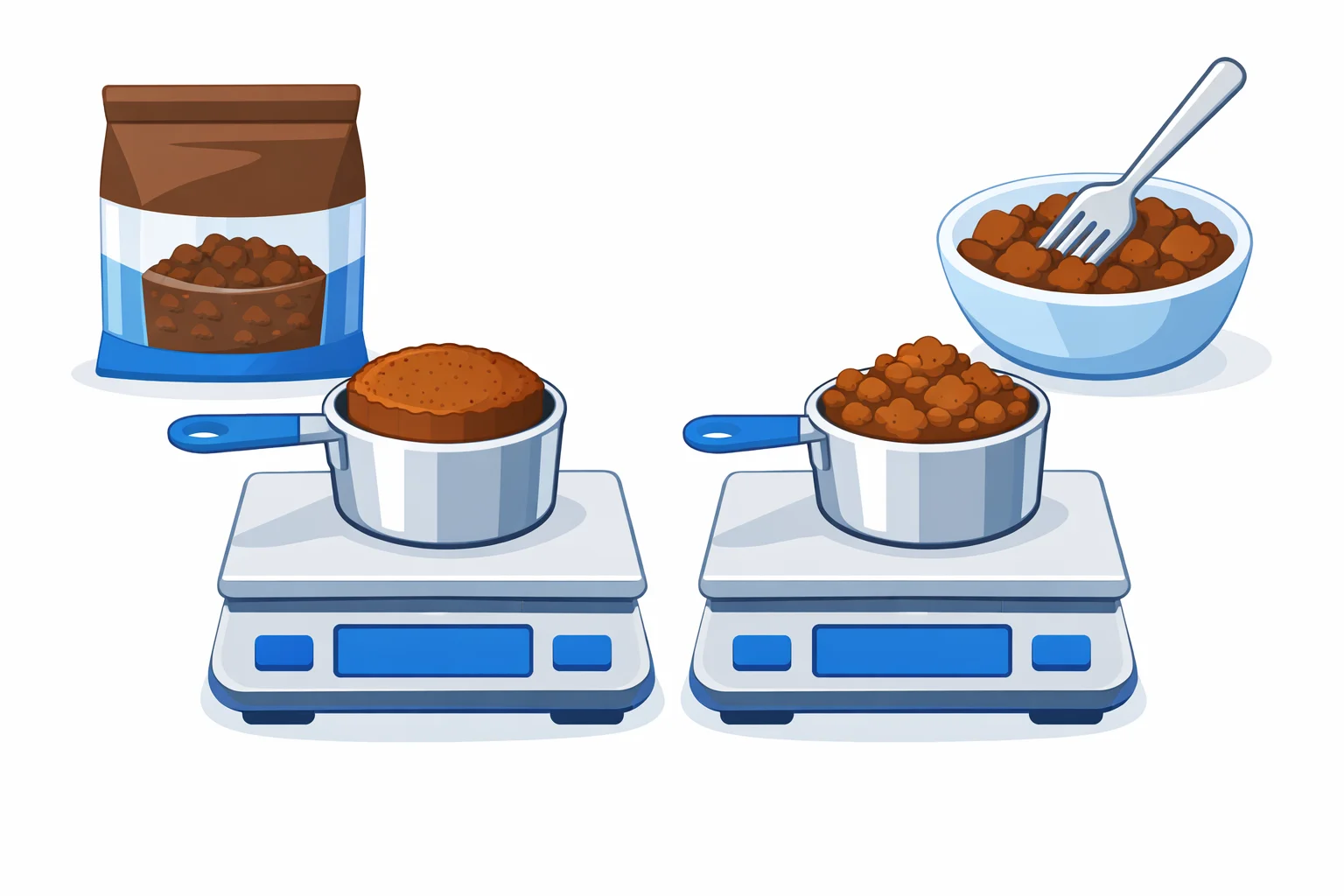
Converting cups to grams of brown sugar isn't one number — it's three, and the difference between them can sink a recipe. A firmly packed cup weighs 220 grams. Press it only lightly and you're down to about 185 g; spoon it in loose without pressing and a "cup" holds just 145 g. That's a 75-gram spread from the exact same measuring cup, all because brown sugar behaves more like wet sand than a free-flowing powder. The converter above lets you pick a packing level and read the real weight. This guide explains which number your recipe actually wants and why getting it wrong shows up in the finished bake.
Why Packing Decides the Weight
Brown sugar is just white sugar crystals coated in a film of molasses. That sticky film makes the crystals cling together and trap air pockets, so a cup loosely filled is honeycombed with gaps. Press down and those gaps collapse — you can fit dramatically more sugar into the same volume. White granulated sugar doesn't do this; its dry crystals settle to a consistent 200 g per cup no matter how you scoop. Brown sugar's compressibility is exactly why recipes specify "packed," and why a volume measurement alone is unreliable. A scale sidesteps the whole problem.
Packed, Lightly Packed, and Loose: Three Numbers
Here are the weights worth memorizing for a single cup. Firmly packed is 220 g — the USDA figure and the universal recipe default. Lightly packed lands near 185 g, which is what most home cooks produce when they fill a cup and give it a casual press. Loose, spooned-in sugar comes to about 145 g and shows up only in the rare recipe that says "loosely packed."
| Packing level | Grams per cup | vs. packed |
|---|---|---|
| Firmly packed (default) | 220 g | — |
| Lightly packed | 185 g | 16% less |
| Spooned / loose | 145 g | 34% less |
The takeaway: when a recipe just says "1 cup brown sugar" with no qualifier, it means packed. That convention is so standard that professional test kitchens treat "packed" as implied. If you want the granulated comparison, our cups to grams white sugar converter shows why white sugar avoids this packing problem entirely.
Do Light and Dark Brown Sugar Weigh the Same?
They do, and this trips people up. The only real difference between light and dark brown sugar is molasses content — light runs around 3.5% molasses, dark closer to 6.5%. That extra molasses deepens the color and the toffee flavor and adds a touch more moisture, but it's a tiny fraction of the total mass. Both pack to roughly 220 g per cup. So you can convert either one with the same numbers and swap them gram-for-gram in any recipe; you'll taste the difference, but the scale won't see it.
How to Pack a Cup the Way Recipes Mean
If you don't have a scale, technique is everything. Spoon brown sugar into a dry measuring cup, then press it down firmly with the back of a spoon or your fingers. Add more, press again, and level the top. The classic test: when you turn the cup over, properly packed sugar holds the cup's shape like a sandcastle for a second before crumbling. If it just spills out, you under-packed it and your 220 g is really closer to 170 g. This is fiddly and inconsistent between bakers, which is the whole argument for weighing — set the bowl on the scale, tare to zero, and pour until it reads 220 g. No pressing, no guesswork, no cup to wash.
Worked Example: Doubling a Cookie Recipe
Say a chocolate chip recipe calls for ¾ cup packed brown sugar and you want to double it. Work in grams:
- ¾ cup packed = 0.75 × 220 = 165 g for a single batch.
- Double it: 165 × 2 = 330 g of brown sugar.
- Compare that to scooping two loose ¾ cups: 0.75 × 145 × 2 = 218 g— you'd be 112 g short, more than a third of the sugar the recipe needs.
That shortfall isn't hypothetical. It's the gap between chewy, spread-out cookies and pale, cakey ones that never caramelize properly. Weighing 330 g once is faster and more reliable than packing six separate cups. If your recipe also lists flour and butter in cups, run the lot through the all-ingredient cups to grams chart rather than converting each line by hand.
What 75 Grams Does to a Batch of Cookies
Brown sugar isn't just sweetness — it's structure and moisture. Its molasses is mildly acidic, so it reacts with baking soda to help cookies rise and brown, and it's hygroscopic, meaning it pulls in water and keeps the crumb soft. Get 145 g when the recipe wanted 220 g and three things shift at once: less sweetness, weaker browning, and a drier, more cake-like texture because there's less sugar to hold moisture. In caramel or toffee, where sugar ratios are exact, a 34% miss can mean the difference between a smooth chew and a grainy seize. The same logic applies to syrups and glazes; for liquid sweeteners, our grams to tablespoons converter handles the small-volume math.
Weighing Brown Sugar That's Gone Hard
Brown sugar hardens when its molasses moisture evaporates and the crystals lock together into a brick. A rock-hard lump measures terribly by volume — it traps huge air gaps and resists packing — but a scale doesn't care about texture. Break the block up first, though, because chunks bridge across the cup and throw off both volume and the feel of a "packed" cup. The fastest fix: microwave the sugar beside a damp paper towel in 20-second bursts until it softens, or set a slice of bread in the bag overnight. Once it's loose, 220 g per packed cup holds true again. This is one more case where weighing wins — a scale reads the real mass whether the sugar is fresh, soft, or recently revived from a brick.
Where Brown Sugar Conversions Slip
Three errors account for most bad batches. First, assuming "1 cup" means a loosely filled cup — it almost never does, so an unpacked scoop leaves you 35–75 g short per cup. Second, treating brown and white sugar as identical by volume: white is 200 g per cup and brown is 220 g packed, so substituting cup-for-cup quietly changes the sugar load by 10% on top of the flavor and moisture differences. Third, packing inconsistently across a recipe — pressing hard for the first cup and gently for the second means your two "cups" might differ by 40 g, which is invisible until the bake comes out wrong.
For the underlying gram weights, the USDA FoodData Central database lists packed brown sugar at about 220 g per cup — the figure this converter and every number here is built on. Nail the packing question and brown sugar stops being the wild card in your recipe. To carry the same precision across the rest of your ingredients, keep the all-in-one cooking converter open in the next tab.