Honey Cups to Grams: Why Honey Weighs More and How to Measure It
Converting cups to grams of honey trips people up because honey is the heaviest thing in the cupboard: one cup weighs about 340 grams. Picture the scene — you tip honey into a measuring cup, and half of it stays welded to the sides when you try to pour it out. That stickiness is exactly why a scale beats a cup for honey, and why the number surprises bakers used to flour and sugar. The converter above gives you the exact grams; this guide explains where 340 comes from, how to measure honey without losing a spoonful to the cup, and how to swap it in for sugar without ruining the texture.
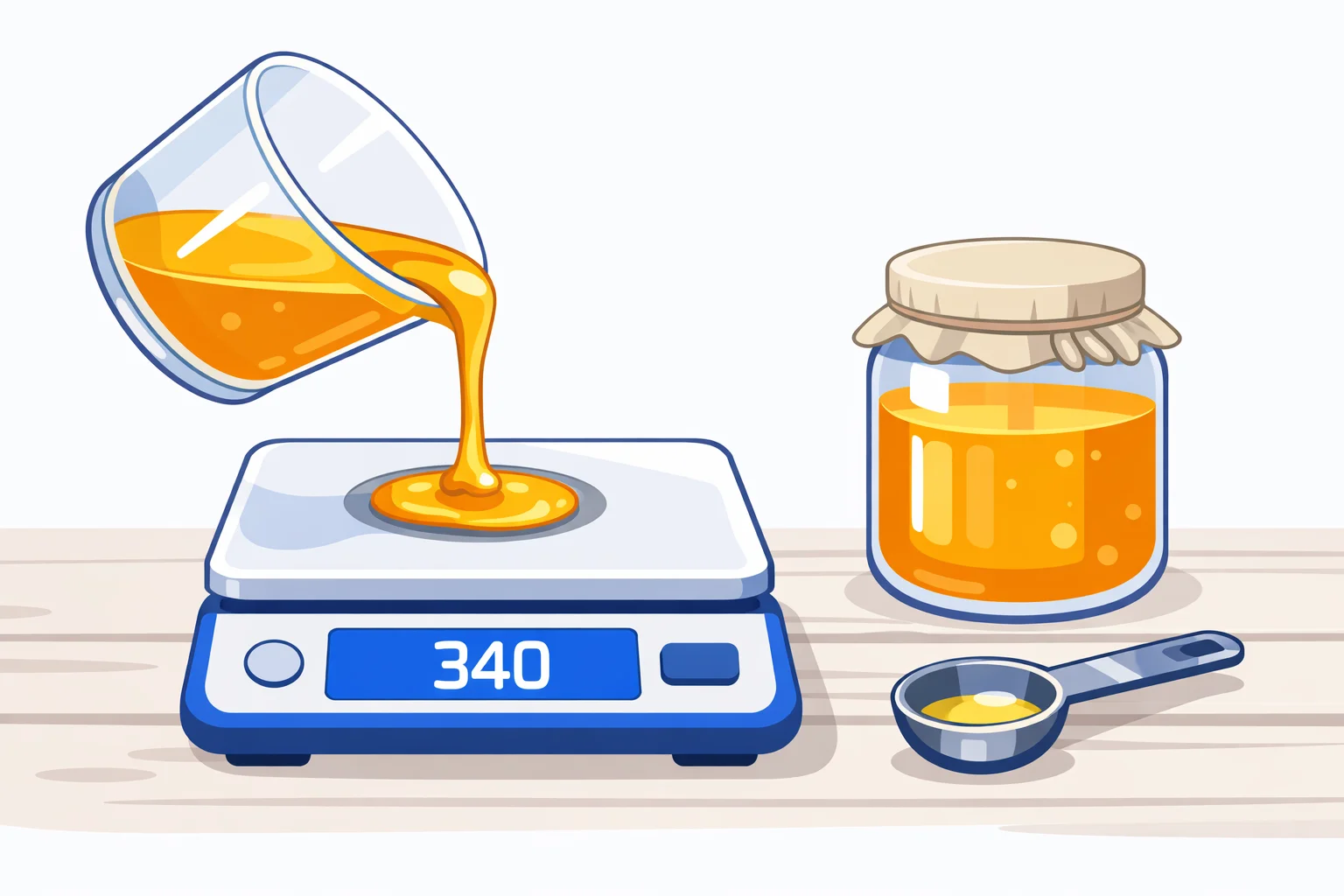
340 Grams a Cup: The Densest Pour in the Pantry
A US cup is a fixed 240 millilitres of space. What you put in it decides the weight, and honey wins by a mile. Its density sits around 1.42 g/mL, so 240 mL × 1.42 lands at roughly 340 g. Compare that to water at 240 g, maple syrup at 322 g, and granulated sugar at just 200 g per cup. Honey beats table sugar by 140 grams in the same volume — a 70% jump. The reason is simple: sugar in a cup is loose crystals with air gaps between them, while honey is those same sugars already dissolved into a gap-free liquid. No air, no wasted space, more mass. The 340 g figure tracks the volume-to-weight data in USDA FoodData Central, which lists a cup of honey at about 339 grams.
The Sticky-Cup Problem Weighing Solves
Honey's viscosity is the practical headache. When you measure ½ cup of honey and scrape it into a bowl, anywhere from 5 to 10 grams stays glued to the cup — that's 3% to 6% of the honey gone before it ever reaches your batter. For a delicate recipe like a glaze or a marinade, that residue throws off the balance. Weighing dodges the problem entirely: zero the scale with the bowl on it, then squeeze honey straight in until it reads the gram target. Nothing gets left behind in a cup because there is no cup. If you do measure by volume, the old trick of coating the cup with a thin film of neutral oil first lets the honey slide out clean.
Honey by the Spoon, Cup, and Jar
Honey scales cleanly because the per-spoon weights are round numbers. Here are the figures worth keeping handy, all based on standard supermarket honey at 340 g per cup.
| Honey amount | Grams | Handy equivalent |
|---|---|---|
| 1 teaspoon | 7 g | a single drizzle |
| 1 tablespoon | 21 g | ≈ 64 calories |
| ¼ cup | 85 g | 4 tablespoons |
| ⅓ cup | 113 g | — |
| ½ cup | 170 g | 8 tablespoons |
| 1 cup | 340 g | ≈ 12 oz jar |
| 1 lb jar | 454 g | about 1⅓ cups |
That last row matters at the store: honey is sold by weight, not volume, so a 12 oz jar holds 340 g — almost exactly one cup. If you need the same precision across the rest of your shopping list, our all-ingredient cups to grams chart covers syrups, sugars, and flours in one place.
Do Raw and Runny Honey Weigh the Same?
Close, but not identical — and the difference comes down to water. Standard filtered honey holds about 17% water and weighs 340 g per cup. Raw, unfiltered honey is usually a touch drier and carries traces of pollen and wax, nudging it to roughly 342 g. Very runny, high-moisture honey (around 20% water) thins out and drops to about 336 g. The spread is only ±4 grams per cup, well within cooking tolerance, so for everyday baking you can treat any honey as 340 g. The variety matters far more for flavor and crystallization speed than for weight.
Trading Sugar for Honey Without Wrecking the Bake
This is where most honey conversions go wrong — people swap it cup-for-cup with sugar and end up with a wet, over-browned mess. Honey is both sweeter and wetter than granulated sugar, so the rule of thumb is ¾ cup honey for every 1 cup sugar. Then three adjustments keep the chemistry honest:
- Cut other liquids by about ¼ cup per cup of honey. Honey is roughly 17% water, so it adds moisture sugar never did.
- Add about ½ teaspoon of baking soda per cup of honey. Honey is mildly acidic (pH around 3.9), and the baking soda neutralizes it so your leavening still works.
- Lower the oven by 25°F (about 15°C).Honey's fructose browns faster than sucrose through the Maillard reaction, so a cooler oven stops the edges scorching before the center sets.
The calculator above runs all four numbers from a single sugar input. For the reverse direction — checking what your sugar weighs before you replace it — the cups to grams sugar converter gives you the baseline. Guidance on these ratios comes from the National Honey Board, which publishes substitution charts for baking.
Worked Example: Converting a Cookie Recipe
Say your cookie recipe calls for 1 cup of granulated sugar plus ½ cup of milk, and you want to use honey instead. Work it step by step:
- Honey to use: 1 cup sugar × 0.75 = ¾ cup honey, which is 0.75 × 340 = 255 g.
- Liquid to remove: ¾ cup honey × 4 tbsp = 3 tbsp. So cut the ½ cup (8 tbsp) of milk down to 5 tablespoons.
- Baking soda to add: ¾ × ½ tsp = about ⅜ teaspoon.
- Bake at 325°F instead of 350°F and start checking 2-3 minutes early.
Skip the liquid cut and you'd be adding 255 g of honey — itself about 43 g of water — on top of a full ½ cup of milk, and the dough spreads into flat, greasy puddles. The 3-tablespoon reduction is what keeps the structure. If you're also scaling the batch up or down, run it through the recipe scaler so every ingredient stays in proportion.
Measuring Honey That Has Crystallized
Crystallized honey is honey that's gone grainy and stiff — completely normal as glucose separates out over time. Here's the catch for measuring: crystallization changes texture, not mass. So 340 grams of crystallized honey is still 340 grams, and weighing it gives the right answer regardless. Volume is the trap. A "cup" of stiff, crystallized honey traps air pockets and packs unevenly, throwing the measurement off by 15 to 20 grams. The fix: gently warm the jar in a bowl of warm (not boiling) water until it flows again, then weigh. Stick to weighing and crystallization never affects your recipe.
Where Honey Conversions Go Sideways
Three errors cause most honey grief. First, the cup-for-cup sugar swap — using a full cup of honey where a recipe wanted a cup of sugar dumps in 140 extra grams of sweetener plus a flood of moisture, and the bake turns dense and damp. Second, ignoring the residue left in the measuring cup; on a small recipe, losing 8 grams of a 85-gram quarter cup is nearly a 10% shortfall. Third, forgetting the oven adjustment — honey-sweetened goods brown noticeably faster, and bakers who keep the original temperature end up with dark edges and raw middles. Weigh your honey, make the three swap adjustments, and the conversion stops being a gamble. To keep the same precision for butter and flour, keep the cups to grams reference open alongside this one.