Cups of Rice to Grams: The Raw-vs-Cooked Trap That Ruins Dinner
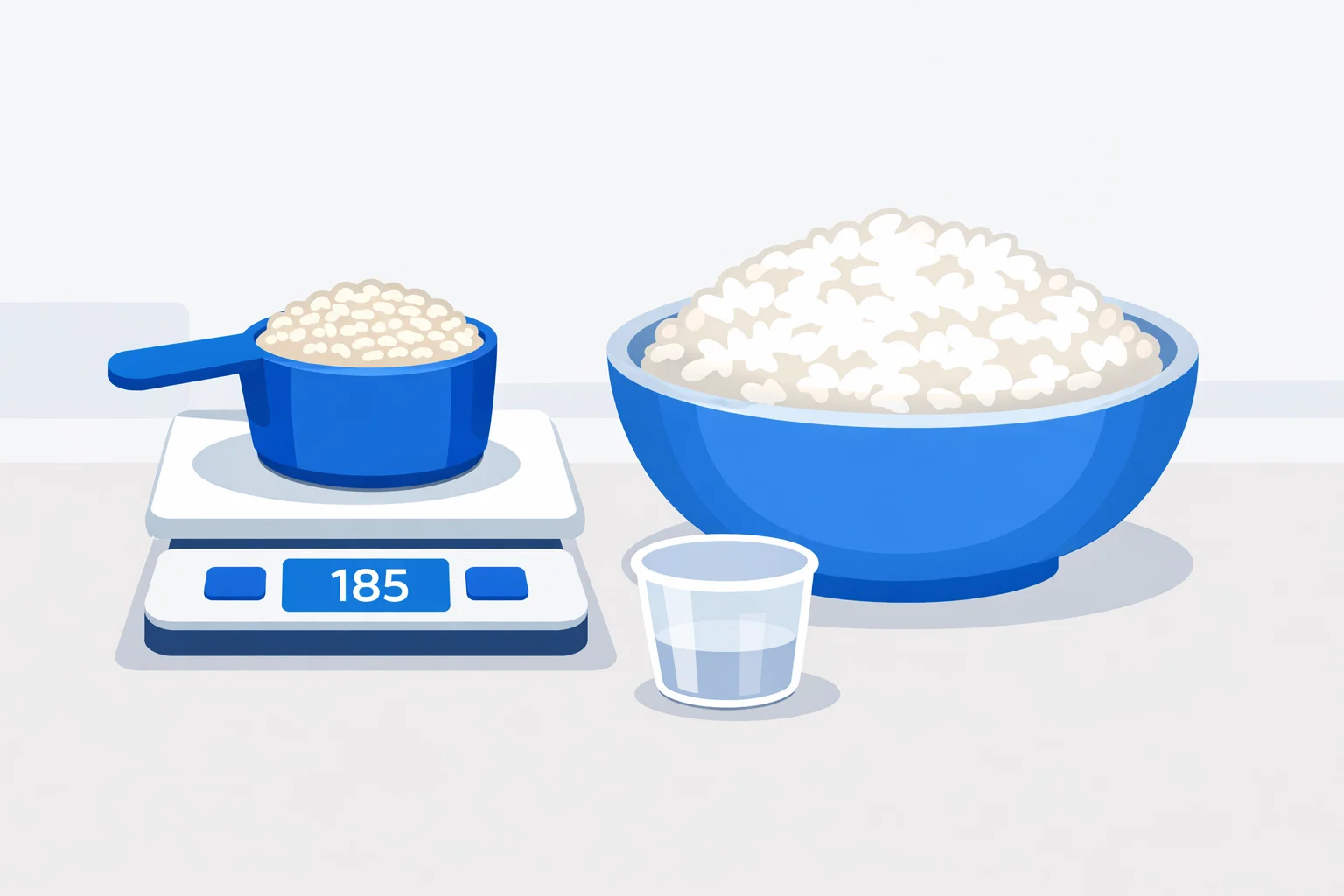
Converting cups of rice to grams trips people up for one reason: a cup of rice doesn't weigh the same before and after it's cooked. One US cup of uncooked long-grain white rice is 185 grams. Cook that same rice and a cup of the fluffed result weighs only about 158g — yet the pot now holds three full cups. So when a recipe says "1 cup of rice," the first question isn't how many grams. It's raw or cooked? The converter above settles both, plus the rice type and even which measuring cup you grabbed.
Why "One Cup of Rice" Has Two Answers
Rice is unusual among pantry staples because it roughly triples in volume when you cook it. Dry grains are dense and hard; once they drink up water and swell, each grain inflates with moisture. A cup of raw rice (185g) absorbs around 1.5 to 2 times its weight in water, finishing near 555g of cooked rice spread across about three cups.
That's why two cooks can read "2 cups of rice" and end up feeding wildly different numbers of people. Measure 2 cups raw and you produce roughly six cups cooked. Measure 2 cups of already-cooked leftover rice and you've got a third as much food. A fried rice recipe almost always means cooked; a rice-cooker recipe almost always means raw. When in doubt, check whether the recipe also lists a water amount — water gets added to raw rice, not cooked.
Gram Weights by Rice Type
Grain shape and starch content change how tightly rice packs into a cup. Slim basmati leaves more air gaps and weighs a little less; squat short-grain rice nestles together and weighs more. Here are the raw and cooked weights for the rices people convert most:
| Rice type | 1 cup raw | 1 cup cooked |
|---|---|---|
| White, long-grain | 185g | 158g |
| Basmati | 180g | 155g |
| Jasmine | 185g | 158g |
| Brown, long-grain | 190g | 195g |
| Short-grain / sushi | 200g | 186g |
| Arborio (risotto) | 200g | 200g |
| Parboiled / converted | 182g | 165g |
| Wild rice | 160g | 164g |
Notice brown rice flips the usual pattern. Raw, it's barely heavier than white. But cooked, a cup of brown rice (195g) outweighs cooked white (158g) by a clear margin, because the bran keeps the grains firm and dense instead of fluffing apart. If you're weighing several ingredients at once, our full cups-to-grams ingredient chart covers rice alongside grains, sugars and flours in a single table.
The 3x Rule: How Rice Grows in the Pot
A handy shortcut: white rice roughly triples by weight and volume. Start with 100g raw, finish near 300g cooked. Start with 1 cup raw, finish near 3 cups cooked. It's not exact for every grain, and the spread is worth knowing:
- Parboiled rice expands most — about 3.2 cups cooked per raw cup — because pre-steaming hardens the grain so it drinks water without bursting.
- Long-grain white, basmati and jasmine land near the classic 3x.
- Short-grain and arborio expand least, around 2.4 to 2.5x, since their high surface starch makes them clump rather than separate.
- Brown rice yields about 2.7x and takes longer to get there — the bran slows water absorption.
This is the number that quietly wrecks meal planning. If a casserole calls for 4 cups cooked rice and you measure 4 cups raw, you'll end up with 12 cups — enough for a small army. To scale a whole dish without doing this math by hand, the recipe scaler adjusts every ingredient together.
The 180 mL Rice-Cooker Cup Nobody Warns You About
Here's a trap that sends people to the internet at dinnertime: the little plastic cup that comes with a rice cooker is not a US cup. It's the Japanese go (合), a traditional unit equal to 180 mL— only about three-quarters of a US measuring cup's 236 mL. A level rice-cooker cup of raw white rice weighs roughly 150g, not 185g.
This matters because the water lines printed inside the cooker's bowl are calibrated to that 180 mL cup. Fill the cup with rice, level it, dump it in, then add water to the matching line — the system only works if you use the cooker's own cup. Measure your rice with a US cup but fill water to the cooker line and the ratio drifts, leaving rice that's either gummy or undercooked. The metric cup used in the UK, Australia and the EU adds the opposite twist: at 250 mL it's about 6% larger than a US cup, so a "cup" of rice there is closer to 196g. Switch the measuring-cup setting in the tool to see exactly what your scoop weighs.
Worked Example: Hitting a Cooked-Rice Target
Say a stir-fry recipe wants 4 cups of cooked riceand you're starting from dry jasmine. You can't measure 4 raw cups — you'd overshoot massively. Work backward using jasmine's 3.0x yield:
- Raw cups needed = cooked cups ÷ yield
- Raw cups = 4 ÷ 3.0 = 1.33 cups (about 1⅓ cups)
- In grams = 1.33 × 185 = 247g of dry jasmine rice
So 247g of raw jasmine — a touch under 1⅓ cups — cooks into the 4 cups the recipe wants. The tool does this in reverse automatically: switch the toggle to Cooked, type 4, and it shows the raw grams to start with. For converting the soy sauce, oil and other small amounts in the same recipe, the grams to teaspoons converter handles the seasonings.
How Much Raw Rice Per Person
Portioning rice by grams beats eyeballing every time. As a side dish, plan on 50–60g of raw rice per person, which cooks to about a cup each. As the main event — a biryani or a rice bowl — bump that to 75–90g raw. A single 185g cup of dry rice therefore stretches to three or four side portions, or feeds about two as a main.
The classic restaurant ratio is one loose fistful — roughly 75g — per adult. According to the USDA FoodData Central database, a cup of cooked white rice (158g) carries about 205 calories, so a 60g raw side portion lands near 200 calories cooked — useful if you're tracking intake rather than just feeding a crowd.
When Weighing Rice Actually Matters
You don't need a scale for a casual pot of rice — the cup-and-water-line method is fine for a weeknight. Weighing pays off in three spots: sushi rice, where the rice-to-vinegar ratio is exact; risotto, where 320g of arborio feeds four precisely; and calorie tracking, where a guessed scoop can be off by 80 calories. For everything else, scoop away.
The smartest habit is to weigh your dry rice once, note what your usual scoop comes to, and trust that number afterward. Keep this converter handy when a recipe and your measuring cup disagree about what a "cup" means — pick your rice, set raw or cooked, match your real cup, and you'll get the gram weight that's genuinely in the pot.