Cups to Grams of Milk: Why the Carton You Grab Changes the Number
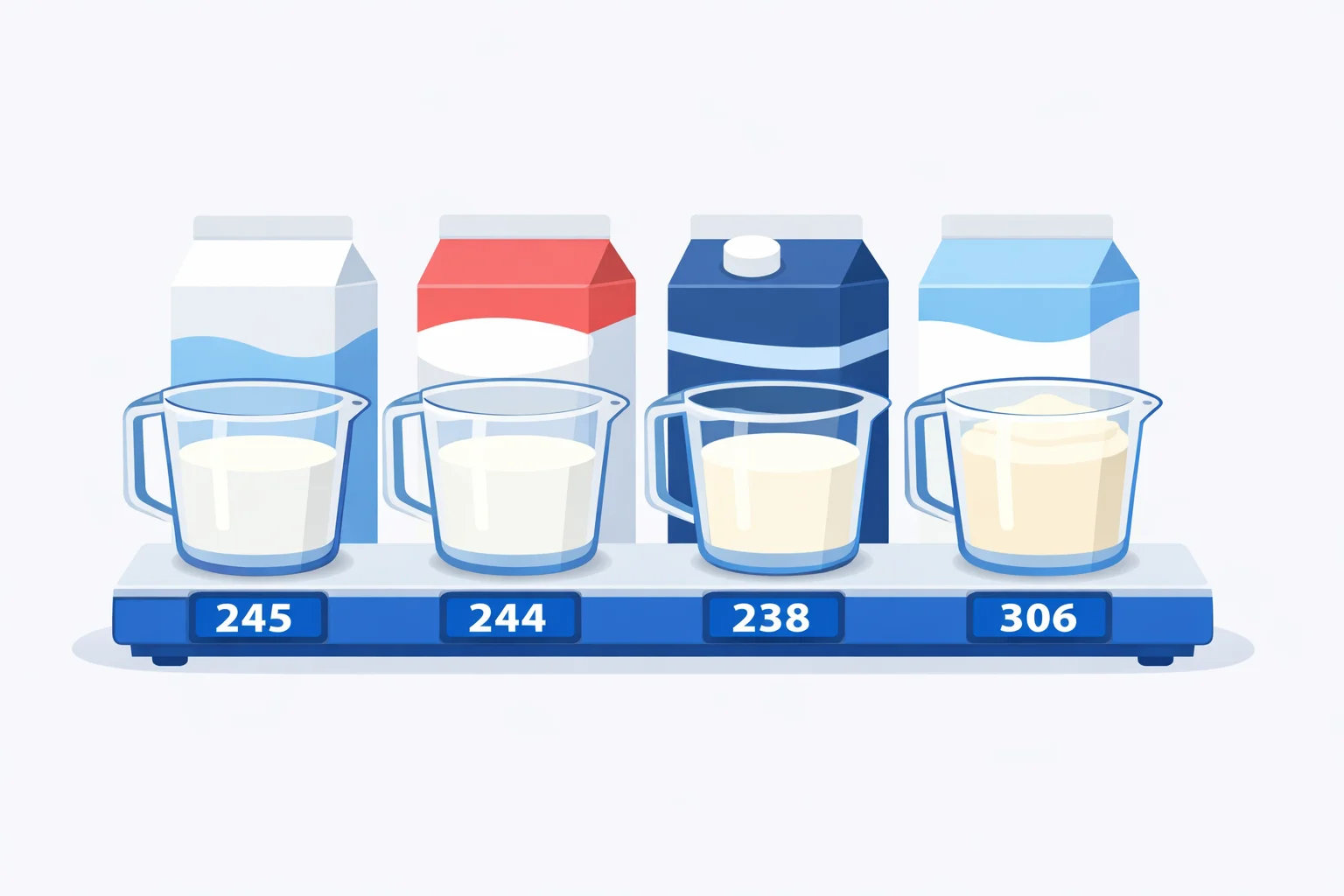
Converting cups to grams of milk looks like one tidy number, until you learn that a cup of skim milk weighs slightly morethan a cup of whole milk. Not less. Skim is 245 grams, whole is 244 — and that's before you even reach cream or condensed milk, where the spread blows wide open. The real answer depends entirely on which carton you pulled from the fridge. The converter above sorts it out: pick your milk, get the exact grams. This guide explains why the weights land where they do and where guessing the wrong dairy can quietly sink a recipe.
A Cup Is Fixed Volume, Not Fixed Weight
A US cup is defined as exactly 240 millilitres — a measure of space, not mass. Pour 240 mL of any liquid and you've got one cup, full stop. What changes from one milk to the next is density: how many grams that fixed 240 mL of space holds. Water sits at 1.000 g/mL, so a cup of water is 240 g. Milk runs a touch heavier than water because of dissolved milk solids — proteins, lactose, and minerals — which is why a cup of milk beats a cup of water by a few grams. Every figure on this page is just density multiplied by 240 mL, then rounded.
Why Skim Outweighs Whole (Yes, Really)
Butterfat is lighter than water — about 0.9 g/mL against water's 1.0. So when whole milk carries 3.25% fat, a slice of every cup is occupied by something less dense than the liquid around it, pulling the total weight down. Strip that fat out for skim milk and the remaining liquid is denser, so it weighs marginally more. The gap is tiny — 245 g for skim versus 244 g for whole, with 1% and 2% sitting right between at 245 g — but the direction catches people off guard. "Richer" reads as "heavier" in our heads, and for milk it's backwards. For drinking milks the practical takeaway is simple: treat them all as 245 g per cup and move on.
The Gram Weights, Milk by Milk
Here's every common dairy pour at one cup, ordered from lightest to heaviest. Note how the drinking milks cluster within a single gram, then the canned milks pull dramatically away.
| Dairy (1 cup / 240 mL) | Grams | vs whole milk |
|---|---|---|
| Heavy / whipping cream (36% fat) | 238 g | 6 g lighter |
| Light / coffee cream | 240 g | 4 g lighter |
| Half-and-half | 242 g | 2 g lighter |
| Whole milk (3.25%) | 244 g | — |
| Skim / 1% / 2% / buttermilk | 245 g | 1 g heavier |
| Evaporated milk | 252 g | 8 g heavier |
| Sweetened condensed milk | 306 g | 62 g heavier |
If your recipe lists several dairy items in cups, it's faster to run the lot through our all-ingredient cups to grams chart than to convert each line by hand.
Where the Numbers Break From the Pack
The two canned milks are the ones worth memorizing because they're so far from the herd. Evaporated milk is regular milk with roughly 60% of its water boiled off, which concentrates the solids and pushes a cup to about 252 g. Sweetened condensed milk does the same reduction andadds a heap of sugar — close to 45% of its weight — so its density climbs to around 1.29 g/mL and a cup hits 306 g. That's why a standard 14-ounce can holds about 397 g, or just over 1¼ cups. Cream runs the opposite way: the more butterfat you whip in, the lighter the cup, because fat keeps displacing heavier water. Heavy cream at 238 g is the lightest pour on the chart for exactly that reason.
Worked Example: A Custard That Needs Exact Liquid
Say you're making a baked custard that calls for 2 cups of whole milk and ½ cup of heavy cream, and your scale is faster than wrangling a wet measuring cup. Work it in grams:
- 2 cups whole milk = 2 × 244 = 488 g.
- ½ cup heavy cream = 0.5 × 238 = 119 g.
- Total dairy to weigh into the bowl: 488 + 119 = 607 g.
Now watch what a wrong assumption does. If you'd treated that ½ cup of cream as if it weighed the same as condensed milk (306 g/cup), you'd have poured 153 g — 34 grams of extra liquid, plus a flood of sugar that never belonged in a savory custard. Weighing the right dairy keeps the set of the custard predictable. If you need the cream in small splashes instead, our tablespoons to millilitres converter handles the spoon-level math.
Millilitres vs Grams: When Each One Wins
Because milk is mostly water, you can often get away with treating millilitres and grams as interchangeable — but only for thin milks. A cup of drinking milk is 240 mL and 244-245 g, so the two numbers sit within 2%. For condensed milk that shortcut falls apart: 240 mL weighs 306 g, a 28% gap. So measure thin milks by volume when you're pouring into a jug, and weigh the thick canned milks every time. If you only need a clean volume figure rather than weight, the cups to millilitres converter skips the density question entirely.
A Quick Word on Oat, Almond, and Soy
Plant milks were designed to pour like dairy, so they land close. Unsweetened almond milk is the lightest at about 240 g per cup — basically water, since it's mostly water with a little almond. Soy milk sits near 243 g, and oat milk runs 245-250 g depending on how much oil and added sugar the brand uses. The spread between plant milks is wider than between dairy milks, so when a recipe's liquid balance is delicate, check the specific carton rather than assuming one number covers them all. For everyday baking, 240-245 g per cup is close enough for any unsweetened plant milk.
The Swaps That Quietly Wreck a Recipe
Three mix-ups cause most milk-conversion grief. First, swapping evaporated and sweetened condensed milk because the cans look alike — that's a 54-gram weight difference per cup plus a massive sugar change, and it turns a savory sauce into dessert or a fudge into soup. Second, assuming heavy cream is heavier than milk because it's "thicker" — it's actually 6 g lighter per cup, so recipes that rely on weighed cream get thrown off if you guess upward. Third, mixing up the 240 mL US cup with the older 236.6 mL customary cup; the 1.4% difference is invisible for a splash of milk but adds up across a big batch of liquid.
For the underlying densities, the USDA FoodData Central database lists volume-to-weight figures for every milk and cream on this page — the source behind each gram count here. Get the milk type right and the conversion stops being a guess. To keep the same precision across butter, flour, and sugar, keep the all-in-one cooking converter open in the next tab.