Cups of Oats to Grams: Why Steel-Cut Weighs Double Rolled
Converting cups of oats to grams sounds trivial until you notice the catch: a cup of rolled oats weighs about 90 grams, but a cup of steel-cut oats weighs 180 grams — exactly double. They're the same grain in the same cup, yet one packs twice the weight. Reach for the wrong type when a recipe lists grams and your granola bakes greasy or your porridge sets like cement. The converter above settles it in one tap: pick the oat form, choose dry or cooked, and read the real gram weight in the cup.
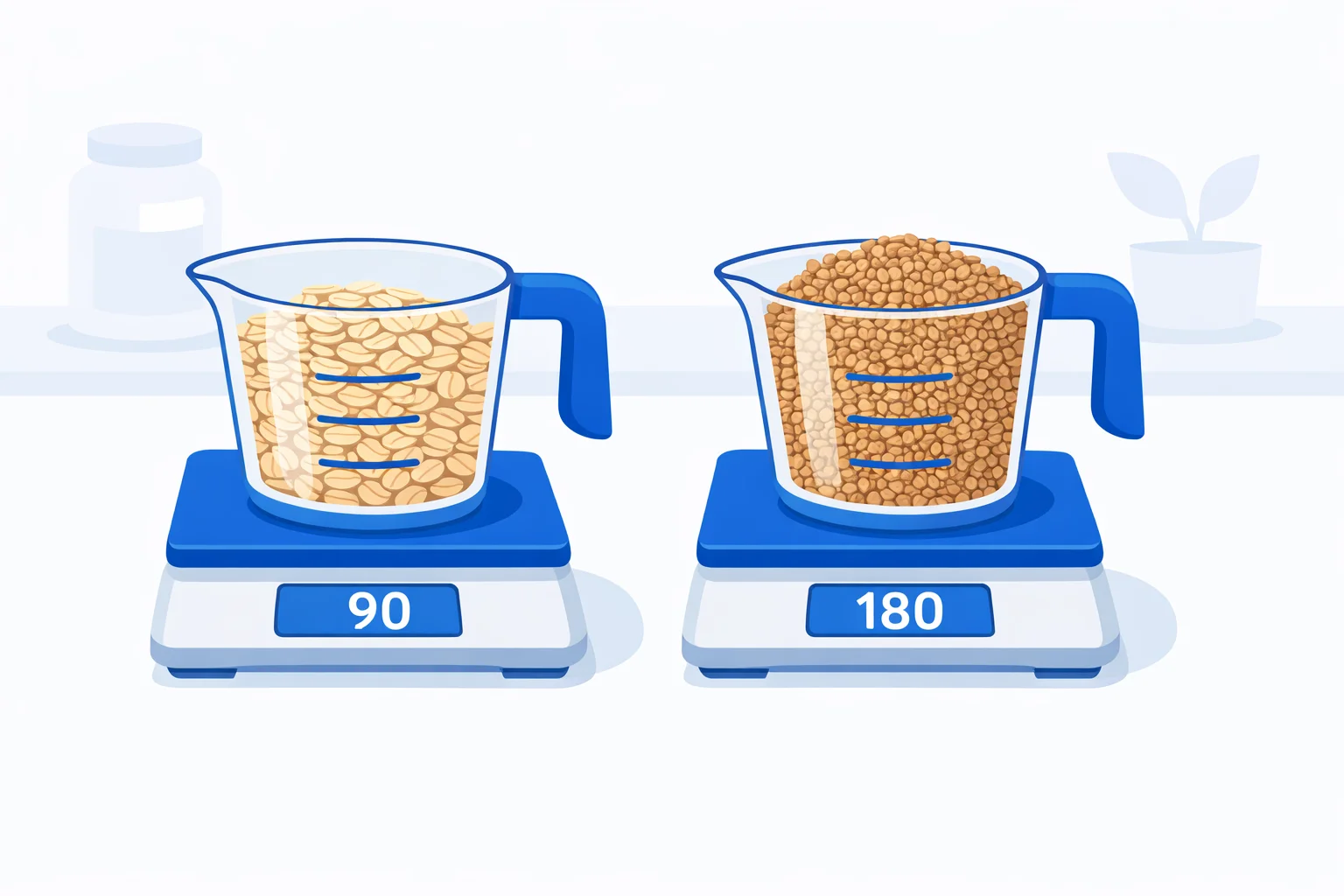
The Same Cup, Double the Weight
Most pantry conversions wobble by a few grams depending on how you scoop. Oats break that rule. The spread between the lightest and heaviest oat product is enormous: instant oats sit near 80g per cup, while whole oat groats hit 190g. That's a 2.4x range for an ingredient most recipes just call "oats."
Why such a gap? Oats are one of the few staples sold in radically different physical shapes. Flour is always powder. Sugar is always crystals. But oats arrive as flat flakes, chopped pinheads, intact grains, or fine ground flour — and each shape fills a cup completely differently. Get the form right and the grams fall into place.
Gram Weights by Oat Type
Here are the dry weights for the oat products people convert most. These assume a level US cup (236 mL), scooped rather than packed:
| Oat type | 1 cup (dry) | ½ cup | Calories / cup |
|---|---|---|---|
| Instant oats | 80g | 40g | 300 |
| Quick oats | 85g | 43g | 326 |
| Rolled / old-fashioned | 90g | 45g | 341 |
| Oat bran | 94g | 47g | 231 |
| Oat flour | 95g | 48g | 384 |
| Steel-cut (Irish) | 180g | 90g | 682 |
| Whole oat groats | 190g | 95g | 739 |
One number jumps out: oat bran carries only about 231 calories per cup versus 341 for rolled oats, even though they weigh almost the same. That's because bran is the fibre-rich outer husk, not the starchy whole grain. If you're tracking macros, swapping bran for rolled oats is a quiet way to cut calories without shrinking the bowl. For weighing several breakfast ingredients at once, our full cups-to-grams ingredient chart lists oats next to nuts, seeds, dried fruit and honey.
Why Flakes Weigh Less Than Whole Grain
It comes down to trapped air. Rolled oats start as whole groats that get steamed soft, then pressed between heavy rollers into flat flakes. Those flakes are stiff and irregular, so when they pile into a cup they bridge and overlap, leaving big air pockets. The result is a cup that's maybe 40% air by volume — hence the light 90g.
Steel-cut oats skip the rolling. The groat is simply sliced into two or three hard pieces on a steel blade. Those dense pinheads behave like tiny gravel: they settle and nest into each other, squeezing out the air. A cup is nearly solid grain, which is why it doubles to 180g. Whole groats — the intact grain, nothing done to it — pack tighter still at 190g. The pattern is simple: the more a process flattens or fluffs the oat, the lighter the cup. Grinding oats into flour partly reverses this, settling near 95g per cup as the powder fills the gaps.
Worked Example: Swapping Steel-Cut for Rolled
Say a baked-oatmeal recipe calls for 2 cups of rolled oatsbut all you have is steel-cut, and you want to keep the same amount of actual oat. Don't measure 2 cups of steel-cut — you'd nearly double the grain. Work in grams instead:
- 2 cups rolled oats = 2 × 90 = 180g of oat
- Steel-cut weighs 180g per cup, so 180g ÷ 180 = 1 cup of steel-cut
So 1 cup of steel-cut replaces 2 cups of rolled by weight. (Texture is another matter — steel-cut won't soften the same way in a baked dish, so this swap works best in long-cooked recipes.) The converter does this instantly: read the grams for your original oat, switch the type, and match the weight. To halve or double the whole recipe afterward, the recipe scaler adjusts every ingredient together.
Serving Sizes and the 90-Gram Calorie Trap
A standard single serving of oats is 40–50g dry— almost exactly half a cup of rolled oats. That cooks into a full bowl and lands around 170 calories before toppings. The trap is rounding a cup up to 100g. A cup of rolled oats is 90g, not 100g, so logging "1 cup = 100g" overstates breakfast by roughly 40 calories. Eat oats daily and that single rounding error adds about 14,000 phantom calories to your tracker over a year.
A full cup (90g) is about 340 calories of dry oats — a genuinely filling, athlete-sized bowl. According to the USDA FoodData Central database, raw oats run about 379 calories per 100g, the figure the tool uses to estimate each scoop. The fix is boring but effective: weigh your oats once, learn what your usual scoop really is, and stop guessing.
Liquid Ratios: From Dry Oats to a Bowl
Dry weight is only half the kitchen question. The other half is how much liquid each oat needs and how much porridge you end up with. Flatter oats drink less and cook fast; denser oats drink more and take longer:
- Rolled oats: 1 part oats to 2 parts water, ready in ~5 minutes, yielding about 2 cups cooked per dry cup.
- Quick oats: roughly 1 to 1.75, done in 2–3 minutes — the thin flakes hydrate fast.
- Steel-cut: a thirsty 1 to 4 ratio, 25–30 minutes of simmering, expanding to about 3.5 cups per dry cup.
- Oat groats: 1 to 3, the longest cook of all at 45–60 minutes.
That's why a half-cup of dry steel-cut (90g) makes a far bigger bowl than a half-cup of rolled (45g) — it both weighs more and expands more. The porridge panel in the tool runs this math for you, showing the millilitres of liquid and the finished volume. If you need to scale that liquid into tablespoons or teaspoons for a single serving, the grams to tablespoons converter handles the small measures.
When Cups Are Fine and When to Weigh
For a casual weekday bowl, a cup is fine — oats are forgiving, and an extra splash of water never ruined breakfast. Weighing earns its keep in three spots: baking, where 90g versus 110g of oats changes how a flapjack or granola sets; calorie tracking, where the 90g-not-100g gap compounds daily; and any recipe that mixes oat types, where cups lie outright about how much grain you actually have.
The habit that saves the most grief is treating "oats" as several different ingredients rather than one. A cup of one form is not a cup of another. Keep this converter open when a recipe and your tub of oats disagree — pick the type, set dry or cooked, and you'll weigh out exactly what the recipe meant, not what the cup pretended.