Teaspoons to mL: The 5 mL Spoon Your Drawer Doesn't Have
A teaspoon is 5 mL — that's the conversion to memorize, and it's the number printed on every medicine label. But here's the catch the search results skip: the spoon in your cutlery drawer almost certainly isn't 5 mL. Real household teaspoons have been measured holding anywhere from about 2.5 mL to over 7 mL. So "teaspoons to mL" has two answers — the textbook 5 mL, and whatever your actual spoon scoops. This converter handles the first; the article explains why the second one matters more than you'd think, especially when you're measuring something stronger than vanilla.
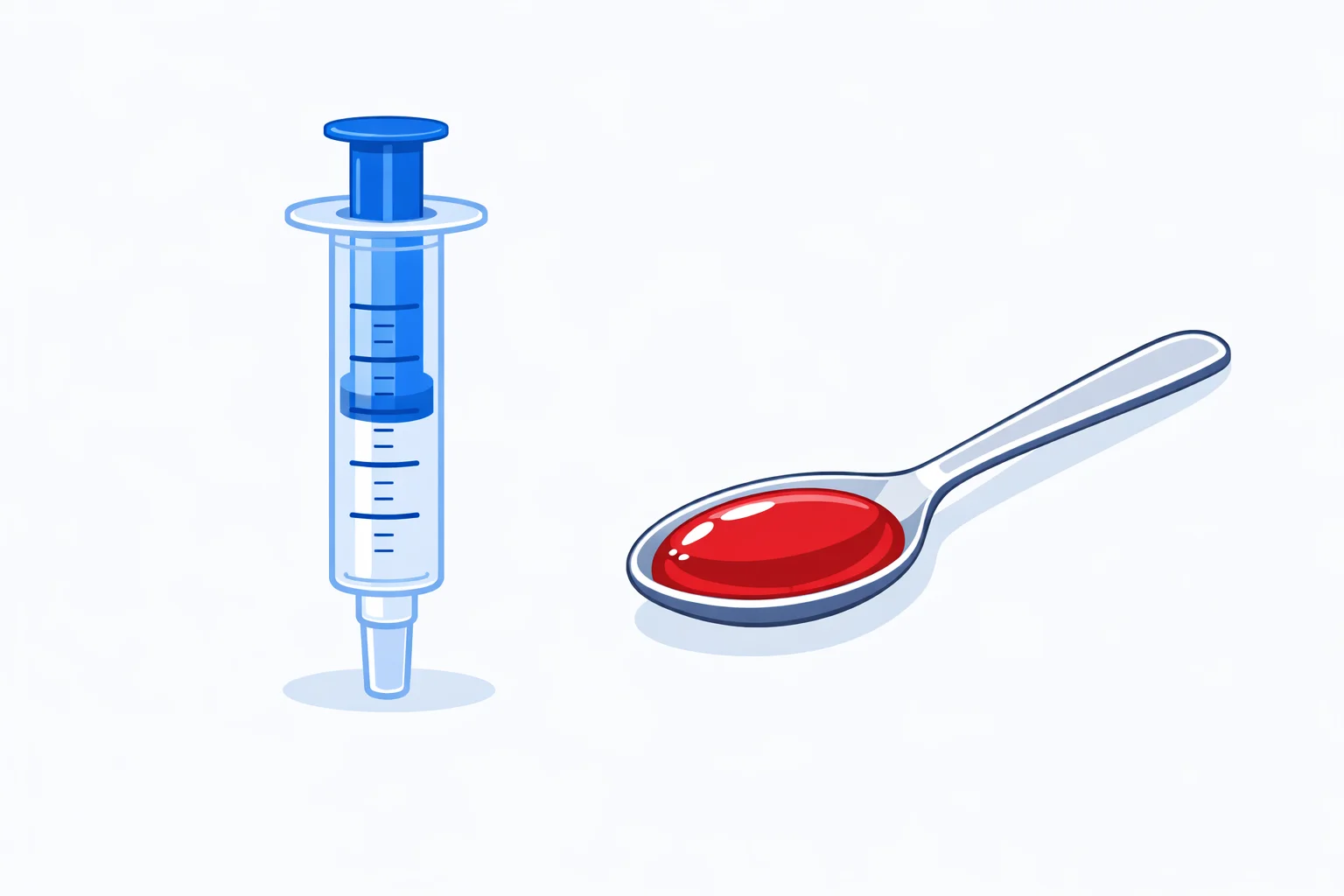
The 5 mL Spoon You Don't Actually Own
The metric teaspoon is defined as exactly 5 mL, full stop. It's the figure the UK, Canada, Australia, New Zealand and the EU all adopted, and it's what regulators put on dosing cups and syringes. So when a recipe or a bottle says "1 teaspoon," it means 5 mL of volume — no ingredient dependence, because volume doesn't care whether you're measuring water, oil or syrup.
The trouble is that "teaspoon" is also the name of an object, and those objects vary enormously. A demitasse spoon might hold 2.5 mL; a soup-style teaspoon can scoop 7 mL or more. That's a 3x spread hiding behind one word. For a sprinkle of cinnamon it's irrelevant. For a dose of medicine, it's the difference between a correct 5 mL and a 40% overdose.
4.93 mL or 5 mL? The Gap That Doesn't Matter
You'll see two numbers quoted for a teaspoon: 5 mL and 4.93 mL. Both are right. The US customary teaspoon is defined as one-third of a US tablespoon, which works out to exactly 4.92892 mL. The metric teaspoon is a clean 5 mL. The difference is 0.07 mL — about one large drop from an eyedropper, and far below what any kitchen spoon can resolve.
So in practice, round to 5 mL and move on. The only time the 4.92892 figure earns its keep is when you're scaling a big batch: 24 US teaspoons is 118.3 mL versus 120 mL with the rounded value — a 1.7 mL gap that still won't change a recipe, but might matter if you're calibrating a measuring device. For the bigger spoon, where the variation is real and dramatic, see our tablespoons to mL converter — a tablespoon ranges from 14.79 mL in the US to 20 mL in Australia.
Why Pharmacists Banned the Kitchen Spoon
Liquid medicine doses are written in teaspoons and milliliters interchangeably: 1 teaspoon = 5 mL, half a teaspoon = 2.5 mL. But pediatric pharmacists spent years watching parents pour doses with cutlery and get them wrong. When a "teaspoon" can be anything from 2.5 to 7 mL, a twice-daily dose can drift 40% high or 50% low without anyone noticing.
That's why the US FDA and the American Academy of Pediatrics now push milliliter-only dosing, and why bottles ship with a marked oral syringe or cup. The syringe isn't fussiness — it's the only way to hit 5 mL reliably. The takeaway for the kitchen is the same: when a small amount of something potent is involved, trust the mL marking, not the spoon's name.
Worked Example: A Child's Cough Syrup Dose
Say a label reads: "Children 6–11 years: 1½ teaspoons every 4 hours, max 4 doses daily." You want to measure it in mL on the supplied syringe. Walk it through:
- 1.5 teaspoons × 5 mL = 7.5 mL per dose. That's your syringe fill.
- Four doses a day: 7.5 × 4 = 30 mL of syrup daily — useful for knowing when the bottle runs out.
- If you only had a 5 mL syringe, that's one full pull plus a half (5 mL + 2.5 mL).
Now the danger case: a parent grabs a regular teaspoon that actually holds 7 mL and fills it 1½ times. That delivers 10.5 mL instead of 7.5 mL — a 40% overdose, repeated four times a day. Same words on the label, wildly different outcome. The 7.5 mL figure on a marked syringe removes the guesswork entirely.
Teaspoons to mL Reference Table
These use the 5 mL standard — the right one for medicine and modern recipes. The fractional rows are the ones people look up most, because that's how doses and small amounts of spices are written.
| Teaspoons | Milliliters (5 mL) | US exact (4.93 mL) | Common use |
|---|---|---|---|
| ¼ tsp | 1.25 mL | 1.23 mL | Pinch of salt, baking soda |
| ½ tsp | 2.5 mL | 2.46 mL | Infant medicine dose |
| ¾ tsp | 3.75 mL | 3.70 mL | Spice measure |
| 1 tsp | 5 mL | 4.93 mL | Vanilla, standard child dose |
| 1½ tsp | 7.5 mL | 7.39 mL | ½ tablespoon |
| 2 tsp | 10 mL | 9.86 mL | Common adult dose |
| 3 tsp | 15 mL | 14.79 mL | 1 tablespoon |
| 6 tsp | 30 mL | 29.57 mL | 1 US fluid ounce |
Two anchors worth memorizing: 3 teaspoons make a tablespoon (15 mL), and 6 teaspoons make a US fluid ounce (about 30 mL). If your recipe gives weight in grams instead of spoons, the conversion depends on the ingredient's density — our grams to teaspoons converter handles that for sugar, salt, flour and more.
The Teaspoon That Stayed Put: Australia's Quirk
Here's a fact that trips up cooks: Australia famously uses a 20 mL tablespoon instead of the usual 15 mL — yet its teaspoon is the standard 5 mL, same as everywhere else. The consequence is pure arithmetic: 20 ÷ 5 = 4, so an Australian tablespoon holds four teaspoons, not three.
This is reassuring if you're converting teaspoons. Whether a recipe is American, British or Australian, "1 teaspoon" means 5 mL. The variation everyone worries about lives in the tablespoon and the cup, not the humble teaspoon. So you can convert teaspoon measures across borders without checking which country wrote the recipe — a rare luxury in cooking conversions.
The Three Spoon Errors That Ruin a Recipe
Teaspoon mistakes are almost never bad math. They're mix-ups of which spoon or which abbreviation. The three that cause real damage:
- Reading "tsp" as "tbsp."They look nearly identical but a tablespoon is three times a teaspoon. Use a tablespoon of baking soda where 1 teaspoon was called for and you've gone from 5 mL to 15 mL — triple the leavener, and a soapy, bitter result.
- Using a cutlery spoon for medicine.A drawer "teaspoon" that holds 7 mL turns a 5 mL dose into a 40% overdose. Always use the marked syringe or cup.
- Heaping instead of leveling. A heaped teaspoon of baking powder can hold 50–100% more than a level one. Recipes assume level spoons, so scrape the top flush with a knife — the difference can flatten or overflow a bake.
When 0.07 mL Is Worth Caring About
Be honest about the stakes. For a teaspoon of soy sauce, lemon juice or olive oil, the difference between 4.93 mL and 5 mL — or even between a 4 mL and a 6 mL spoon — disappears on the plate. Cooking absorbs small volume errors easily, so eyeball it and don't overthink.
Precision starts mattering with three things: medicine, leaveners and extracts. A 5 mL dose measured 40% wrong is a real clinical error. A teaspoon of baking soda that's actually a heaped 8 mL will leave a metallic aftertaste. And almond extract is potent enough that an extra 2 mL can overpower a whole cake. For those, measure the mL — with a syringe for medicine and a level spoon for baking. For everything else, a teaspoon is 5 mL and good enough. If you're juggling spoons, cups and grams in one recipe, the all-in-one cooking converter keeps every unit in one place.