Quarts to Cups: Portioning a Carton Down Without a Mess
Converting quarts to cups is the math you reach for the moment a carton hits the counter. You bought a quart of broth, the recipe wants "2 cups," and now you need to know how much of that box to pour. The answer is built into the unit: 1 quart is exactly 4 cups, so a quart carton holds four level pours and you'd use half of it. No density, no fudge factor, no ingredient lookup — pouring liquids is the one corner of the kitchen where the numbers are truly exact. This guide covers the quick mental math, how to split a quart into servings, and the one quart that isn't 4 cups at all.
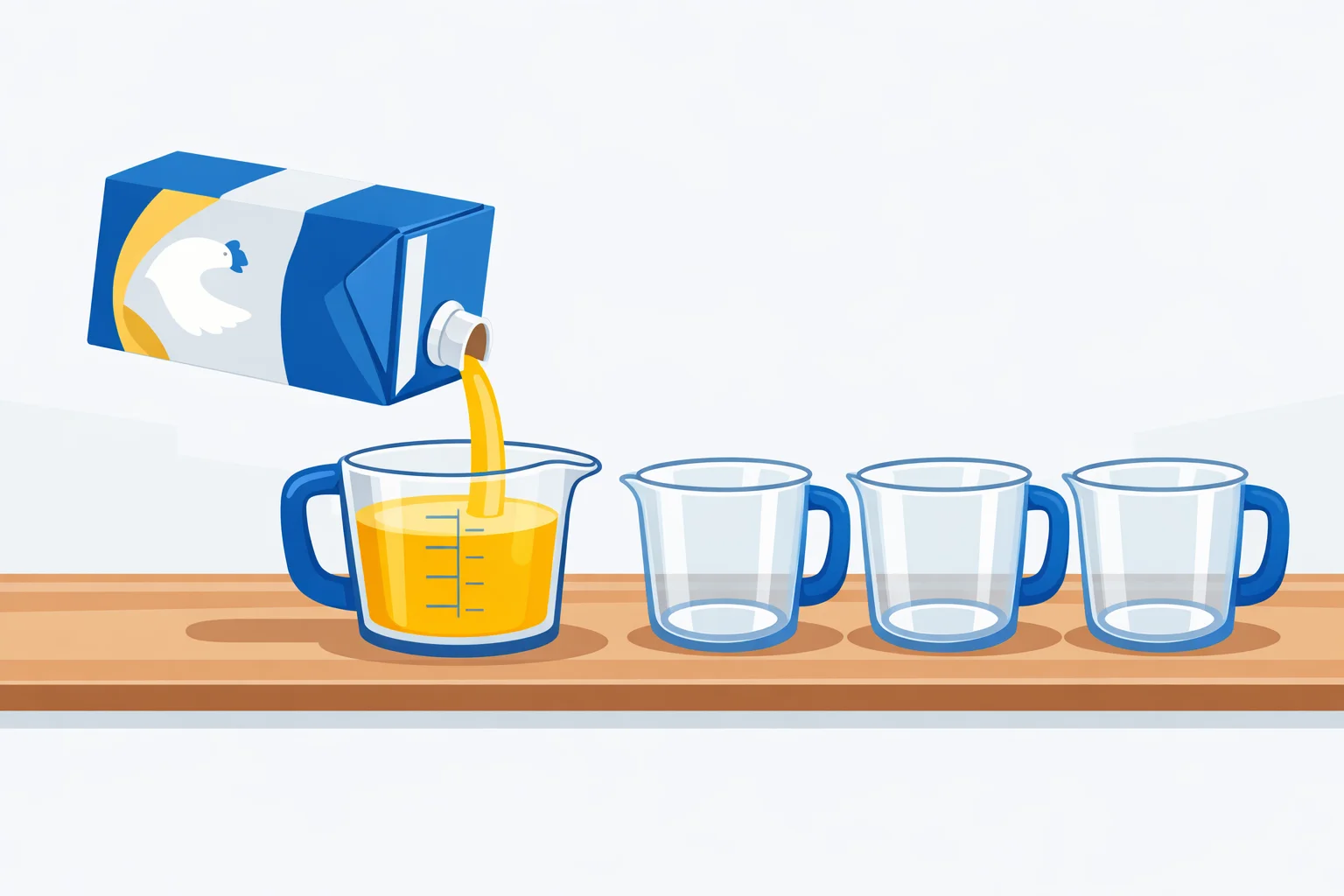
What a Quart Container Actually Holds
Most of the time you're converting quarts to cups because something came packaged in quarts and the recipe speaks in cups. Knowing what the common quart containers pour out saves a trip to the calculator:
| Quart container | In cups | Handy to know |
|---|---|---|
| Broth / stock carton | 4 cups | The 32 fl oz box is the reference quart — pour 2 cups, half the box is gone |
| US quart of ice cream | 4 cups | About 8 half-cup scoops |
| Buttermilk / heavy cream | 4 cups | Enough for two standard cake batters |
| Yogurt or sour cream tub | 4 cups | Same as 64 tablespoons if you're dolloping |
Every liquid quart on that list is 4 cups because the carton size — 32 fluid ounces — is the definition of a US liquid quart. The only quart that breaks the pattern is the one used for produce, which we'll get to below.
The 4-Cup Rule and Its Fluid-Ounce Backup
Multiply quarts by 4. That's the whole conversion. One quart is 4 cups, 2 quarts is 8, 3 quarts is 12, and a half quart drops to 2 cups. The reason it's a clean integer is that the US gallon is fixed by law at 231 cubic inches; a quart is a quarter of that, and a cup is a quarter of the quart — so four cups rebuild the quart exactly, with nothing rounded away.
When a quart amount isn't a whole number, the fluid-ounce backup is faster than long division. A quart is 32 fluid ounces, so 1.25 quarts is 40 fl oz, and since a cup is 8 fl oz, that's 5 cups. If you already own a fluid-ounce measure, our ounces to cups converter turns any carton label straight into cups without touching quarts at all.
Splitting a Quart Into Bowls and Scoops
The reason most people convert a quart to cups isn't curiosity — it's portioning. Take the cups and divide by your serving size. A quart of soup ladled into 1-cup bowls feeds 4 people. Bump the portion to a heartier 1.5 cups and the same quart stretches to 2.67 servings, so you'd round down to 2 full bowls with a little left for the cook. A quart of ice cream at a standard half-cup scoop gives you 8 servings — which is exactly why a quart tub is the go-to size for a family dessert.
Here's a worked example. You're making punch for a party and the recipe yields 3 quarts. That's 3 × 4 = 12 cups. Pouring into 6-ounce (0.75-cup) cups, you get 12 ÷ 0.75 = 16 servings. Want bigger 8-ounce (1-cup) pours instead? Then it's 12 servings flat. The green servings splitter in the tool above does this division live so you can dial the cup size to whatever glassware you actually have.
Reading a Recipe Down: Quarts, Pints, Cups
US liquid measure is a tidy doubling ladder, and reading it downward is what quarts-to-cups really is. Each rung is half the one above:
- 1 quart = 2 pints — so a quart splits cleanly into two pint jars.
- 1 pint = 2 cups — which is where the 4 cups per quart comes from.
- 1 cup = 16 tablespoons — so a full quart is 64 tablespoons.
That means a half quart is 1 pint is 2 cups — three ways of saying the same 473 mL. When a recipe jumps between units mid-list, it helps to pick one and convert everything to it. Going the other way — turning cups back into quarts to know how much to buy — the cups to quarts converter divides by 4 for you, and if you're scaling the entire ingredient list rather than one liquid, the recipe scaler resizes every line at once and keeps the ratios honest.
The Dry-Quart Surprise at the Produce Stand
Here's the gotcha that catches people: not every quart is 4 cups. Berries, mushrooms, and loose produce are sold by the dryquart, a separate unit that's about 16% bigger than the liquid quart. A US dry quart is 1,101 mL against the liquid quart's 946 mL, so it fills roughly 4.65 standard cups — not 4. That's why a quart basket of strawberries overflows your 4-cup measure by about two-thirds of a cup.
For anything you pour — stock, milk, cream, water — ignore the dry quart entirely; it never applies. It only shows up when a volume of solid food is sold "by the quart." The general tables published by NIST's Office of Weights and Measures list the liquid and dry quarts side by side, and the gap is real enough that a baker following a "quart of blueberries" recipe with a liquid measure will come up short.
Quarts vs Liters: The 5% You Can Usually Ignore
A US liquid quart is 946 mL, just shy of a full liter at 1,000 mL — about 5.4% smaller. For most cooking that gap doesn't matter: swap a quart of stock for a 1-liter carton and you're 54 mL (under a quarter cup) over, which won't break a soup. Where it does matter is baking and beverages measured precisely. A liter of cream is 4.23 cups, not 4, so a recipe written in liters and cooked with quart cartons drifts a little leaner each time you scale it up. When precision counts, convert through milliliters with our cups to mL converter and skip the customary system's rounding altogether.
Where Quart-to-Cup Conversions Go Sideways
The arithmetic is exact, but three habits still cause trouble. The first is the dry-versus-liquid quart mix-up above — ordering "2 quarts of raspberries" expecting 8 cups when you'll actually get about 9.3. The second is the British quart: an Imperial quart is 1,136 mL, roughly 20% larger than the US version, so it works out to about 4.8 US cups. Follow a UK recipe with US cups and you'll be nearly a cup short of liquid. The third is the pint trap hiding inside it — a US pint is 2 cups (473 mL), but a UK pint is 568 mL, so "a pint of cream" in a London cookbook is about 20% more than an American one. When a recipe's origin is unclear, the safe move is to convert to milliliters and sidestep every one of these regional quarts at once.