Cups to Quarts: The Exact Volume Math Behind Scaling Big Recipes
Converting cups to quarts comes down to a single number you'll never forget once it clicks: 4. Four cups make one quart. So when your soup recipe doubles and the pot suddenly needs 10 cups of stock, that's 2.5 quarts — and a quart carton is a lot easier to grab than ten separate cup pours. Unlike weighing flour or honey, this conversion has no density, no fudge factor, and no ingredient to look up. It's exact arithmetic baked into the way US measures are defined. This guide shows where the 4 comes from, the full ladder up to gallons, and the one trap that catches people at the produce stand.
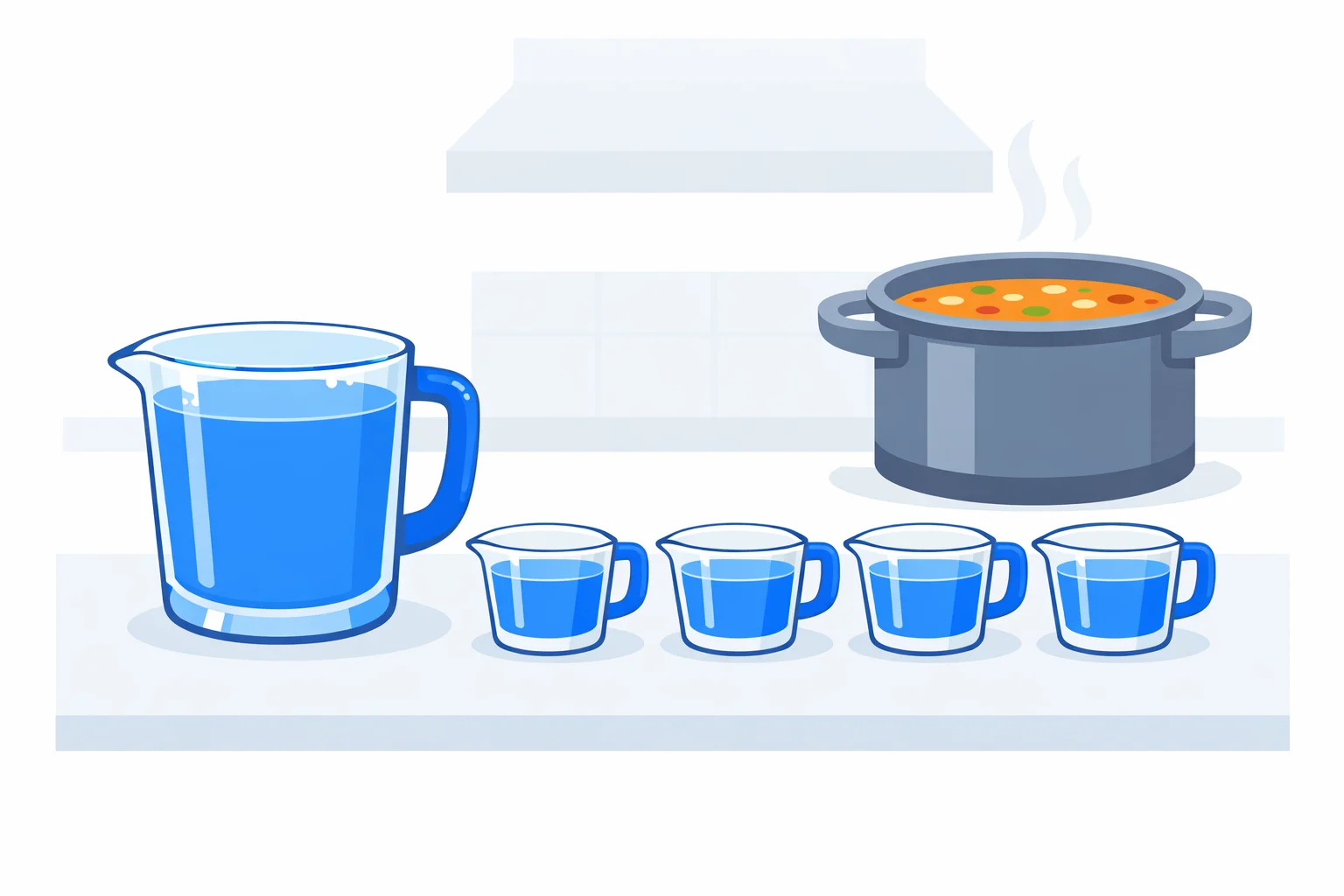
Why 4 Cups Always Equals 1 Quart
The ratio isn't a kitchen approximation — it's a legal definition. The US gallon is fixed at exactly 231 cubic inches. A quart is one-quarter of that, so 57.75 cubic inches. A cup is defined as one-quarter of a quart, which lands at 14.4375 cubic inches. Multiply that cup by four and you get 57.75 — right back to the quart. In metric terms, a US liquid quart is 946.353 mL and a US cup is 236.588 mL; divide and you get a clean 4.000. There's no rounding hiding in that number, which is why the conversion holds for water, broth, milk, or any liquid you pour.
The Kitchen Volume Ladder, Cup to Gallon
US liquid volume is built on a tidy doubling pattern. Each step up the ladder is exactly twice the one below it, until you reach the quart:
- 2 cups = 1 pint — the "pint's a pound" size, roughly 473 mL.
- 2 pints = 1 quart — so 4 cups, or about 946 mL.
- 4 quarts = 1 gallon — which means 8 pints or 16 cups, about 3.79 liters.
Hold the whole thing in your head with the old "Gallon Man" trick taught in US classrooms: one big G (gallon) contains 4 Q's (quarts), each Q contains 2 P's (pints), and each P contains 2 C's (cups). Count the cups inside the gallon and you get 16. If you'd rather skip the customary ladder entirely, our cups to milliliters converter jumps straight to metric, and the cups to ounces tool handles fluid-ounce labels where 1 cup is 8 fl oz and a quart is 32.
A Quart Isn't One Fixed Volume
Here's what most cups-to-quarts charts quietly ignore: there are three different quarts, and they don't hold the same amount. The US liquid quart is 946 mL. The US dry quart — the one berry baskets and produce are sold in — is 1,101 mL, about 16% larger. And the British Imperial quart is larger still at 1,136 mL, roughly 20% bigger than the US liquid version.
| Quart type | Volume (mL) | In US cups | Where you meet it |
|---|---|---|---|
| US liquid quart | 946 mL | 4.00 cups | Milk, stock, water, most recipes |
| US dry quart | 1,101 mL | 4.65 cups | Berries, mushrooms, loose produce |
| Imperial quart (UK) | 1,136 mL | 4.80 cups | British and older recipes |
This is why a "quart of strawberries" overflows your 4-cup measure — you're pouring a dry quart into a liquid measure. The general tables in NIST's Office of Weights and Measures list all three side by side. For everyday recipe liquids you can ignore the dry and Imperial quarts entirely — just know they exist so a produce label never throws you.
Scaling a Stockpot: A Worked Example
Say a chili recipe serves 6 and calls for 5 cups of broth, and you're cooking for a crowd of 18. That's a 3× scale, so 5 × 3 = 15 cups of broth. Now convert: 15 ÷ 4 = 3.75 quarts. Most boxed stock comes in 32-ounce (1-quart) cartons, so you'd buy four cartons and have a quarter-quart — one cup — left over. Push it further and the gallon math kicks in: a catering batch needing 32 cups is 32 ÷ 4 = 8 quarts, which is exactly 2 gallons. Once you're above about 8 cups, thinking in quarts and gallons saves you from miscounting individual cup pours. To resize every ingredient at once instead of one at a time, the recipe scaler multiplies the whole list and keeps the ratios intact.
Where Cups-to-Quarts Conversions Go Wrong
The math is exact, but two mix-ups still trip people up. The first is confusing dry and liquid quarts when buying produce: order "2 quarts of blueberries" expecting 8 cups and you'll get about 9.3, because dry quarts run 4.65 cups each. The second is reaching for a British recipe and assuming its quart matches yours — an Imperial quart of cream is 1,136 mL, nearly a cup more than the 946 mL a US cook would measure, enough to throw off a custard. A third, smaller slip: pints. A US pint is 2 cups (473 mL), but a UK pint is 568 mL, so "a pint" in a London recipe is about 20% more liquid than an American one. When precision matters, convert to milliliters and sidestep the ambiguity completely.
When to Stop Counting Cups and Switch to Quarts
Cups are the right unit for measuring into a recipe — they're what your measuring set is built around, and most ingredient amounts land under 4 cups anyway. Switch your thinking to quarts once a volume crosses roughly 4 to 8 cups, because counting eight or twelve separate cup pours invites error, and stock, water, and milk all come packaged in quart and half-gallon containers. Quarts also win for storage and pots: a 6-quart Dutch oven or a 1-quart freezer container is labeled in quarts, not cups, so converting up tells you whether your 14 cups of soup (3.5 quarts) will actually fit. For a fixed reference you can pin to the fridge, the Encyclopædia Britannica entry on the quart lays out the liquid, dry, and Imperial definitions in one place.