Pints to Quarts: The Conversion That Decides Your Canning Time
Converting pints to quarts is simple arithmetic — 2 pints make 1 quart, so you divide by two — but in a canning kitchen that single conversion carries weight a calculator can't show. Swap two pint jars for one quart jar and you haven't just changed the container; you've changed how long the food has to sit in boiling water to be safe. A salsa processed 15 minutes in pints needs 20 in quarts. Get that wrong and you risk under-heated food at the jar's cold center. This guide covers the exact math, how a batch packs into jars, and the regional pints that quietly break the rule.
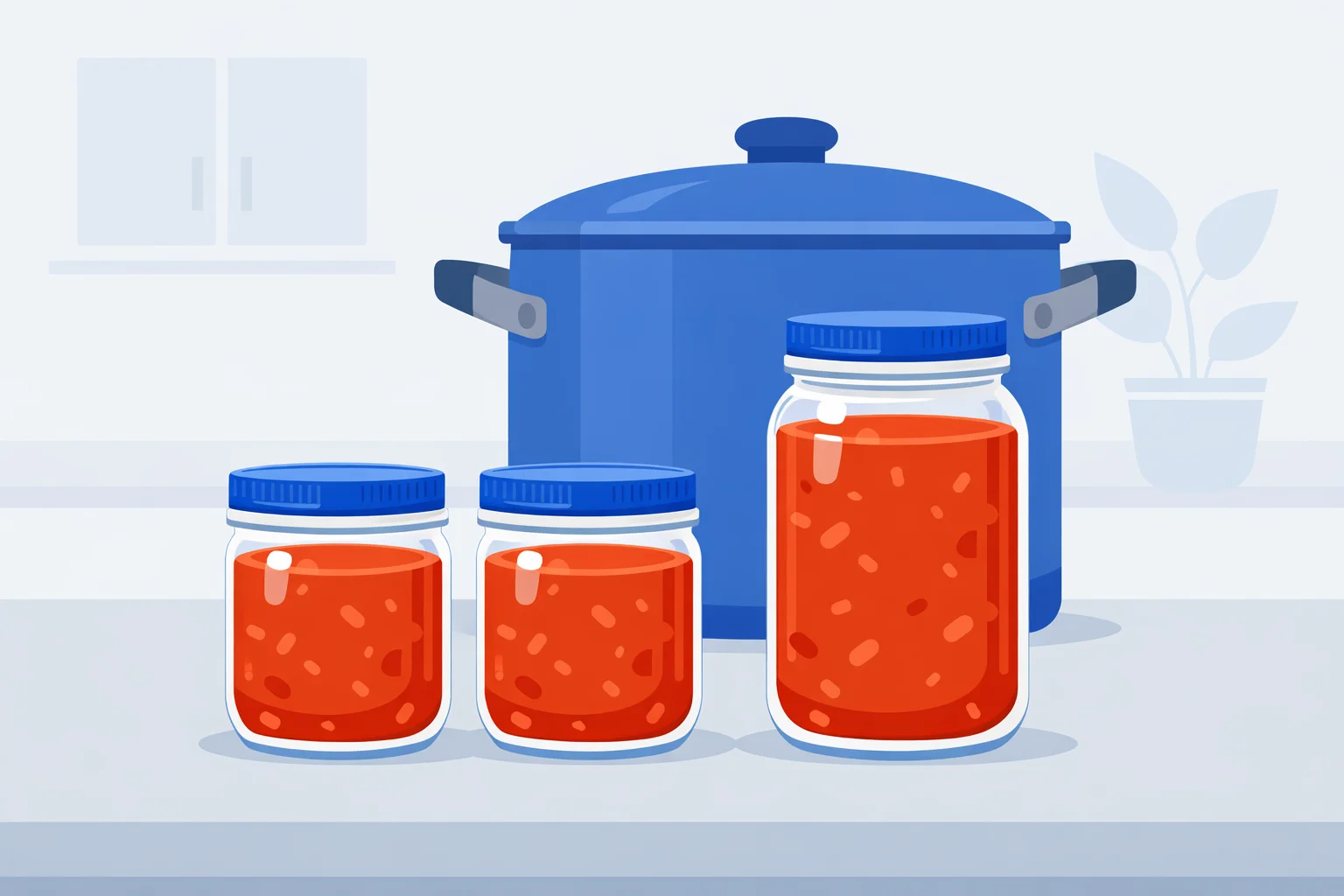
Why Jar Size Changes Your Processing Time
Here's the part most pint-to-quart converters never mention: the two jars don't cook the same. A quart holds twice the volume of a pint — 946 mL against 473 mL — but it doesn't have twice the surface area, so heat has to travel farther to reach the cold spot at the center. Tested recipes from the National Center for Home Food Preservation add 5 to 10 minutes when you move up from pints to quarts.
Crushed tomatoes in a boiling-water canner are the classic case: about 35 minutes in pints and 45 in quarts at sea level. Load both jar sizes into one canner and you time the whole batch for the quarts — the longer number always wins. Under-processing isn't a quality issue you can taste your way around; it's the gap that lets Clostridium botulinumsurvive. So when a recipe is written for pints and you only have quart jars, you can't just double the food and keep the clock the same.
The Two-Pint Rule, and Why It Stays Exact
Divide pints by 2 to get quarts. That's it — 2 pints is 1 quart, 6 pints is 3 quarts, and an odd 5 pints lands on 2.5 quarts. The relationship is a clean fraction because the whole US liquid system is defined off the gallon, fixed by law at 231 cubic inches. A quart is one-quarter of that gallon, and a pint is one-eighth, so two pints rebuild a quart with nothing rounded away.
The fluid-ounce backup is handy when amounts get fiddly. A pint is 16 fluid ounces and a quart is 32, so 3 pints is 48 fl oz — exactly 1.5 quarts. Because these are pure volume units with no ingredient density in play, the math holds whether you're measuring water, stock, or a thick tomato sauce. That's different from weight conversions, where the same cup of flour and cup of honey land at wildly different gram counts.
Packing a Batch: Pint Jars vs Quart Jars
The reason most home canners convert pints to quarts is jar planning. Say a recipe yields 7 pints of green beans. That's 7 ÷ 2 = 3.5 quarts — three full quart jars plus one leftover pint, or seven pint jars if you go small. The amber jar packer in the tool above does this split live, which matters because the choice isn't only about shelf space.
Pint jars win for anything you open and finish in one go — a single dinner's worth of beans, a batch of jam you'll use up in two weeks. Quart jars win for staples like tomatoes or broth you cook with in volume. There's a real cost angle too: quart jars use less lid metal per unit of food and take less canner space per pint of yield, so a big tomato harvest is cheaper to put up in quarts. To check the cup math on a partial jar, the quarts to cups converter breaks a quart back into its 4 cups, and the cups to pints converter handles the reverse when a recipe gives you cups to start.
Where Pints Sit on the Volume Ladder
US liquid volume is a doubling ladder, and the pint sits right in the middle of it. Knowing the rungs above and below turns any conversion into a matter of stepping up or down:
- 1 gallon = 8 pints — so a half-gallon of milk is 4 pints.
- 1 quart = 2 pints — the conversion this page is built around.
- 1 pint = 2 cups — which makes a pint 16 fluid ounces.
Read it as a chain and the awkward numbers fall out fast. Eight pints is 4 quarts is 1 gallon is 16 cups — four ways of naming the same 3.785 liters. When a recipe bounces between units mid-list, pick one rung and convert everything to it. If you're scaling the whole ingredient list rather than one liquid, the cups to quarts converter handles the larger jumps without you tracking pints by hand.
The Imperial Pint That Throws Off UK Recipes
A pint isn't the same size everywhere, and that catches people following British recipes. The US liquid pint is 473 mL, but the Imperial pint used in the UK is 568 mL — about 20% larger. So "a pint of double cream" in a London cookbook is closer to 2.4 US cups, not 2. Two Imperial pints come to 1,137 mL, which spills over a US quart by almost a full cup.
The gap compounds when you scale. Follow a UK jam recipe calling for 4 pints of fruit pulp with US measures and you're short by roughly 380 mL — more than a cup and a half of fruit missing from the batch. When a recipe's origin is unclear, the safest move is to convert everything to milliliters and dodge the pint question entirely. Our cups to mL converter gives you the metric number that means the same thing on both sides of the Atlantic.
The Dry Pint Hiding in the Produce Aisle
One more pint can trip you up: the dry pint. When you buy a pint of blueberries or cherry tomatoes, that container isn't the 473 mL liquid pint — it's the US dry pint, which is 550.6 mL, about 16% larger. So a "pint" of berries fills roughly 2.33 liquid cups, not 2. Two dry pints make a dry quart of 1,101 mL, the unit produce stands use for baskets of beans and tomatoes.
For anything you pour, ignore the dry pint completely — it only matters when a volume of solid food is sold by the pint or quart. But it explains why a recipe's "1 pint cherry tomatoes" weighs in heavier than you'd expect from a liquid measure, and why doubling a produce pint into a quart jar of sauce leaves you a little short on liquid yield.
Mistakes That Cost Canners a Whole Batch
Three errors turn an easy conversion into a wasted afternoon. The first is timing a mixed jar load for the pints when quarts are in the canner — always run the longer time, because the quart's center heats slower and the whole batch is only as safe as its slowest jar. The second is treating a dry pint of produce as a liquid pint: a recipe built on 4 liquid pints of crushed tomato needs about 1.9 liters, but four produce pints of whole tomatoes won't crush down to that once you remove skins and cores. The third is the headspace slip — quart jars usually need the same ½ to 1 inch of headspace as pints, not double, so don't leave a giant air gap just because the jar is bigger. Each of these is the kind of detail a plain "÷ 2" conversion hides, and each can mean reprocessing — or tossing — a batch you thought was done.