Oven Temperatures: The Fan-Oven Offset Every Chart Forgets
An oven temperature converter hands you 350°F = 177°C = Gas Mark 4 in a click — and that clean conversion is exactly why a tray of cookies can still come out charred at the edges and raw in the middle. You set the dial to 180°C, your math was spot on, so what went wrong? The oven had a fan. Swapping Fahrenheit, Celsius and Gas Mark is the easy part; the number that actually ruins bakes is the one most charts ignore — a fan oven runs about 20°C hotter than the dial implies. Nail that adjustment alongside the three-scale conversion and your bake matches the recipe's intent, not just its arithmetic.
Three Scales, One Oven
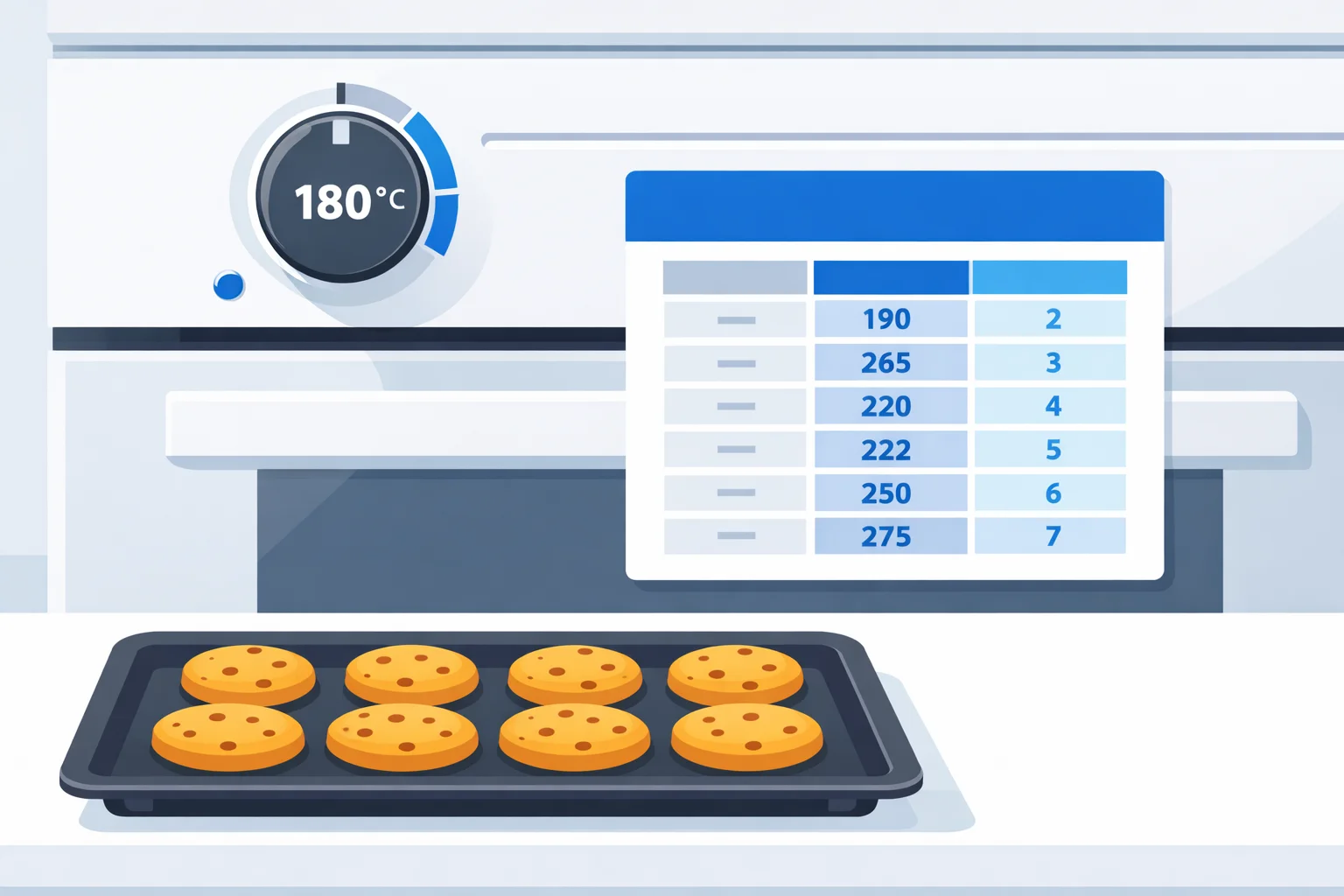
Recipes are written in three temperature languages. American recipes use Fahrenheit, most of the world uses Celsius, and older British and Irish recipes use Gas Mark — a numbered scale built for gas ovens. The same moderate oven is 350°F, 180°C, and Gas Mark 4 at once. None is "more correct"; each is just the dial your particular oven happens to wear.
The Fahrenheit-to-Celsius step is pure math: °C = (°F − 32) × 5/9. Gas Mark is the awkward one, because it's a set of fixed settings rather than a continuous readout. You can't dial "Gas Mark 4.3" — the knob clicks to whole and quarter marks. That's why the converter above snaps any temperature to the nearest standard mark instead of inventing a decimal one.
The 20°C Fan-Oven Offset
Here's the part most charts skip. A conventional oven heats with still air, so heat reaches food mostly by radiation from the elements. A fan (convection) oven blows that hot air around, stripping away the cooler insulating layer that normally clings to the surface of a cake or roast. The food browns and sets as if the oven were roughly 20°C — about 25°F — hotter than the number on the dial.
The fix is simple. When a recipe is written for a conventional oven and yours has a fan, drop the temperature by 20°C, 25°F, or one full gas mark. A recipe calling for 200°C conventional becomes 180°C fan. 400°F becomes 375°F. Gas Mark 6 becomes Gas Mark 5. Bake time also runs about 10–15% shorter, so check early. The standard convection-baking guidance backs this 25°F rule. Tick the fan box in the converter and it does the subtraction for you.
How Gas Mark Numbers Actually Work
Above Gas Mark 1, the scale is beautifully regular: every whole mark adds exactly 25°F. The formula is °F = (Gas Mark × 25) + 250. So Gas Mark 1 is 275°F, Gas Mark 4 is 350°F, and Gas Mark 9 is 475°F. Memorize that Gas Mark 4 = 350°F and you can count up or down in 25°F steps from there without ever touching a chart.
The trap sits below Gas Mark 1. Gas Mark ½ is 250°F and Gas Mark ¼ is 225°F — still 25°F apart, but the quarter labels mean the (mark × 25) + 250 formula stops working. Plug ½ in and you'd get 262.5°F, not the real 250°F. Those low marks handle slow custards, meringues and overnight braises, where a 25°F miss genuinely matters because the whole point is gentle, controlled heat. The quirks of the gas mark scale are why the full chart in the converter above lists every mark from ¼ upward rather than trusting a single formula.
Why 350°F Becomes 180°C, Not 177°C
Run 350°F through the formula and you get 176.67°C. Yet your oven dial says 180°C — or maybe 175°C. Neither is a mistake. Oven thermostats are marked in tidy 10°C or 5°C steps, so manufacturers round the Fahrenheit and Gas Mark anchors to the nearest convenient figure. 350°F rounds up to 180°C; 425°F (218.3°C) rounds up to 220°C.
Does the 3°C of rounding matter? Almost never. A typical home oven swings ±15°C as the thermostat cycles the elements on and off, and the temperature varies more than that between the top and bottom shelves. The rounding sits comfortably inside that noise. So trust the labelled dial value, not the decimal — chasing 176.67°C on an oven that wanders by 15°C is false precision.
Worked Example: A US Cookie Recipe in a UK Fan Oven
Say you've got an American chocolate chip cookie recipe: bake at 375°F for 11 minutes. You're in the UK with a fan oven that reads in Celsius. Walk it through:
- Convert the temperature: °C = (375 − 32) × 5/9 = 190.6°C, which your dial labels 190°C. That's Gas Mark 5.
- Apply the fan offset: 190°C − 20°C = 170°C fan (or 340°F — Gas Mark 4 on a gas fan oven).
- Trim the time: 11 minutes × 0.88 ≈ 9.7 minutes, so check at 9 and pull them when the edges set but the centres still look soft.
Skip the fan step and you'd bake at 190°C fan — effectively 210°C of browning power — and the edges scorch before the middle cooks, exactly the charred-rim, raw-centre cookie this page opened with. If you're also resizing the batch, the recipe scaler explains why bake time barely moves even when you double the dough.
What Bakes at Each Temperature
Temperature isn't arbitrary — each band does a specific job. Low heat sets delicate proteins gently; high heat drives the Maillard browning and steam that crisp pastry and char a pizza crust. Here's which conventional-oven setting suits which bake:
| °F | °C | Gas | Typical bakes |
|---|---|---|---|
| 325°F | 160°C | 3 | Custards, cheesecake, rich fruit cake, slow braises |
| 350°F | 180°C | 4 | Most cakes, cookies, brownies, banana bread, lasagne |
| 375°F | 190°C | 5 | Muffins, scones, victoria sponge, sheet pies |
| 400°F | 200°C | 6 | Shortcrust pastry, roast vegetables, crisp cookies |
| 425°F | 220°C | 7 | Puff pastry, roast potatoes, choux buns |
| 450°F | 230°C | 8 | Pizza, focaccia, hot-and-fast roasting |
| 475°F | 240°C | 9 | Artisan bread, Neapolitan-style pizza |
Notice the clustering: most cakes and cookies sit at 350°F/180°C, the sweet spot where the crumb sets before the outside over-browns. Pastry and roasting jump to 400–425°F to force quick steam and crisping. Bread and pizza push past 450°F, where a hot, fast bake gives oven spring and a blistered crust. When a recipe gives weights in grams instead of cups, pair this with our cups to grams chart to nail the ratios too.
Conversion Mistakes That Burn Dinner
Most oven disasters trace back to three specific slip-ups, not bad arithmetic:
- Ignoring the fan. Baking a 180°C conventional recipe at 180°C fan adds the equivalent of 20°C of browning. Cakes dome and crack, cookies spread and scorch, roasts dry out. Always subtract 20°C for a fan oven.
- Misreading low gas marks.Assuming Gas Mark ½ follows the 25°F-per-mark rule lands you at 262°F instead of 250°F — small, but it's the difference between a set and a split custard at those gentle temperatures.
- Using the rough "subtract 30, halve" shortcut for baking. For 425°F it gives 197°C instead of the true 218°C — a 21°C error that under-bakes pastry. The shortcut is fine for ballpark roasting, never for precision baking. Use the real formula.
One habit worth building: keep an oven thermometer on the shelf. Built-in thermostats routinely read 10–20°C off, so even a flawless conversion lands on the wrong real temperature if the oven itself lies. A cheap hanging thermometer tells you what's actually happening where the food sits — the number that matters once the conversion math is done. For everything else in the recipe, the all-in-one cooking converter handles cups, grams and spoons in one place.