Gas Mark to Celsius: The 100-Year-Old Scale Hiding in Your Recipes
Gas Mark to Celsius conversion confuses people because the two scales were never meant to line up — Gas Mark 4 is 180°C, yet the number 4 has nothing to do with 180. There's no hidden formula linking "4" to "180°C" directly. Instead, gas marks are a set of fixed dial positions invented in 1920s Britain, each one tied to a Fahrenheit value that only later got translated into Celsius. Once you know where the scale came from, the whole chart stops looking random and starts making sense.
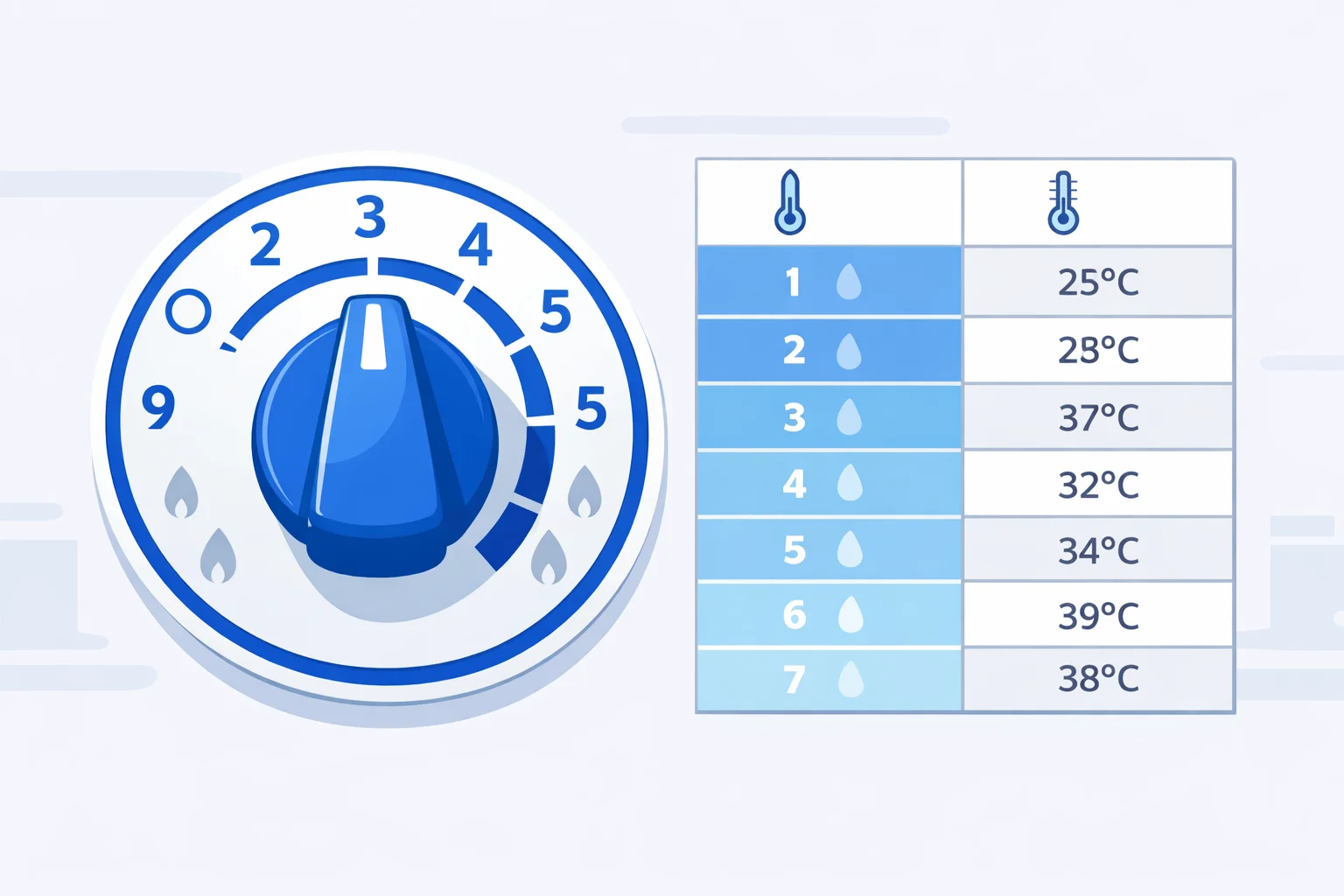
The Regulo Dial That Started It All
Before the 1920s, gas ovens had no thermostat at all. Cooks judged heat by holding a hand inside or watching how fast a sheet of paper browned. Then the British Davis Gas Stove Company introduced the Regulo, a thermostatic control that held a steady temperature — and rather than printing degrees, they numbered the settings. That numbering became the gas mark scale we still use today, almost unchanged a century later.
Why numbers instead of degrees? Partly marketing, partly practicality. A simple 1-to-9 dial looked friendlier than a thermometer, and it sidestepped the messy fact that early ovens couldn't hold a precise degree anyway. The scale stuck so firmly that British and Irish recipe books printed gas marks as the default for decades — which is exactly why a recipe from your grandmother might say "Gas Mark 5" with no Celsius in sight.
Why a Number Means a Temperature
Each gas mark is locked to a Fahrenheit anchor, because the Regulo was calibrated in Fahrenheit when Britain still used it. Gas Mark 1 is 275°F, and every full mark above it climbs by exactly 25°F. So Gas Mark 2 is 300°F, Gas Mark 3 is 325°F, and so on up to Gas Mark 9 at 475°F. The Celsius figures came later, by running those Fahrenheit values through the standard conversion and rounding to whatever the oven dial could show.
That two-step history is the key insight most charts hide. A gas mark isn't "a Celsius temperature with a different name" — it's a Fahrenheit setting wearing a number, with Celsius bolted on afterward. If you ever forget a value, recover it from Fahrenheit first. For the full picture across all three scales at once, the oven temperature converter lets you start from whichever unit your recipe happens to use.
The 25-Degree Rule and Its Celsius Twist
For Gas Mark 1 and above, one formula does all the work: °F = (Gas Mark × 25) + 250. To reach Celsius, take that Fahrenheit result and apply °C = (°F − 32) × 5/9. Here's Gas Mark 6 worked all the way through:
- Fahrenheit: (6 × 25) + 250 = 150 + 250 = 400°F
- Celsius: (400 − 32) × 5/9 = 368 × 5/9 = 204.4°C
- Dial value: ovens round 204.4°C down to 200°C
Notice the gap between the calculated 204.4°C and the printed 200°C. That rounding is deliberate and harmless, and it explains nearly every "the chart doesn't match my oven" complaint. The math gives you a decimal; the dial gives you a round number. Both point at the same shelf.
Where the Pattern Breaks: Marks ¼ and ½
The neat 25°F-per-mark rule only holds from Gas Mark 1 up. Below it, the scale uses fractions that don't follow the formula. Gas Mark ½ is 250°F (130°C) and Gas Mark ¼ is 225°F (110°C). Plug ½ into (mark × 25) + 250 and you'd get 262.5°F — wrong by 12.5°F. The fractions are spaced 25°F apart from each other, but they don't connect back to the main formula.
This matters more than it sounds. Those low marks are exactly where gentle heat is the whole point — meringues drying out without cracking, a pavlova holding its shape, an overnight braise breaking down collagen. A 12°F error at 250°F is the difference between a crisp meringue and a weeping, browned one. So at the bottom of the scale, never guess — read the value straight off the chart in the converter above.
175°C or 180°C? Why Charts Disagree
Pull up three gas mark charts and you'll find three slightly different Celsius columns. Gas Mark 4 shows as 180°C on one, 175°C on another. Gas Mark 3 is 160°C here, 170°C there. Nobody's wrong. The exact conversions land on awkward decimals — Gas Mark 4 is 176.7°C, Gas Mark 3 is 162.8°C — and each publisher rounds to whatever their target ovens print.
British ovens often mark dials in 10°C steps (160, 170, 180), while many European models use 5°C or different roundings, which is how 175°C creeps in. The practical answer: pick the dial value closest to the chart and stop worrying about the last few degrees. A typical home oven drifts ±15°C as the thermostat clicks on and off, and the temperature varies between the top and bottom shelves by more than the rounding ever could.
| Gas Mark | Exact °C | Common dial °C | Fahrenheit |
|---|---|---|---|
| 3 | 162.8°C | 160 or 170°C | 325°F |
| 4 | 176.7°C | 175 or 180°C | 350°F |
| 5 | 190.6°C | 190°C | 375°F |
| 6 | 204.4°C | 200°C | 400°F |
| 7 | 218.3°C | 220°C | 425°F |
Worked Example: Baking Gran's 1970s Sponge
Say you've inherited a handwritten victoria sponge recipe: "Gas Mark 5, 20 minutes." Your modern oven reads in Celsius and has a fan. Walk it through step by step:
- Gas Mark 5 to Fahrenheit: (5 × 25) + 250 = 375°F.
- Fahrenheit to Celsius: (375 − 32) × 5/9 = 190.6°C, so the dial value is 190°C.
- Fan adjustment: 190°C − 20°C = 170°C fan.
- Time: a fan oven cooks faster, so check at about 17–18 minutes instead of 20.
Skip the fan step and you'd bake at 190°C fan — effectively 210°C of browning power — and the sponge domes, cracks, and dries at the edges before the centre sets. If you're also resizing the recipe to fit a different tin, the recipe scaler shows why the temperature stays put even when you scale the quantities up or down.
"Moderate" and "Hot": Decoding Old Recipes
Older recipes love vague heat words — "a moderate oven," "a hot oven," "cook slowly." These predate thermostats and map directly onto gas marks. A "moderate oven" is Gas Mark 4 (180°C); a "hot oven" is Gas Mark 7 (220°C). Here's the full translation between the descriptive terms and the numbered scale:
| Recipe term | Gas Mark | Celsius | Fahrenheit |
|---|---|---|---|
| Very cool / very slow | ¼–½ | 110–130°C | 225–250°F |
| Cool / slow | 1–2 | 140–150°C | 275–300°F |
| Warm / moderately slow | 3 | 170°C | 325°F |
| Moderate | 4 | 180°C | 350°F |
| Moderately hot | 5–6 | 190–200°C | 375–400°F |
| Hot | 7 | 220°C | 425°F |
| Very hot | 8–9 | 230–240°C | 450–475°F |
The clustering tells a story. Most cakes and bakes live at Gas Mark 4 (180°C), where the crumb sets before the crust over-browns. Pastry and roasting jump to Gas Mark 6–7 to force quick steam and crisping. Bread and pizza push to Gas Mark 8–9, where a fast, fierce bake gives oven spring and a blistered crust. When the same old recipe lists ingredients in imperial cups, the cups to grams chart converts those into the metric weights a digital scale wants.
The Gas Mark Slip-Ups That Ruin Bakes
Three specific mistakes cause most gas mark disasters — and none of them is bad arithmetic:
- Treating the fan oven as conventional. Setting a Gas Mark 6 (200°C) recipe to 200°C fan adds roughly 20°C of browning. Roasts dry out, biscuits scorch, cakes crack. Always drop one full mark for a fan.
- Applying the formula to fractions. Assuming Gas Mark ½ follows (mark × 25) + 250 lands you at 262°F instead of the real 250°F — a 12°F miss right where delicate meringues and custards are least forgiving.
- Confusing Gas Mark with the dial number on a non-gas oven. Some electric ovens have a numbered knob that is notthe gas scale — it might run 1–6 as plain settings. If your oven shows actual degrees, ignore any "number" and convert the gas mark to Celsius instead.
One habit beats every conversion trick: keep a cheap oven thermometer on the middle shelf. Built-in thermostats routinely read 10–20°C off, so even a flawless gas-mark-to-Celsius conversion lands on the wrong real temperature if the oven itself lies. The standalone gas mark reference confirms the anchor values, but your own thermometer tells you what's happening where the food actually sits. For everything else in the recipe — cups, spoons and grams — the all-in-one cooking converter handles the measurements in one place.