Peanut Butter Cups to Grams: How to Measure a Sticky, Dense Spread
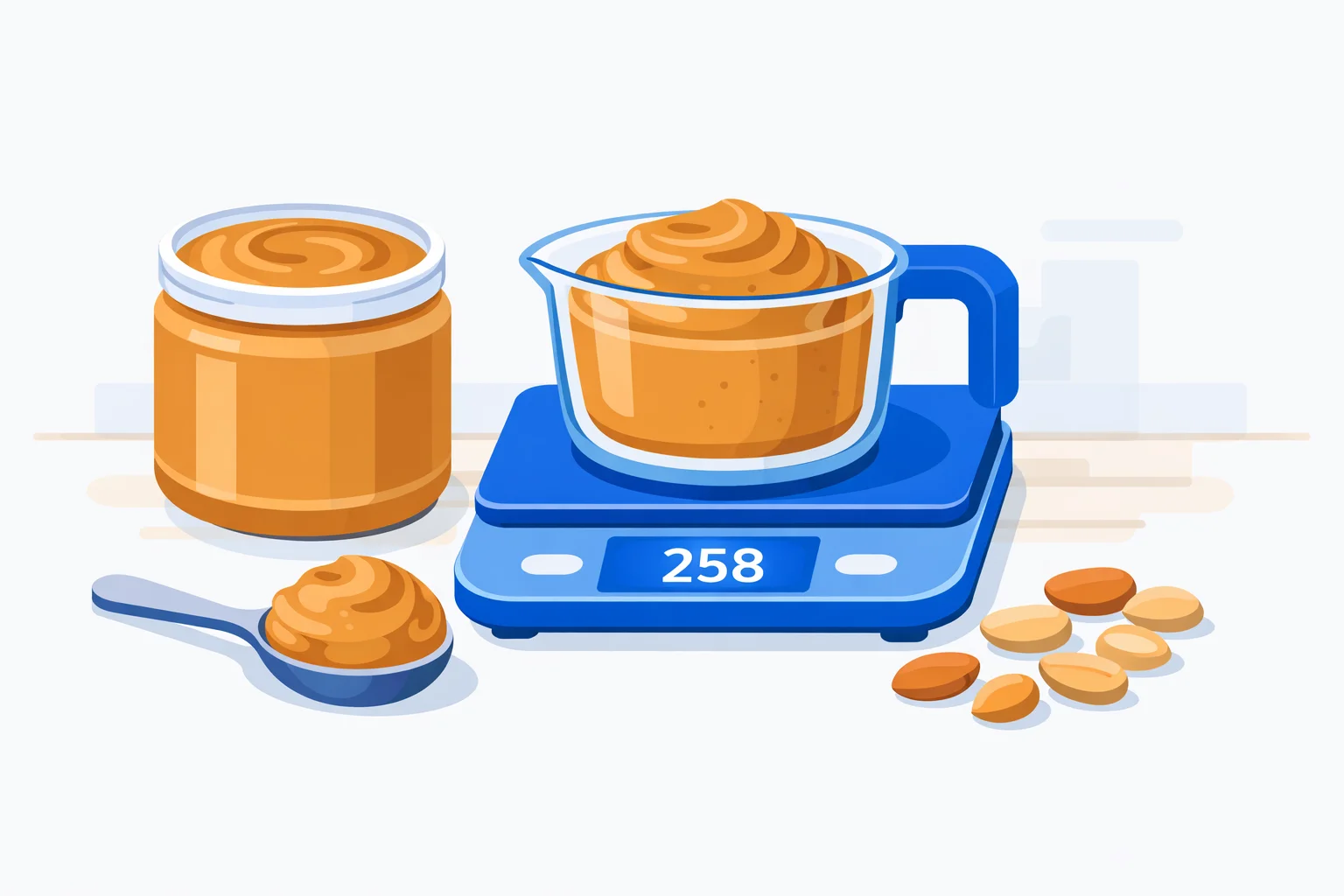
A cups to grams peanut butter conversion sounds simple until you actually try to pack a measuring cup with the stuff. One cup of creamy peanut butter weighs 258 grams — but getting an honest cup out of the jar is the hard part. It smears up the sides, traps air pockets, and refuses to come out clean. That's why peanut butter is one ingredient where weighing wins almost every time. The converter above gives you grams, tablespoons, and even calories for any amount; this guide covers the old water-displacement trick, why crunchy and powdered versions throw the numbers off, and how to read a recipe's cups straight off the jar label.
Why Peanut Butter Fights the Measuring Cup
Peanut butter is dense and sticky at the same time, which is a bad combination for volume measuring. A US cup is 240 mL of space, and creamy peanut butter packs into it at about 258 grams — denser than flour (125 g) and even sour cream (240 g). But because it clings, the "cup" you scoop can easily hide 10 to 15 grams of trapped air, or leave that much behind smeared on the cup walls. So two cooks measuring "one cup" from the same jar can end up 20 grams apart. For a spread this calorie-dense, that swing is enough to change how a cookie dough holds together.
The Water-Displacement Trick for Sticky Cups
Here's the technique pastry chefs use to dodge the sticky-cup problem entirely, and it relies on one fact: a cup measures volume, and water fills the space peanut butter doesn't. Say a recipe wants ½ cup of peanut butter. Fill a 2-cup measuring jug with ½ cup of cold water first. Then spoon peanut butter in until the water rises to the 1-cup line. The peanut butter has displaced exactly ½ cup of volume. Pour off the water, and the peanut butter slides out clean — no smearing, no guessing.
The rule generalizes: to measure any amount of peanut butter, add it to (1 cup minus your target) of water until the level hits the 1-cup mark. Want ⅓ cup? Start with ⅔ cup of water. It works for shortening, lard, and honey too — any sticky, water-resistant ingredient. That said, a digital scale set to 258 grams per cup is still faster and skips the draining step. If you bake by weight often, our cups to grams honey converter uses the same logic for the other notoriously sticky ingredient.
Peanut Butter by the Spoon, Cup, and Jar
These are the creamy-peanut-butter weights worth keeping handy. The tablespoon figures matter most, since peanut butter recipes and nutrition labels both lean on them — the standard label serving is 2 tablespoons, or 32 grams.
| Amount | Grams | Handy equivalent |
|---|---|---|
| 1 teaspoon | 5 g | — |
| 1 tablespoon | 16 g | a thin toast layer |
| 2 tablespoons | 32 g | one label serving (~190 kcal) |
| ¼ cup | 65 g | 4 tablespoons |
| ⅓ cup | 86 g | — |
| ½ cup | 129 g | half a stick of cookie fat |
| 1 cup | 258 g | ~57% of a 16 oz jar |
To turn a jar's weight back into cups, the four standard sizes map out neatly:
| Jar | Grams | In cups |
|---|---|---|
| 16 oz jar (standard) | 454 g | ≈ 1¾ cups |
| 18 oz jar (Jif / Skippy) | 510 g | ≈ 2 cups |
| 28 oz jar (family size) | 794 g | ≈ 3 cups |
| 40 oz jar (club size) | 1134 g | ≈ 4⅓ cups |
If your recipe lists ounces and you'd rather think in cups, our ounces to cups converter handles the in-between amounts.
Does Crunchy Weigh the Same as Creamy?
Not quite. Crunchy peanut butter runs about 250 grams per cup against creamy's 258 — roughly 8 grams lighter. The peanut chunks can't pack as tightly as smooth paste, so they leave microscopic air gaps around each piece. It's a small difference, about 3 percent, and for most recipes you can swap them freely. Natural peanut butter behaves differently again: once you stir the separated oil back into the jar, it levels smoothly and weighs around 252 grams per cup. The USDA FoodData Central database lists gram weights for specific brands if you need a precise figure for one jar.
The Powdered Peanut Butter Trap
This is the substitution that quietly ruins a recipe. Powdered peanut butter — PB2 and similar brands — has had most of its oil pressed out, dropping the fat from about 16 grams per serving to 1.5. That makes it great for protein shakes, but it also means a dry cup weighs only about 60 grams instead of 258. Measure powdered by the cup where a recipe wanted regular peanut butter, and you're short by nearly 200 grams of peanut solids and fat — almost four-fifths of the intended amount. Your cookies won't spread, your fudge won't set, and the peanut flavor will be faint. Always rehydrate powdered peanut butter with water first, or follow the label's 2-tablespoons-powder-plus-1-tablespoon-water ratio before measuring.
Reading the Gram Weight as Calories
Peanut butter is the rare ingredient where the gram weight doubles as a rough calorie count. At about 5.88 calories per gram, a full 258-gram cup carries roughly 1,517 calories — more than most people eat in a single meal. Scale that down and a 2-tablespoon (32 g) scoop is near 190 calories, a single tablespoon about 95. That density is exactly why peanut butter shows up in energy bars and weight-gain shakes: you pack a lot of calories into a small volume. If you're tracking macros, weigh the spoonful rather than eyeballing it — a "heaping" tablespoon can easily be double a level one, which means 190 calories instead of 95.
Worked Example: One Cup for Cookies
A classic peanut butter cookie recipe calls for "1 cup creamy peanut butter." Work it through:
- Grams needed: 1 cup × 258 g = 258 g of creamy peanut butter.
- From a 16 oz jar (454 g), that's 258 ÷ 454 = about 57% of the jar — a little over half gone.
- In tablespoons, if you'd rather spoon it: 258 ÷ 16 = 16 level tablespoons.
Now run the trap: grab powdered peanut butter by mistake and one cup gives you just 60 grams — a 198-gram shortfall that turns the dough crumbly and dry. Doubling the batch for a bake sale? The recipe scaler keeps the peanut butter, sugar, and egg in the same ratio so the cookies still spread right.
Where Peanut Butter Measuring Goes Wrong
Three mistakes cause most of the trouble. The biggest is the powdered-for-regular swap above — nearly 200 grams short per cup, and a flavorless result. The second is the heaping spoon: a rounded tablespoon of peanut butter can hold 24 to 30 grams instead of 16, so "2 tablespoons" on a label easily becomes 50 grams and 300 calories if you don't level it off. The third is light packing — scooping soft peanut butter without pressing the air out, which can leave a cup 15 grams shy. The fix for all three is the same: weigh it, or use the water-displacement method. For gram weights across your whole ingredient list, keep our all-ingredient cups to grams chart open beside this one.