Cream Cheese Cups to Grams: The Block Trick That Skips the Measuring Cup
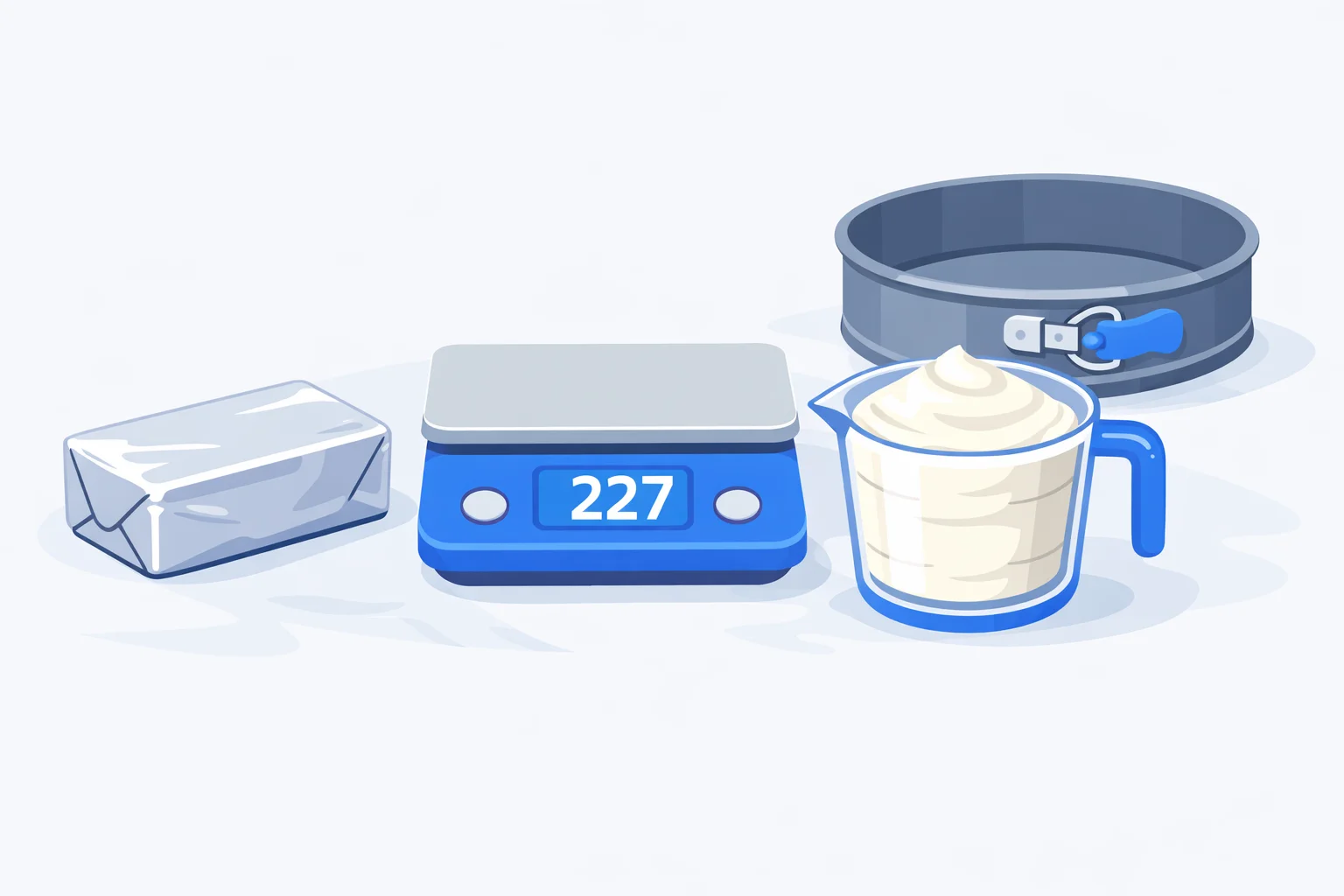
A cups to grams cream cheese conversion is one of the few in baking where you can skip the measuring cup entirely. One cup of block cream cheese weighs 227 grams — and that happens to be the exact weight of a standard 8 oz brick. So when a recipe says "1 cup of cream cheese," you don't pack a cup and lose half of it to the sides. You unwrap one block. The converter above does the numbers for any amount; this guide explains why the block-equals-cup trick works, when whipped cream cheese quietly breaks it, and how to buy the right number of bricks for a cheesecake.
Why 1 Cup Equals One 8 oz Block
The number lines up because of how cream cheese is packed and how ounces convert. A US cup is 240 mL of space, and block cream cheese is a dense, gap-free paste — no air pockets like flour, no crystals like sugar. Press it into a cup and it weighs about 227 grams. Now the package side: one ounce is 28.35 grams, so an 8 oz block is 8 × 28.35 = 226.8 g, which rounds to that same 227. The block and the cup arrive at the identical weight from two different directions. That's why nearly every American cream-cheese recipe is written in blocks or in cups interchangeably — they're the same thing.
Reading the Package Instead of the Cup
Once you trust the 227 g = 1 cup = 1 block rule, shopping gets fast. Cream cheese comes in a handful of standard sizes, and each maps cleanly onto cups:
| Package | Grams | In cups |
|---|---|---|
| 3 oz block (older recipes) | 85 g | ≈ ⅜ cup |
| 8 oz block (standard brick) | 227 g | 1 cup |
| 12 oz tub | 340 g | 1½ cups |
| Two 8 oz blocks | 454 g | 2 cups |
| Three 8 oz blocks | 680 g | 3 cups |
The 3 oz block is the one that catches people — it's the older size some mid-century recipes still call for, and at 85 g it's closer to ⅜ cup than a half. If your recipe lists ounces and you'd rather think in cups, our ounces to cups converter handles the in-between amounts.
The Whipped-Tub Trap That Wrecks Cheesecake
Here's the one substitution that ruins the math. Whipped cream cheese, sold in tubs, has air beaten into it to make it spreadable straight from the fridge. That air takes up volume without adding weight, so a cup of whipped cream cheese weighs only about 150 grams — roughly a third less than the 227 g of a block. Use a cup of whipped where a recipe wanted block, and your cheesecake batter is short by 77 grams of actual cheese per cup. The texture goes loose, the filling won't set firm, and a three-cup recipe ends up missing 231 grams — more than a whole block. For baking, always reach for the foil-wrapped brick. Save the tub for bagels.
Neufchâtel, the ⅓-less-fat cheese sold in the same brick shape, is the safe swap: at about 232 g per cup it's within a few grams of full-fat, so you can trade them one-for-one by weight. The USDA FoodData Central database lists both forms if you want to check a specific brand's numbers.
Cream Cheese by the Spoon and Cup
For smaller amounts — a frosting that wants 3 tablespoons, a dip that calls for ⅓ cup — these are the block-cream-cheese weights worth keeping handy. Everything here assumes the standard brick at 227 g per cup.
| Amount | Grams | Handy equivalent |
|---|---|---|
| 1 teaspoon | 5 g | — |
| 1 tablespoon | 14 g | a thin bagel layer |
| ¼ cup | 57 g | 4 tablespoons |
| ⅓ cup | 76 g | — |
| ½ cup | 113 g | half a block |
| 1 cup | 227 g | one 8 oz block |
| 2 cups | 454 g | two blocks |
Notice the half-block line: 113 g is exactly half a brick, so for a ½-cup recipe you can slice a block down the middle rather than measuring. If you bake with the other block-sold dairy fat, our cups to grams butter converter uses the same stick-and-block logic.
Worked Example: Cream Cheese for a Cheesecake
Say you're making a classic New York cheesecake that lists "3 cups cream cheese, softened." Work it through:
- Grams needed: 3 cups × 227 g = 681 g of block cream cheese.
- Blocks to buy: 681 ÷ 227 = 3 standard 8 oz blocks. No measuring cup required — just open all three.
- If you only have 12 oz tubs (340 g each), you need 681 ÷ 340 = 2 tubs, with about 1 g to spare.
Now run the trap: if you grabbed whipped cream cheese instead, three cups would give you 3 × 150 = 450 g — a 231 g shortfall, basically one block missing. The cake would never set. Scaling the recipe for a bigger pan? The recipe scaler keeps the cream cheese, eggs, and sugar in the same ratio when you bump the batch up.
When You Shouldn't Bother With Cups
Cups are genuinely the wrong tool for cream cheese in two cases. First, anytime the recipe already gives you blocks or ounces — "two 8 oz packages" tells you to use exactly 454 g, and translating that into "2 cups" just adds a rounding step that can drift. Second, for precision bakes like a competition cheesecake or a no-bake filling, where being 15 grams off changes how firmly it sets. Cold block cream cheese resists packing evenly and traps air, so a "cup" of it can swing by 10 to 20 grams depending on how hard you press. A scale removes that variable completely: zero the bowl, add cheese until it reads the gram target.
Where Cream Cheese Conversions Go Wrong
Three mistakes cause most of the grief. The big one is the whipped-for-block swap covered above — a third less cheese per cup, and a filling that won't firm up. The second is assuming a tub equals a block: a 12 oz tub is 340 g and 1½ cups, not the 227 g of a brick, so a recipe wanting "one package" needs a block, not a tub. The third is light measuring — scooping soft cream cheese into a cup without pressing out the air gaps, which can leave you 20 grams short on a single cup. The fix for all three is the same: weigh the block, or just count bricks. For weights across your whole ingredient list, keep our all-ingredient cups to grams chart open beside this one.