KRW to USD: What Your Korean Won Is Really Worth
A KRW to USD converter turns Korean won prices into dollars in a tap — which matters the moment you're staring at a ₩25,000 K-pop album on Weverse, a ₩38,000 Olive Young cart, or a stack of leftover notes from a Seoul trip and wondering what it's all worth. At roughly ₩1,385 to the dollar in 2026, that album is about $18, the skincare haul about $27, and a single ₩1,000 note just 72 cents. This page does the math live, then explains the two things that trip people up most: the currency's wall of zeros, and how much the rate quietly moves.
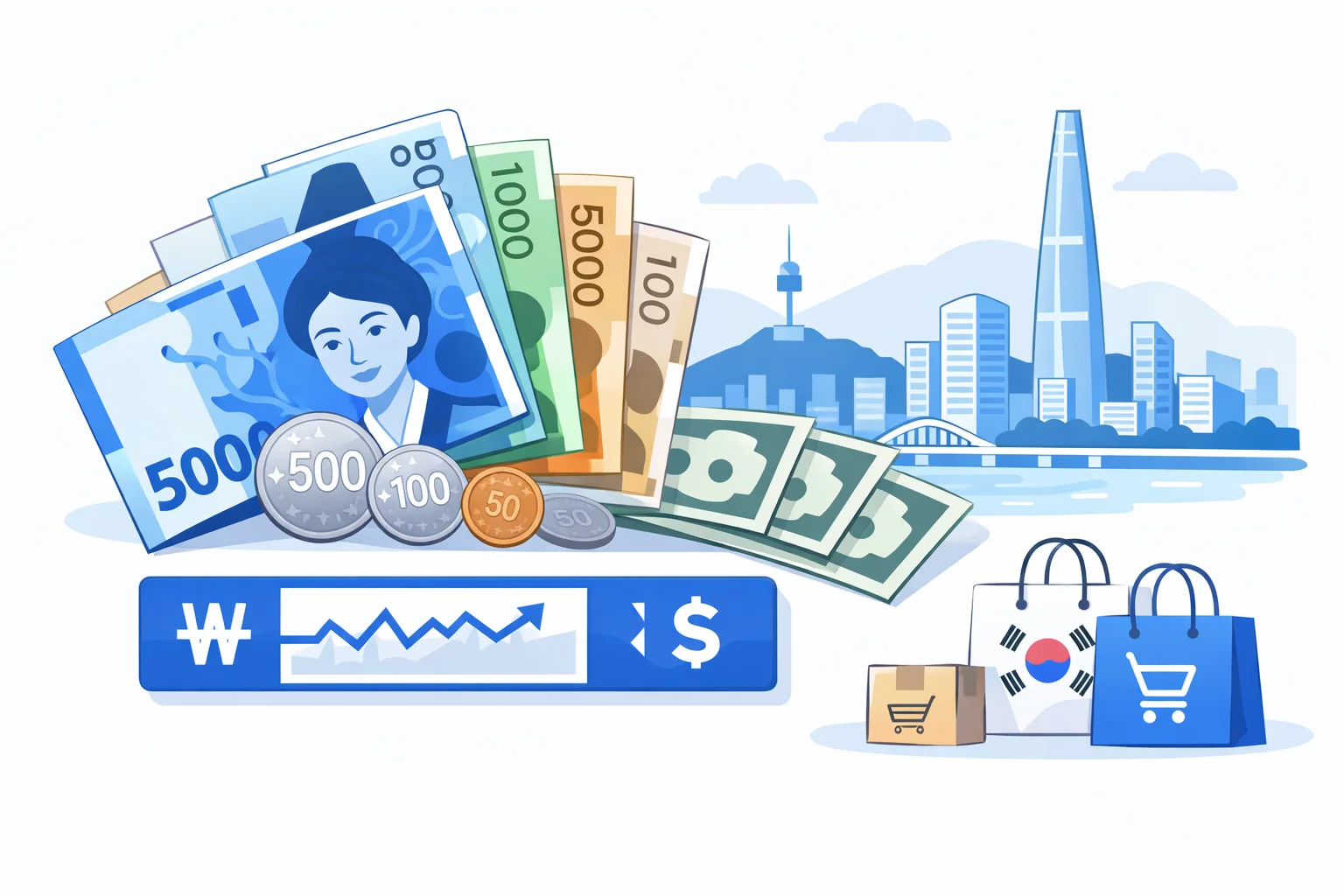
Why ₩1,000 Is Only About 72 Cents
The Korean won wears a lot of zeros, and that throws people. One US dollar buys around 1,385 won, so ₩1,000 is worth about $0.72 and the largest banknote in circulation — the blue ₩50,000 bill, which put Shin Saimdang on it in 2009 as the first woman on Korean currency — is worth only around $36. There is no ₩100,000 note. That's not weakness; it's scale. The won was simply never redenominated, so where other countries lopped off zeros after inflation, Korea kept counting in thousands.
You'll recognise the pattern if you've dealt with other zero-heavy currencies — our USD to VND converter shows the Vietnamese dong taking it to an even wilder extreme, where a single US dollar buys tens of thousands. With the won, the everyday notes are ₩1,000, ₩5,000, ₩10,000 and ₩50,000, carrying scholars and a king — King Sejong, who invented the Hangul alphabet, is on the ₩10,000 bill. Knowing a ₩10,000 note is about $7.20 is the single most useful anchor you can carry.
Turning Won Into Dollars in Your Head
The exact conversion is simple division: won ÷ rate = dollars. At 1,385, a ₩47,000 dinner is 47,000 ÷ 1,385 ≈ $33.94. Nobody does that in their head at a night market, so use the anchor instead. Every ₩10,000 is about $7.20, so ₩47,000 is roughly 4.7 × $7.20 ≈ $34. Close enough to decide whether the second round of Korean barbecue is worth it.
Avoid the old “drop three zeros” shortcut. It treats ₩1,000 as exactly $1, which was roughly true only when the won hovered near 1,000 per dollar in the mid-2000s. At today's 1,385 it overstates the dollar value by about 39% — you'd think a ₩50,000 meal cost you $50 when it was really $36. If you want a quick ceiling, drop the three zeros for the old-rule figure, then knock off between a quarter and a third to land near the truth.
The Night the Won Nearly Hit ₩2,000
The won's modern personality was forged in one brutal winter. Through early 1997 it traded near 800 per dollar, tightly managed and calm. Then the Asian financial crisis hit: foreign capital fled the region, Korea's foreign reserves drained toward empty, and by late December the won had crashed to nearly 2,000 per dollar — it had lost more than half its value in months. Korea took an International Monetary Fund rescue package of about $58 billion, the largest bailout in the fund's history to that point.
What happened next is the part Koreans still talk about. In early 1998, roughly 3.5 million people lined up to donate gold — wedding rings, medals, baby trinkets — in a national campaign to help repay the debt. About 227 tonnes of gold, worth some $2.2 billion, was collected. Koreans call the whole episode the “IMF crisis,” and it left a lasting instinct to guard the won against sudden capital flight — an instinct that still shapes how freely the currency trades today.
Why the Won Falls When the World Gets Scared
Here's a quirk worth knowing before you try to time a conversion: the won usually weakenswhen global markets panic, even when Korea is doing fine. That's the opposite of the Japanese yen, which strengthens in a crisis. If you want to see that contrast in action, our JPY to USD converter walks through the yen's safe-haven behaviour — the mirror image of the won.
The mechanism is Korea's open, export-driven market. Semiconductors alone are roughly a fifth of the country's exports — Samsung and SK Hynix chips, Hyundai cars, LG appliances — so the won tracks the global trade and tech cycle. Foreign investors own a large slice of the Korean stock market, and when fear spikes they sell Korean shares and convert the proceeds out of won, all at once. So the won behaves like a risk-on currency: firm when global growth looks good and money is chasing returns, soft the moment everyone runs for cover. The Bank of Korea sets policy and manages reserves against exactly these swings.
What a Korean Shopping Cart Really Costs
For a huge share of people converting won to dollars, the reason is shopping — Coupang, Gmarket, Musinsa, YesAsia, Olive Young, K-pop merchandise stores. The won price is only the start. Two add-ons decide your real cost: your card's foreign-transaction fee, typically about 3% on a standard US bank card, and international shipping, which often runs $15 to $40.
Work a real cart. A ₩25,000 physical album is about $18.05 at the mid-market rate. A 3% card fee adds $0.54, and $20 shipping adds — well, $20. Landed cost: about $38.60, or roughly 114% more than the sticker implied. Notice which line hurts: the card fee is tiny, but flat shipping doubles a cheap order. That's why seasoned K-shoppers batch several items into one parcel and hunt for free-shipping thresholds. The landed-cost panel in the converter above lets you plug in your own card fee and shipping to see the damage before you check out.
The Currency You Can't Take Home
The won carries a practical catch most travelers only discover at the airport back home: it barely trades outside Korea. The won has long been one of the world's more tightly managed currencies, a legacy of 1997, so most foreign banks won't stock it, and offshore desks price it through non-deliverable forwards that settle in dollars rather than in actual won. Korea only began opening its onshore market to registered foreign banks and extending trading hours in 2024.
What that means for you is simple. Change leftover won back to dollars beforeyou leave Korea — at a bank or a major-airport counter — because your hometown bank may refuse it or offer a dismal rate. And empty your coin pouch: no exchange anywhere will buy back ₩500 or ₩100 coins, so spend them, drop them in a donation box, or top up a T-money transit card. If you're heading the other direction and need to turn dollars into won for a trip, our dollars to won converter covers budgeting won from the dollar side — including how much cash a Korea trip really needs.
Four Ways People Get Won-to-Dollar Wrong
- Using the dead ₩1,000 = $1 rule. At 1,385 it overstates dollars by about 39%. That ₩120,000 hotel night is $86.64, not $120.
- Confusing won with yen.₩1,000 is about $0.72 but ¥1,000 is about $6.45 — nearly nine times more. Mistake a ₩50,000 tag for yen and you'll brace for $323 instead of $36.
- Accepting “pay in USD” at checkout. Dynamic currency conversion, online or at a Korean card terminal, bakes in a 3–8% markup. Always choose to be charged in won and let your own bank convert.
- Letting coins pile up.₩500 coins are worth about $0.36 each and are worthless once you've flown home — a pocketful can quietly be $10 you can never spend.
When the Rate Is Worth Watching
For most conversions, don't agonise over the daily rate. On a ₩30,000 souvenir, the difference between a good day and a bad one is a few cents — not worth a second thought. Grab the live figure, buy the thing, move on.
Timing earns its keep in two cases. First, large one-off sums: the won can swing 3–5% in a jittery month — it fell hard in late 2024 during a domestic political shock, touching its weakest level since the 2009 global financial crisis — so on a $10,000 tuition payment or a property deposit, a few percent is hundreds of dollars. Second, recurring flows like tuition, payroll or family support, where a persistent trend compounds over years. In both, the provider's spread usually matters more than the exact day — our multi-currency converter lets you add a markup and see the take-home. Everywhere else, the rule holds: get the number, and don't overthink it.