INR to USD: Turning Rupees Into Dollars for Study, Travel, and Investing
An INR to USD conversion turns rupees into dollars — and the answer is always a smaller number than you started with, because you divide by the rate instead of multiplying. At about ₹87.5 to the dollar, ₹1,000 is roughly $11.43 and ₹1 lakh is about $1,143. But the people reaching for this conversion rarely stop at the number. They're a student wiring a tuition deposit to a US university, a parent funding a semester abroad, or an investor moving money into a brokerage. For all of them, two rules matter far more than the daily rate: a legal ceiling on how many dollars you can buy, and a tax that looks scarier than it is.
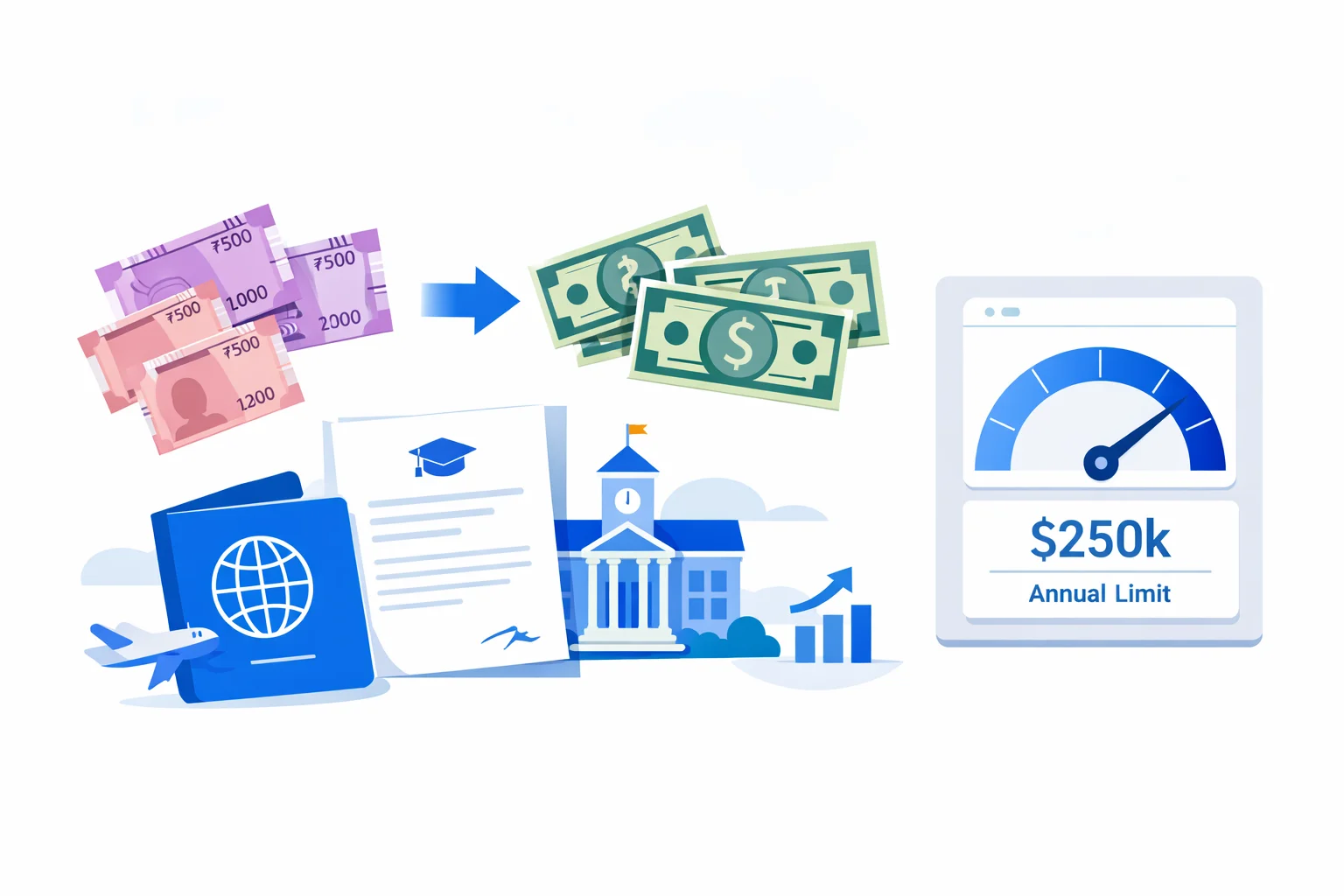
Dividing, Not Multiplying: The Rupee-to-Dollar Math
Here's the trap that catches people going the other way. Converting dollars to rupees, you multiply — every dollar becomes dozens of rupees. Going from rupees to dollars, you flip it: divide the rupee amount by the INR/USD rate. Get the operation backwards and a ₹5 lakh transfer looks like $43 million instead of the correct $5,714. The tool above and our USD to INR converter handle both directions, but the mental model is worth locking in.
Three quick worked examples at a rate of 87.5:
- ₹1,000 to USD: 1,000 ÷ 87.5 = $11.43.
- ₹1,00,000 (1 lakh) to USD: 100,000 ÷ 87.5 = $1,142.86.
- ₹10,00,000 (10 lakh) to USD: 1,000,000 ÷ 87.5 = $11,428.57.
A fast sanity check for round numbers: divide by 87.5 is close to dividing by 88, and dividing by 88 is roughly "knock off the last digit, then subtract a bit." ₹8,800 ≈ $100. Not exact, but close enough to catch a typo before you wire the wrong amount.
The $250,000 Wall Most People Don't Know Exists
You cannot simply convert unlimited rupees into dollars and send them abroad. India runs a managed capital account, and the gateway is the Liberalised Remittance Scheme (LRS). Under LRS, every resident individual — including minors — can remit up to USD 250,000 per financial year, which runs April to March, not the calendar year. That one number is the single most important thing an outbound sender should know, and most learn it only when a bank asks them to sign an LRS declaration.
The $250,000 is a combined ceiling. Travel, education, medical treatment, gifts to relatives abroad, and buying foreign stocks all draw from the same pool. Send $60,000 for a year of tuition and take a $5,000 holiday, and you've used $65,000 of your annual window — the gauge in the converter above tracks exactly this. For a typical student or tourist, $250,000 is enormous headroom; for a family buying overseas property or making a large investment, it's a real constraint that resets every April.
TCS: The 20% That Isn't Actually a Tax
The scariest line item on an outbound transfer is TCS — Tax Collected at Source. Read a headline and you'd think the government keeps 20% of your money. It doesn't. TCS is a prepayment of your own income tax that gets fully credited back when you file your return, and refunded if you overpaid. It's a cash-flow timing issue, not a cost.
The rules, as they stand for the current financial year, hinge on a ₹10 lakh threshold (raised from ₹7 lakh in the 2025 budget):
| Purpose of remittance | TCS rate above ₹10 lakh |
|---|---|
| First ₹10 lakh (any purpose) | 0% — nothing collected |
| Education funded by an approved bank loan | 0% |
| Education (self-funded) or medical treatment | ~2% |
| Travel, gifts, investment, everything else | 20% |
Say you remit ₹15 lakh for a self-funded degree. Only the ₹5 lakh above the threshold is taxable, at roughly 2% — about ₹10,000 collected upfront, and reclaimable at tax time. Move that same ₹15 lakh for a foreign investment, and the general 20% rate applies to the ₹5 lakh excess: ₹1,00,000 held aside — a big number, but still your money, parked with the taxman until you file. The purpose dropdown in the tool switches the rate so you see the effect instantly.
Why a Strong Dollar Makes a US Degree Cost More Rupees
For anyone earning in rupees and spending in dollars, the exchange rate is a silent tax that never appears on an invoice. A $50,000 tuition bill cost about ₹31.5 lakh in 2015 at a rate near 63. Today, at 87.5, that identical $50,000 sticker price runs ₹43.75 lakh — over ₹12 lakh more for the same course, with not a cent of the fee having changed. The dollar got stronger; your rupees bought less of it.
A useful gauge of dollar strength is the US Dollar Index (DXY), which measures the greenback against a basket of major currencies. When DXY climbs, it's not just the rupee weakening — the dollar is beating almost everyone, and that global strength flows straight into what a US education, holiday, or gadget costs a rupee earner. This is the mirror image of a tourist bringing dollars into India, who cheers the same move. If you're comparing study destinations, our GBP to USD converter is handy for weighing a UK offer against a US one on the same rupee budget.
What It Really Costs to Buy Dollars in India
The mid-market rate — the one on Google — is a rate you will never actually get. Banks, forex cards, and money-changers all convert your rupees at a marked-up rate, typically around 2%worse than mid-market. On ₹1 lakh that's about $23 quietly shaved off; on a ₹40 lakh property transfer, it's closer to $900. The markup scales with everything you send, which is why it matters far more than a flat fee on large sums.
Your options, roughly cheapest to priciest:
- Specialist transfer services: often within 0.5-1% of mid-market for account-to-account transfers, the best rate for large sums.
- Bank forex cards / net-banking wires: around 2% in the rate plus a flat SWIFT charge of ₹500-1,500 — convenient, middling value.
- Airport and hotel counters: 4-6% off mid-market. Fine for a small cash buffer, painful for anything larger.
Whatever you choose, judge it by the dollars that actually land, not the fee it advertises. The breakdown panel in the converter does this for you. And if you juggle several currencies, our multi-currency converter lets you set a custom markup and watch the delivered amount move.
Rupee-to-Dollar Mistakes That Sting Students and Travelers
- Treating TCS as a loss.People delay a tuition transfer to "avoid" the 2% TCS. But it's refundable — delaying just risks a worse rate. If the rupee slips 1% while you wait, you've lost real money to dodge a tax you'd have gotten back anyway.
- Forgetting the limit is per financial year. The $250,000 cap resets on April 1, not January 1. A large remittance in March plus another in April are counted in two different years — useful to know when timing a big move.
- Saying yes to dynamic currency conversion abroad.When a US terminal offers to bill your Indian card "in rupees," that's DCC, and it bakes in a 3-8% markup. Always choose to be charged in dollars and let your own bank convert.
- Buying all your travel dollars at the airport. A ₹2 lakh forex load at a 5% airport spread costs about ₹10,000 in markup — roughly ₹6,000 more than buying the same dollars through a bank at 2% a week earlier. Buy ahead of the trip.
Beyond Tuition: Using Rupees to Buy US Stocks
A growing reason to convert rupees to dollars has nothing to do with travel or school — it's investing. Buying US stocks or ETFs through an international brokerage is a permitted LRS purpose, so the same $250,000 annual window covers it. The catch: as a general (non-education) remittance, investment transfers above ₹10 lakh attract the full 20% TCS, though it's the same refundable credit as always.
There's a subtler currency angle too. When you hold US assets bought with rupees, a weakening rupee quietly boosts your returns in rupee terms — a stock that's flat in dollars still gains value for you if the rupee slips from 87.5 to 90. That currency tailwind is one reason many Indian investors diversify into dollar assets in the first place, converting on a schedule rather than trying to time a rate that has trended one direction for two decades.