Dollars to Rupees: How to Convert — and Actually Spend — in India
Converting dollars to rupees the minute you land in India is how most first-time visitors quietly lose their first ₹500. The rate itself is the easy part — at about ₹87.5 to the dollar, $100 becomes roughly ₹8,750, and the converter above does the math live. The hard part is everything after: which of your dollars should become airport cash, which should ride on a card, and why half the country would rather you scan a QR code than take a note at all. This guide covers the rate, then the on-the-ground reality of spending it.
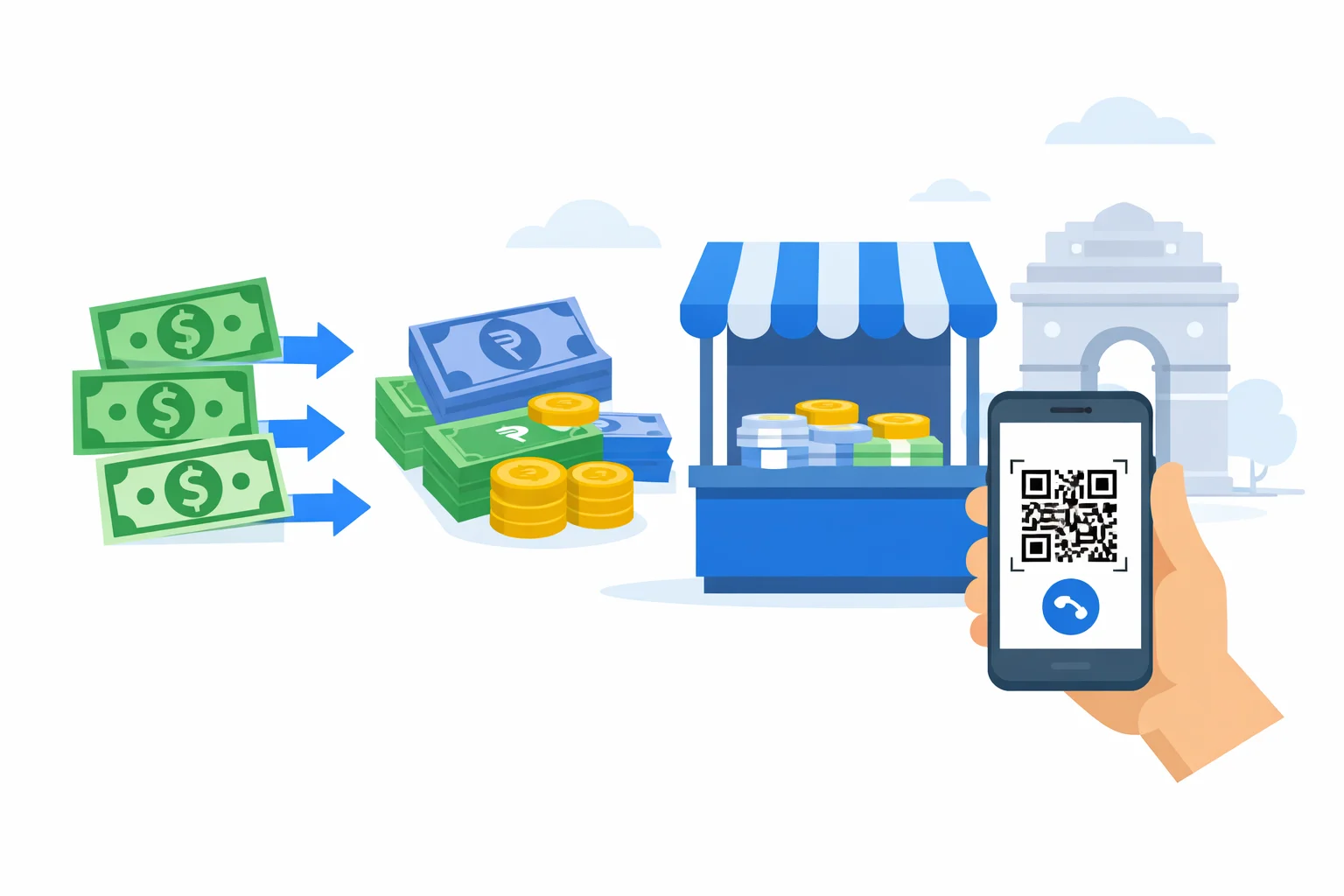
How Many Rupees Your Dollars Really Buy
Dollars to rupees is a multiplication, not the divide-by trap that catches people converting into euros or pounds. Take your dollars, multiply by the USD/INR rate, and you're done. At 87.5, $20 is ₹1,750, $50 is ₹4,375, and $200 is ₹17,500. Because the numbers get big fast, India groups them differently than the West — ₹17,500 looks familiar, but ₹1,75,000 (for $2,000) uses the lakh system, with the comma after two digits, not three.
Here's the shortcut worth memorizing before you fly: multiply by 88 and you're within a rounding error. Or add two zeros to your dollar figure and shave off roughly 12% — $50 → 5,000 → knock off ~600 → ₹4,375. It sounds fussy, but a fast mental estimate is your best defense against a rickshaw driver's "special price" or a shop that quietly rounds up. If you're converting the other direction — pricing out rupees you'll bring home or a payment coming from India — our rupees to dollars converter runs the division and covers India's outbound limits.
The Airport Kiosk Is Where Dollars Go to Die
The brightly lit exchange counter past immigration is the single worst rate you'll see on the whole trip. Airport kiosks routinely price rupees 5-10% below the mid-market rate, so the $100 that's worth ₹8,750 on Google comes back as ₹7,900-8,300 in cash. Make that a habit across a two-week trip and it quietly bleeds ₹3,000-4,000 for nothing.
The fix is simple: change just enough at the airport to cover the taxi and your first day — think ₹3,000-5,000 — and get the rest from a bank ATM in the city, where the rate sits close to mid-market. Skip pre-ordering a big stack of rupees from your US bank too; that usually runs 4-7% over mid-market, and there's a legal wrinkle: as a foreign visitor you're not allowed to carry more than ₹25,000 in Indian currency into the country anyway. A small arrival float plus local ATM withdrawals beats a suitcase of pre-bought notes every time.
Why India Runs on QR Codes, Not Cards
India didn't leapfrog to cards — it leapfrogged past them. UPI, the Unified Payments Interface, now handles well over 10 billion transactions a month, and the practical effect for a traveler is everywhere: the chai stall, the auto driver, the tiny pharmacy all have a printed QR code, and many would rather take a ₹40 UPI payment than dig out change for a card their little terminal can't read.
The good news is that foreign visitors can finally join in. Prepaid wallets like UPI One World let you load rupees in cash at partner airport counters, tie the wallet to your passport and visa, and then pay by scanning QR codes just like a local — with any unused balance refunded when you leave. It won't replace a little cash for the most informal vendors, but it turns the "sorry, no card" wall into a non-issue for most day-to-day spending. Pair it with a no-foreign-fee card for hotels and flights, and you've covered nearly everything.
The ATM Rules Nobody Warns You About
Indian ATMs come with two quirks that catch Americans off guard. First, many machines cap a single withdrawal at ₹10,000 (about $114) — some SBI and private-bank machines go to ₹20,000, but plan around the lower number. Second, the fees stack: the Indian bank charges roughly ₹200-250 per foreign-card withdrawal, then your home bank adds its own foreign-ATM fee and a currency markup near 3%.
That flat fee is why howyou withdraw matters as much as the rate. Pull ₹10,000 in one go and the ₹200 machine fee is about 2% of the cash. Pull ₹2,000 five times to reach the same ₹10,000 and you've paid ₹1,000 in machine fees alone — roughly 10%, before your own bank piles on. So take the maximum the machine allows in a single transaction, use ATMs attached to a real bank branch rather than standalone kiosks, and always decline the machine's offer to "convert" the amount for you — that's dynamic currency conversion, and it bakes in a 3-8% markup on top of everything else.
What a Day in India Actually Costs
Numbers on a converter mean more once you attach them to real things. Here's what everyday India costs, with the dollar equivalent at ₹87.5 so you can feel how far a small amount stretches:
| What you're buying | Rupees | ≈ US dollars |
|---|---|---|
| Masala chai from a street stall | ₹15 | $0.17 |
| Delhi Metro single ride | ₹40 | $0.46 |
| Auto-rickshaw across town | ₹150 | $1.71 |
| Veg thali at a local restaurant | ₹180 | $2.06 |
| Pint of beer in a bar | ₹300 | $3.43 |
| Night in a 3-star hotel | ₹3,500 | $40.00 |
| Domestic flight (Delhi–Jaipur) | ₹4,500 | $51.43 |
A single $10 bill covers a whole day of chai, metro rides and a couple of thalis for a budget traveler. That's the real reason the budget builder above splits spending into stay, food, transport and sights — in India, food and local transport barely move the needle, while your hotel tier is what actually decides whether a day costs $25 or $175. Modeling a bigger trip across several currencies? The multi-currency converter lets you line up several legs at once.
Why the Taj Mahal Costs a Foreigner 22× More
Budget for one line item that surprises nearly every visitor: dual pricing at monuments. India charges foreign tourists far more than citizens at sites run by the Archaeological Survey of India, and it's official, posted policy — not a scam. The Taj Mahal is the headline example: about ₹1,100 for a foreign visitor (plus ₹200 to step inside the mausoleum) versus ₹50 for an Indian citizen. That's more than 22 times the local price.
It's the same story elsewhere — the Red Fort runs around ₹600 for foreigners versus ₹35 for locals, and Amber Fort, Qutub Minar and the rest follow suit. None of these are budget-breakers in dollar terms (₹1,300 is about $15), but they add up on a monument-heavy itinerary, and the price you see quoted on a travel blog is often the Indian one. Assume ₹1,000-1,600 per major site when you plan — which is exactly the range the Trip Budget Builder folds into its "Sights" bucket.
Money Mistakes That Quietly Inflate a Trip
- Saying yes to "pay in dollars."When a hotel terminal or a website offers to charge your card in USD instead of rupees, that's dynamic currency conversion, and it hides a 3-8% markup. Always pick rupees and let your own bank do the conversion.
- Trusting a "0% commission" booth.The sign is technically true — they make their money on a rate 4-6% off mid-market instead. On $300 changed at a bad booth, that's ₹1,000+ gone to a word that sounds free.
- Over-tipping American-style.India isn't a 20%-tip culture. Round up an auto fare, leave ₹50-100 at a restaurant (or 5-10% at nicer spots), and check whether a service charge is already on the bill before adding more.
- Flying home with a fistful of rupees.US banks buy back Indian notes at a poor rate and won't touch coins at all, so leftover rupees are close to dead money. Spend down to a small souvenir stash, or reload it onto your UPI wallet before the airport.
None of this is complicated once you see the pattern: change little at the airport, lean on UPI and a fee-free card, pull ATM cash in big single withdrawals, and refuse every offer to convert "for your convenience." Do that and the gap between the rate on this page and the rate you actually get stays a rounding error — which, on a trip to India, is exactly where you want it.