AED to USD: A Pegged Rate Means Fees Are the Whole Game
An AED to USD converter is the rare currency tool where refreshing the rate is a waste of time. The UAE dirham is pegged to the US dollar at 3.6725, a number the central bank has defended since 1997, so the rate you see today is the rate you'll see next month. That flips the usual advice on its head. With a floating currency you hunt for a good day; with the dirham there is no good day, only a good provider. This guide covers the simple math, why the peg exists, and where dirham-holders quietly lose money — hint: it's never the rate.
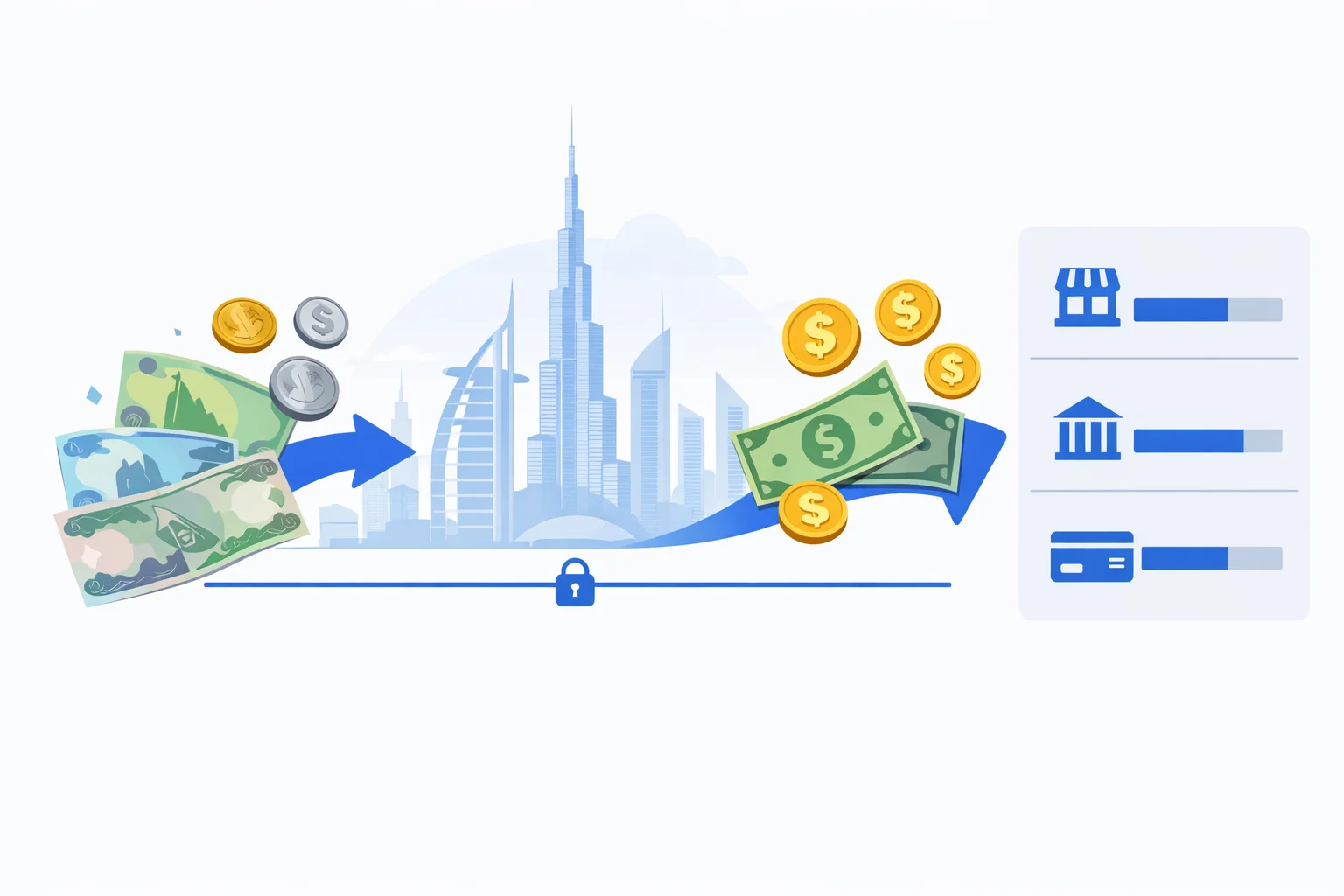
Turning Dirhams Into Dollars at 0.2723
The rate is quoted as USD/AED = 3.6725, meaning one dollar costs 3.6725 dirhams. To go from dirhams to dollars you divide by that number, or equivalently multiply by its inverse, 0.2723. One dirham is worth about 27 US cents.
- AED 1 → USD: 1 ÷ 3.6725 = $0.2723
- AED 1,000 → USD: 1,000 ÷ 3.6725 = $272.29
- AED 100,000 → USD: 100,000 ÷ 3.6725 = $27,229.41
A dirham splits into 100 fils, so a single fil is worth roughly a quarter of a US cent — small enough that fils rarely matter once you're thinking in dollars. If you need the reverse math for a Dubai trip or a dollar invoice, our multi-currency converter multiplies instead of divides. And because the peg holds, you can commit these figures to memory: AED 1,000 is always about $272, this year and, almost certainly, next.
Why the UAE Nails the Dirham to the Dollar
Oil is the reason. The UAE sells crude priced in dollars, and pegging the dirham removes exchange-rate risk from the country's single largest revenue stream. When your export earnings and your currency are locked together, a barrel sold today converts to a predictable pile of dirhams no matter what the market is doing. It's the opposite instinct from a floating petro-currency like the Canadian dollar, where the oil price yanks the exchange rate up and down; the UAE chose stability over that ride.
The dirham isn't alone. Saudi Arabia pegs the riyal at 3.75 to the dollar, Qatar at 3.64, Oman at 0.385, and Bahrain at 0.376 — the whole Gulf Cooperation Council runs on dollar pegs for the same oil-revenue logic. Holding a peg isn't free, though: the central bank must keep deep reserves and shadow US interest-rate moves to defend the level. The UAE has done exactly that for nearly three decades, which is why the dirham ranks among the most stable currencies on earth against the dollar.
The Rate Won't Move, So Fees Are Everything
Here's the mental shift that saves real money. On a floating pair, the exchange rate and the provider's fee both eat into your total, and the rate itself can swing several percent in a month. On AED to USD the rate is frozen — so 100% of the difference between what you should get and what you actually get is fee. Nothing else.
That makes shopping providers the entire game. An AED 10,000 transfer is worth $2,722.94 at the peg. Run it through a UAE exchange house at a 0.5% margin and you keep about $2,708. Push the same money through a bank wire with a 2.5% spread and a $25 SWIFT fee and you land near $2,630 — a $78 gap created entirely by fees, since both used the identical 3.6725 rate. The UAE happens to have one of the world's most competitive money-exchange sectors, with names like Al Ansari and LuLu Exchange fighting over remittance customers, so tight spreads are easy to find if you look past the bank counter. The fee bars in the tool above run this comparison on whatever amount you enter.
What a Dirham Salary Is Really Worth
Most people typing "1000 AED in USD" or "dirham to dollar" are expats sizing up a salary, and the UAE has a feature that makes the math unusually clean: no personal income tax. A wage quoted in dirhams is what you take home, so an AED 10,000 monthly salary is a flat $2,722 in your pocket, with nothing withheld before you convert. The country funds itself through 5% VAT on purchases and a 9% corporate tax on business profits above AED 375,000, introduced in June 2023 — but salaries stay untouched.
This matters because roughly 88% of the UAE's residents are foreign nationals, and a large share of what they earn flows back home. The UAE is one of the largest remittance-sending countries in the world, with outflows running into the tens of billions of dollars a year, per World Bank remittance data. The biggest corridor runs to India, which is why so many workers think in dirhams and dollars in the same breath; our USD to INR converter picks up that leg of the trip. Because the dirham is effectively as good as dollars, that first conversion is cheap — the real cost shows up on the onward hop into a floating currency.
The Quiet Payoff: Your Dirhams Kept Their Dollars
The peg has a benefit that only shows up over years. Because the dirham never slid against the dollar, savings held in dirhams held their dollar value — while regional peers didn't. Look at what a fixed local amount bought in dollars around 2010 versus today:
| Currency | 10,000 units in ~2010 | 10,000 units today | Change in USD value |
|---|---|---|---|
| UAE dirham (pegged) | $2,722 | $2,722 | 0% |
| Indian rupee | $222 | $114 | −49% |
| Pakistani rupee | $118 | $36 | −70% |
| Egyptian pound | $1,786 | $204 | −89% |
The dirham line is flat because the peg pins it in place. An expat who parked earnings in a dirham account over that stretch preserved their purchasing power in dollar terms, while the same money left in rupees or Egyptian pounds would have shed half or more against the greenback. That stability is exactly what the peg is built to deliver, and it's a real, if invisible, form of protection for the millions who earn in dirhams.
Where Dirham-Holders Lose Money
- Watching the rate instead of the fee.Refreshing an app for a "better" 3.6725 is time you'll never get back — the fourth-decimal drift on AED 10,000 is under a dollar. Comparing two providers, by contrast, can save you $50-100 on the same transfer.
- Accepting "charge in USD" at a terminal.If a card machine or website offers to bill your card in dollars, that dynamic currency conversion hides a 3-4% markup. On an AED 5,000 purchase that's about $50 lost for nothing — always pay in the local currency shown.
- Wiring small amounts.A $25 SWIFT fee is trivial on a $27,000 transfer but brutal on an AED 1,000 one, where it's roughly 9% of the whole thing. Match the method to the size, or batch small transfers into one.
- Multiplying instead of dividing.Turning AED 1,000 into "$3,672" by multiplying is the classic slip — the dirham is worth less than a dollar, so you divide. The right answer, $272.29, is smaller, not larger.
When 3.6725 Isn't the Rate You'll Get
Treat 3.6725 as your planning baseline, not the number that hits your account. The peg fixes the mid-marketrate — the wholesale price banks trade at — but you're a retail customer, so a spread sits between you and that figure. Expect anywhere from 0.3% at a sharp exchange house to 3-4% at a bank counter or a card's DCC screen. On a large transfer, trimming that spread from 2.5% to 0.5% is worth far more than any rate move could be, because the rate simply doesn't move.
There is one long-tail caveat: pegs can be revalued. Nothing is truly permanent, and Gulf central banks periodically float the idea of pegging to a basket of currencies instead of the dollar alone. But the UAE has shown no such intent, and 3.6725 has held through oil crashes, a global financial crisis, and a pandemic. For any transfer you're planning this year, it's fixed. To pressure-test a provider's markup against the true mid-market rate, run the numbers through our multi-currency converter before you commit, and use the fee bars above to see exactly what each channel keeps.