Egg Substitutes for Baking: How to Replace Eggs in Any Recipe
An egg substitute only works if it does the same jobthe egg was doing — and most recipes ask each egg to do more than one. You're halfway through brownies, the carton is empty, and the internet shouts "use applesauce!" Swap it into a recipe that needed the egg for lift, though, and you'll pull a flat, gummy pan out of the oven. The calculator above sidesteps that by asking what the egg is for first, then handing you the precise amount of the right swap.
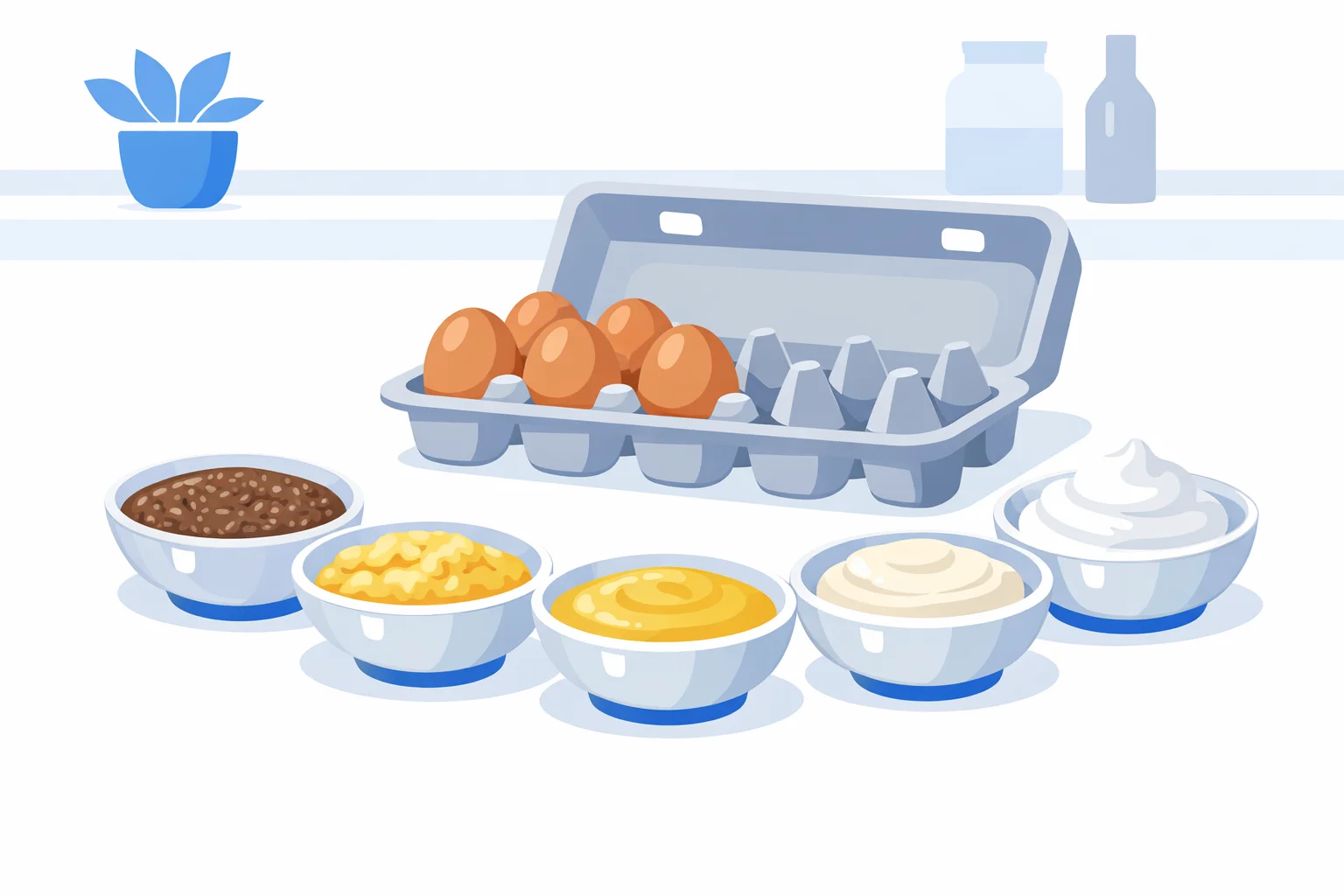
Match the Substitute to the Job, Not the Recipe
Here's the mistake behind almost every failed egg-free bake: treating all substitutes as interchangeable. They're not. A flax egg binds beautifully but adds zero lift. Aquafaba whips into clouds yet won't hold a cookie together. Applesauce keeps a cake moist but does nothing structural. Reach for the wrong one and the recipe fails in a specific, predictable way — flat, crumbly, or dense.
So the first question is never "what replaces an egg?" It's "what was this egg doing?" Answer that and the field narrows from a dozen confusing options to the two or three that actually fit.
The Four Jobs an Egg Does in Batter
A large egg is roughly 50 grams of multitasking — about 75% water, 12% protein, and 10% fat. Those parts handle four distinct jobs, and any given recipe leans on one or two of them:
- Binding.Egg proteins coagulate at 144–158°F (62–70°C), gluing crumbs, oats, and fillings together. It's what keeps cookies, veggie burgers, and meatballs from crumbling. Best swaps: flax egg, chia egg, silken tofu.
- Leavening. Beaten egg traps air; in a sponge cake or soufflé, that trapped air is the entire rise. Best swaps: whipped aquafaba, or a baking soda and vinegar reaction.
- Moisture. The 75% water content keeps a crumb soft. Best swaps: applesauce, mashed banana, yogurt — each adds about ¼ cup of liquid per egg.
- Richness.The yolk's fat and emulsifiers (lecithin) add tenderness and a velvety mouthfeel. Best swaps: silken tofu, nut butter, full-fat yogurt.
A chewy chocolate-chip cookie needs binding. An angel food cake lives and dies on leavening. A fudgy brownie wants moisture and richness. Same ingredient, three completely different reasons it's in the bowl.
How Much of Each Substitute Equals One Egg
Every ratio below is "per one large egg" and scales up cleanly — the tool simply multiplies by your egg count. Keep this chart handy:
| Substitute | Per 1 egg | Main job | Reliable up to |
|---|---|---|---|
| Flax egg | 1 tbsp ground flax + 3 tbsp water | Binding | 3 eggs |
| Chia egg | 1 tbsp chia + 3 tbsp water | Binding | 3 eggs |
| Aquafaba | 3 tbsp (2 tbsp per egg white) | Leavening | 3 eggs |
| Applesauce | ¼ cup (≈60 g) | Moisture | 2 eggs |
| Mashed banana | ¼ cup (≈60 g) | Moisture | 2 eggs |
| Silken tofu | ¼ cup blended (≈62 g) | Moisture + richness | 3 eggs |
| Plain yogurt | ¼ cup (≈60 g) | Moisture + binding | 2 eggs |
| Baking soda + vinegar | 1 tsp soda + 1 tbsp vinegar | Leavening | 2 eggs |
| Commercial replacer | 1 tbsp powder + 2 tbsp water | All-purpose | 4 eggs |
Notice the "reliable up to" column — it matters more than the ratio itself. Doubling a flax egg is fine; quadrupling it gives you a brick. When your amounts land on awkward fractions, run them through our all-in-one cooking converter to switch between tablespoons, cups, and grams.
Flax and Chia: The Binding Workhorses
When the egg's real job is holding things together, a flax or chia egg is the closest stand-in. The mechanism is simple: ground flaxseed and chia are loaded with soluble fiber (mucilage) that, mixed with water, swells into a sticky gel chemically similar to beaten egg. Stir 1 tablespoon of ground flax into 3 tablespoons of water, wait 5–10 minutes, and you get a thick goo that behaves like glue in the bowl.
Two details make or break it. Use groundseeds, not whole — whole flax passes through undigested and won't gel, and whole chia leaves a tapioca-pudding texture. And give it the full rest; rushing the soak is the top reason flax eggs "don't work." Because flax brings a nutty note and a denser crumb, it shines in cookies, banana bread, and whole-grain muffins, and all but disappears in anything already hearty.
When You Need Rise: Aquafaba and the Soda Trick
Leavening is the hardest egg job to fake, because beaten egg builds a protein-stabilized foam that's genuinely tough to copy. The one swap that comes close is aquafaba — the cloudy brine from a can of chickpeas. Its dissolved chickpea proteins and starches let it whip to stiff peaks. Use 3 tablespoons per whole egg, or 2 tablespoons to stand in for a single egg white, and whip it longer than you'd expect: 5–8 minutes, with a pinch of cream of tartar to hold the foam together for meringues and macarons.
For everyday cakes and quick breads that just need a bump of lift, skip the whipping and use a chemical reaction instead: 1 teaspoon of baking soda plus 1 tablespoon of vinegar per egg fizzes on contact and inflates the batter. Get it in the oven fast — the bubbles are fleeting. If your recipe is more about structure than rise, a properly scaled recipe with the right flour weight matters just as much as the egg swap.
Worked Example: 3 Eggs in a Banana Bread
Say your banana bread calls for 3 eggs. In that recipe the eggs mostly bind and add moisture — there's no delicate rise to protect, and banana flavor is already front and center. Walk the swap through:
- Pick a binding swap, so a flax egg leads. The ratio is 1 tbsp flax + 3 tbsp water per egg, so for 3 eggs: 3 tablespoons ground flaxseed + 9 tablespoons water (a little over ½ cup of water).
- Mix and rest 10 minutes until it's a thick gel before adding it to the wet ingredients.
- Because flax adds no lift, bump the leavening: add ¾ teaspoon of baking powder (about ¼ tsp per egg replaced) so the loaf still rises.
- Expect a slightly denser, moister crumb and a 5–10 minute longer bake. Test with a toothpick rather than trusting the original time.
Three eggs sits right at flax's reliable ceiling, which is why the bread works — push the same swap to 5 eggs and it would slump into pudding.
How Many Eggs Is Too Many to Replace?
Two eggs is the comfortable limit for most kitchen swaps, and there's a structural reason. Egg protein forms a network that sets a bake; substitutes mimic one job but never rebuild that full network. Replace one or two eggs and the recipe's flour and gluten carry the structure. Replace four or five and there's nothing holding the crumb together — applesauce or banana just turns it into a wet, sunken mess.
Commercial egg replacers (a blend of starches and leavening agents) stretch furthest, reliably handling 3–4 eggs because they're engineered to rebuild structure rather than mimic a single trait. Past that count, you're better off finding a recipe written to be egg-free from the start than fighting one that depends on six eggs for its entire architecture, like a popover or angel food cake.
When Not to Substitute Eggs
Some recipes are essentially egg foam with a little flour along for the ride. Don't bother swapping in these — the result won't resemble the original:
- Egg-forward classics — meringue, soufflé, angel food and sponge cakes, custards, and frittatas. The egg is the dish; aquafaba gets you partway on meringue but rarely matches the rest.
- Recipes needing 4+ eggs for structure — popovers and Yorkshire pudding rely on a violent egg-driven rise no home swap reproduces.
- An egg wash for shine— here the egg is purely cosmetic. Brush with plant milk plus a little maple syrup instead; you don't need ratios at all.
For everything else — cookies, muffins, quick breads, brownies, pancakes, and most cakes — the right substitute at the right amount gives you a bake nearly indistinguishable from the original. If you're weighing your swaps for consistency, the cups-to-grams converter turns those ¼-cup measures into exact gram weights. For a deeper look at how eggs function in baking, the European Food Information Council breaks down the chemistry of binding, leavening, and emulsification in detail.