Sq Ft to Acres: The 43,560 Rule, Land-Size Chart & Real Estate Examples
Converting sq ft to acres is something you'll do dozens of times if you ever buy land, list a property, or compare lot sizes across neighborhoods. The math is dead simple — divide by 43,560 — but the context around that number matters more than most people realize. A 10,000 sq ft lot sounds large until you learn it's barely a quarter acre. This guide breaks down the conversion, explains where 43,560 comes from, and walks through the real-estate scenarios where getting the acreage right actually affects your wallet.
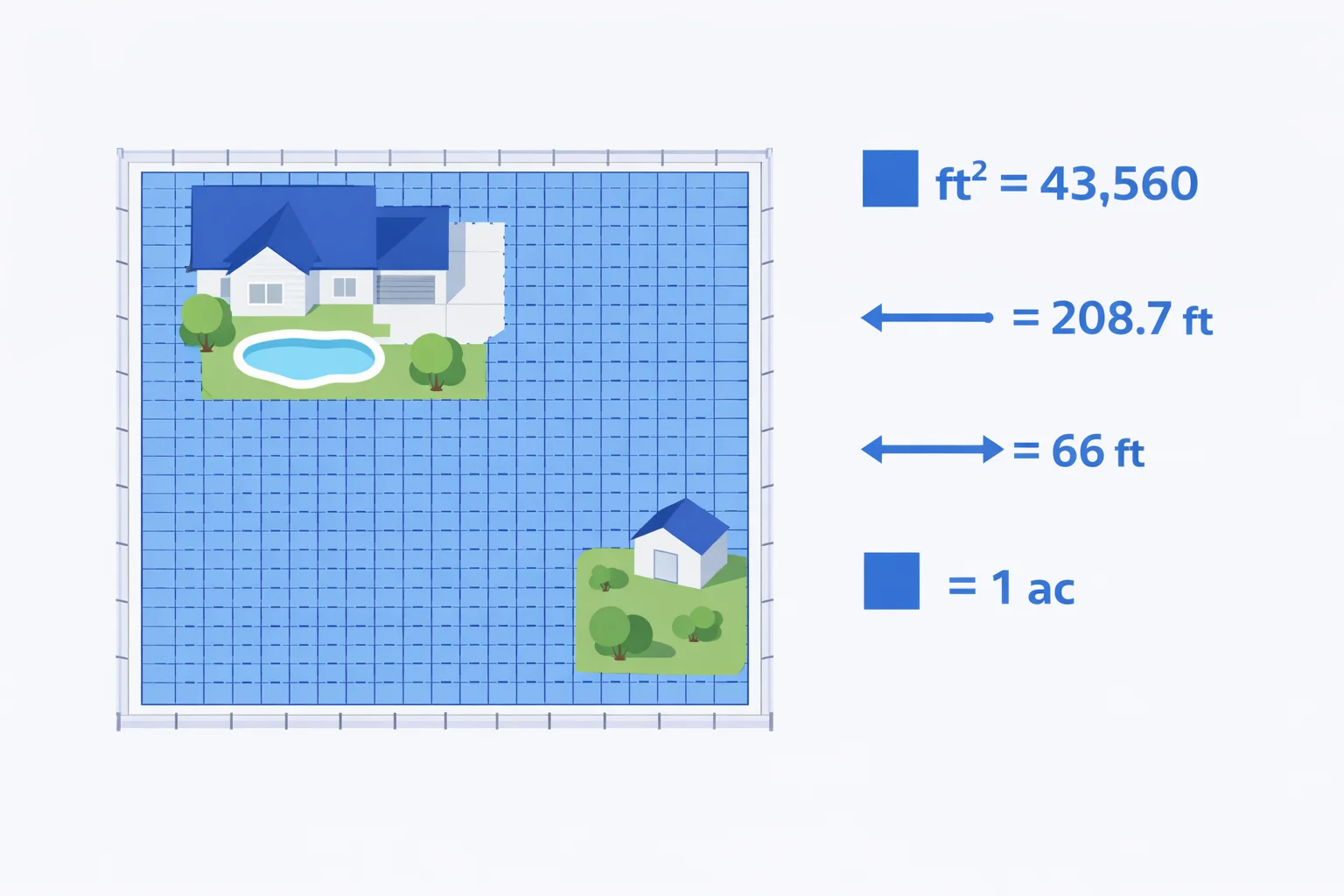
The 43,560 Rule — Where It Comes From
An acre is exactly 43,560 square feet. That oddly specific number has a backstory. In medieval England, an acre was the amount of land a yoke of oxen could plow in a single day. They standardized it as one chain wide (66 feet) by one furlong long (660 feet). Multiply those: 66 × 660 = 43,560. The chain was a real surveying tool — Edmund Gunter invented the 66-foot chain in 1620, and it became the backbone of British and American land measurement for centuries.
The number stuck. Today the National Institute of Standards and Technology (NIST) still defines 1 acre = 43,560 ft² in the U.S. survey system. It's not a metric unit — it's purely an artifact of English Imperial measurement — but it remains the dominant land unit in American real estate, agriculture, and zoning.
Step-by-Step Conversion with Worked Examples
The formula:
acres = square feet ÷ 43,560
Example 1 — Suburban lot:A listing says 8,712 sq ft. Divide: 8,712 ÷ 43,560 = 0.2000 acres. That's exactly one-fifth of an acre — a standard suburban lot in many Midwest subdivisions.
Example 2 — Half-acre parcel: You measured 21,780 sq ft on a county GIS map. Divide: 21,780 ÷ 43,560 = 0.5000 acres. Half an acre gives you room for a 2,500 sq ft house, a two-car garage, and a generous backyard with a pool.
Example 3 — Commercial plot: A developer is selling 130,680 sq ft. Divide: 130,680 ÷ 43,560 = 3.0000 acres. Three acres is common for small retail plazas or medium-density apartment complexes under zoning code R-3.
Example 4 — Odd parcel:The survey shows 17,424 sq ft. Divide: 17,424 ÷ 43,560 = 0.4000 acres. Two-fifths of an acre. Not a neat fraction you'd see in marketing, but the calculator handles it instantly.
Lot Size Reference Chart
This table covers the lot sizes you'll encounter most often in U.S. real estate. Bookmark it — agents, appraisers, and builders reference these numbers constantly.
| Lot Type | Sq Ft | Acres | Approx. Dimensions |
|---|---|---|---|
| Urban rowhouse | 2,500 | 0.057 | 25 × 100 ft |
| City single-family | 5,000 | 0.115 | 50 × 100 ft |
| Quarter acre | 10,890 | 0.250 | 104 × 104 ft |
| Half acre | 21,780 | 0.500 | 148 × 148 ft |
| Full acre | 43,560 | 1.000 | 209 × 209 ft |
| Five acres (hobby farm) | 217,800 | 5.000 | 467 × 467 ft |
Visualizing an Acre Without a Tape Measure
43,560 square feet is abstract. These comparisons make it concrete:
- Football field: An American football field (including end zones) covers 57,600 sq ft — about 1.32 acres. The playing field alone (without end zones) is 48,000 sq ft, or 1.10 acres. So one acre is roughly 76% of a football field.
- Tennis courts:A single tennis court is 2,808 sq ft. You'd need about 15.5 tennis courts to fill one acre.
- Parking spaces: A standard parking space is roughly 180 sq ft (9 × 20 ft). One acre fits about 242 parking spaces — though in practice, lanes and landscaping cut that to around 150-180 usable spots.
- City blocks:A typical city block varies wildly — Portland's are about 1.6 acres while Manhattan's are closer to 5 acres. There's no universal "one block = X acres" rule.
If you need the reverse direction — starting with acreage and want square footage — use our acres to square feet converter.
Sq Ft to Acres in Real Estate Pricing
Land listings in the U.S. use acres for rural and suburban property but square feet for urban lots. Comparing across those formats requires conversion. Here's a real example:
A 2-acre parcel in rural Texas is listed at $60,000 ($30,000/acre). A 12,000 sq ft lot in a Houston suburb is listed at $85,000. Which is cheaper per acre? The Houston lot is 12,000 ÷ 43,560 = 0.2755 acres, so the price per acre is $85,000 ÷ 0.2755 = $308,530/acre. The rural parcel costs 10× less per acre — but location, utilities, and zoning make that comparison more nuanced than the raw number suggests.
County tax assessors also use acreage to calculate property tax. If your assessment reads "0.34 acres" but your survey says 15,246 sq ft, a quick check: 15,246 ÷ 43,560 = 0.3500 acres. Close enough — but a 0.01-acre discrepancy on a $500,000 property could shift your tax bill by hundreds annually. Always verify.
Mistakes That Cost Money in Land Deals
- Confusing gross and net acreage. A 2-acre parcel might have only 1.4 usable acres after deducting easements, flood zones, and right-of-way. Always ask for the net buildable area, not just the total lot size.
- Rounding too aggressively.Calling a 9,583 sq ft lot "a quarter acre" inflates it by 13.6%. A real quarter acre is 10,890 sq ft. In a $200/sq ft market, that rounding error implies $261,400 of value that doesn't exist.
- Mixing up sq ft and acres in price comparisons. Listing A is $12/sq ft. Listing B is $175,000/acre. To compare: $175,000 ÷ 43,560 = $4.02/sq ft. Listing B is a third the cost per square foot — not obvious until you normalize the units.
- Ignoring survey vs. tax record discrepancies. County GIS data is often approximate. A fresh survey might differ by 500–2,000 sq ft from the recorded assessment. On boundary disputes, the survey wins.
Zoning, Setbacks, and Usable Acreage
Knowing your lot in acres is step one. Step two is figuring out how much of it you can actually build on. Zoning codes dictate minimum lot sizes, maximum lot coverage ratios, and required setbacks from property lines.
A common residential zone might allow 40% lot coverage. On a 10,890 sq ft quarter-acre lot, that means your building footprint can't exceed 4,356 sq ft. Front, side, and rear setbacks — typically 20-30 feet in front, 5-10 on sides, 15-25 in back — shrink the buildable envelope further. For a 10,890 sq ft lot that's 104 × 104 ft with 25-ft front, 20-ft rear, and 5-ft side setbacks, the buildable area drops to roughly 74 × 94 = 6,956 sq ft. That's 64% of the lot — not 100%.
From Acres to Metric — Hectares and Square Meters
If you're dealing with international buyers or reading land data from countries that use metric, you'll need to bridge the gap:
- 1 acre = 0.4047 hectares
- 1 acre = 4,046.86 square meters
- 1 hectare = 2.471 acres
- 1 sq ft = 0.0929 square meters
So a 0.25-acre lot is about 0.1012 hectares or 1,011.7 m². For international property comparisons, our square feet to square meters converter handles the direct sq ft → m² conversion, and the acres to hectares converter works for larger parcels.
When You Need This Conversion
A few scenarios where sq ft to acres isn't optional:
- Buying or selling land. Rural listings use acres; urban listings use square feet. Comparing both requires conversion.
- Property tax verification.Tax assessments reference acreage. Cross-check against your survey's square footage to catch errors.
- Agricultural planning. Seed rates, fertilizer coverage, and irrigation capacity are all calculated per acre. If your field data is in sq ft, convert first.
- Zoning compliance.Minimum lot sizes in zoning codes are usually stated in acres (e.g., R-1 = 1-acre minimum). Know your lot's acreage before filing a building permit.
- Insurance and appraisal. Home insurers factor lot size into premiums. Appraisers need accurate acreage for comparable sales analysis.