Square Feet to Square Yards: The Divide-by-9 Rule, Carpet Pricing & Flooring Guide
Sq ft to sq yd conversion trips up more carpet shoppers than you'd expect. You measure your living room in square feet — that's what the tape measure gives you — then walk into a flooring store where everything is priced per square yard. The math is simple (divide by 9), but getting the details wrong means buying too little carpet and paying for a second delivery, or buying too much and eating the restocking fee. This guide covers the formula, the practical pitfalls, and the real-world numbers you'll encounter when shopping for carpet, sod, or fabric.
The Divide-by-9 Rule Explained
One yard equals 3 feet. Square both sides and you get 1 square yard = 9 square feet. That's it. To convert any area from square feet to square yards, divide by 9.
Formula: sq yd = sq ft ÷ 9
The inverse works the same way — multiply square yards by 9 to get square feet. A carpet remnant labeled 12 sq yd covers 108 sq ft. Simple, and unlike many unit conversions, there's no messy decimal factor to memorize.
Why Carpet Is Sold in Square Yards
Walk into any carpet store and you'll see prices per square yard, not square foot. This isn't arbitrary. Carpet manufacturing traces back to the British textile industry, where the yard was the standard unit of length. Carpet rolls are woven in widths of 12 feet (4 yards) or 15 feet (5 yards), and wholesale pricing naturally settled on the square yard as the base unit.
Some big-box retailers like Home Depot have shifted to per-square-foot pricing to match how Americans measure rooms. But independent carpet shops, commercial flooring suppliers, and online wholesalers still default to square yards. If you see a carpet advertised at $27 per square yard, that's $3 per square foot — a detail that changes your budget math dramatically for a large room.
Step-by-Step Worked Examples
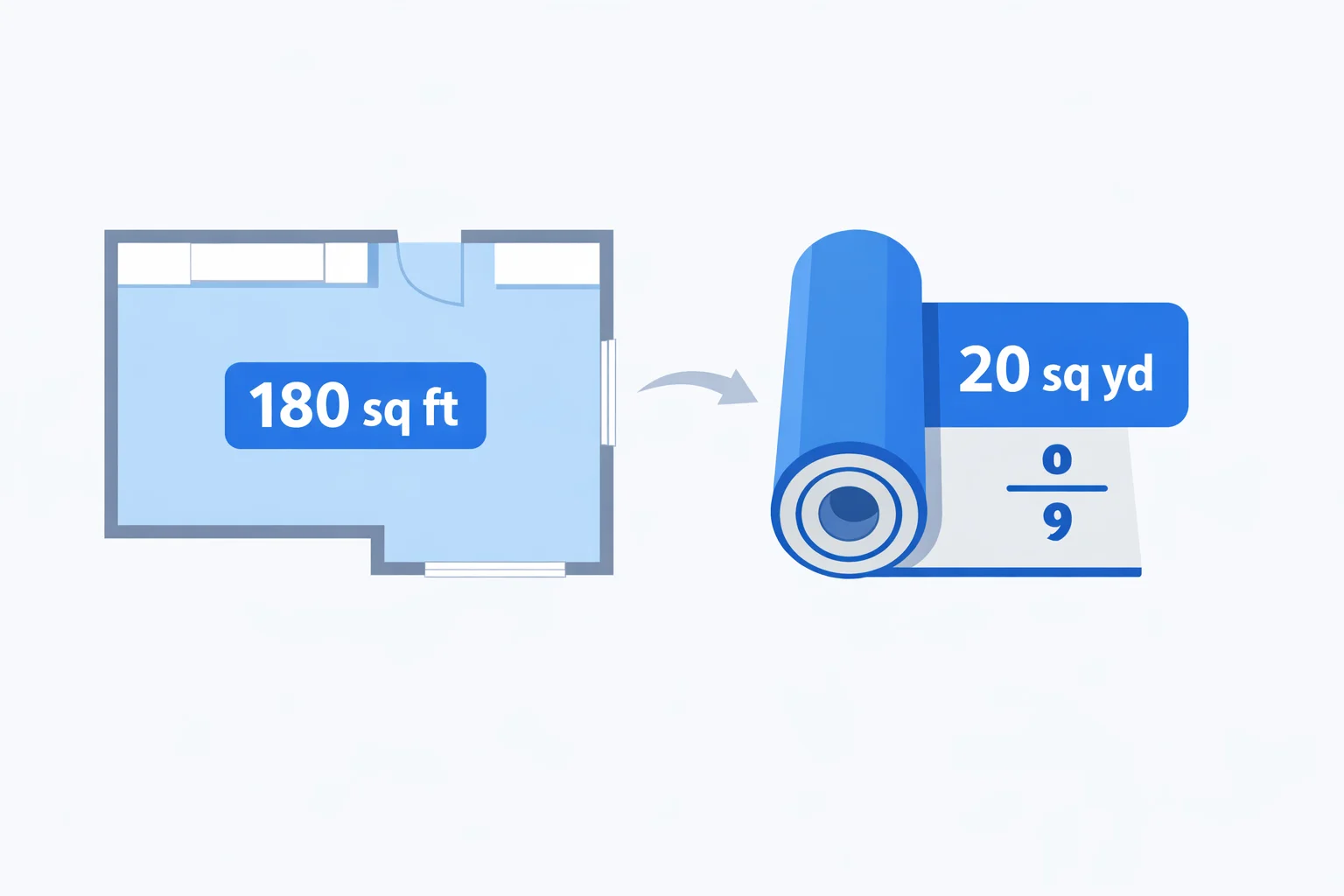
Example 1: Standard bedroom.A 12×15 ft bedroom is 180 sq ft. Divide by 9: 180 ÷ 9 = 20 sq yd. At $30 per sq yd, that's $600 for material before waste.
Example 2: L-shaped living room. Measure the two rectangles separately — say 15×20 ft (300 sq ft) and 10×12 ft (120 sq ft). Total: 420 sq ft ÷ 9 = 46.67 sq yd. Round up to 47 and add 10% waste: about 52 sq yd to order.
Example 3: Whole-house carpet. Three bedrooms (144 + 180 + 120 sq ft), a hallway (60 sq ft), and stairs (70 sq ft) = 574 sq ft. That's 63.78 sq yd. With 15% waste for the stairs and hallway cuts, order about 73 sq yd. If you also need to convert your measurements to metric units, our square feet to square meters converter handles that instantly.
Carpet Buying Guide: Measuring, Waste & Seams
The divide-by-9 formula gives you the theoretical minimum. Real carpet installation always requires more material. Here's what drives the difference:
- Roll width constraints. Carpet comes in 12 ft or 15 ft widths. A 13-foot-wide room needs a 15 ft roll, wasting 2 ft of width across the entire length. That scrap adds up fast.
- Seam placement. Seams should run perpendicular to the main light source (usually windows) and away from high-traffic paths. This sometimes means orienting the carpet in a less material-efficient direction.
- Pattern matching. Patterned carpet requires aligning the repeat at every seam. A 12-inch repeat pattern can add 5–10% more material on a room with multiple seams.
- Standard waste allowance. Most installers recommend 10% extra for rectangular rooms and 15% for rooms with alcoves, closets, or angled walls. Stairs can require 20% waste due to the cutting geometry.
A pro tip from flooring installers: always sketch your floor plan with dimensions and take it to the carpet store. They'll calculate the optimal cut from the roll, which is almost always more efficient than your own estimate. The sketch also protects you — if the installer runs short, the measurements on your sketch prove it wasn't your error.
Common Room Sizes in Square Feet and Square Yards
This reference table covers the most common residential room sizes. These are based on U.S. Census Bureau housing data and standard builder footprints:
| Room Type | Typical Size (sq ft) | Square Yards | Carpet Cost @$25/yd² |
|---|---|---|---|
| Half bath | 30–50 | 3.3–5.6 | $83–$139 |
| Full bathroom | 50–100 | 5.6–11.1 | $139–$278 |
| Small bedroom | 100–144 | 11.1–16.0 | $278–$400 |
| Standard bedroom | 144–200 | 16.0–22.2 | $400–$556 |
| Master bedroom | 200–350 | 22.2–38.9 | $556–$972 |
| Living room | 250–400 | 27.8–44.4 | $694–$1,111 |
| Family/great room | 400–600 | 44.4–66.7 | $1,111–$1,667 |
| Finished basement | 500–1,000 | 55.6–111.1 | $1,389–$2,778 |
These cost estimates are material only at $25/sq yd — a mid-range price point. Budget carpet starts around $10–15/sq yd, while premium wool or patterned styles can hit $60–80/sq yd. Installation typically adds $3–6 per square yard on top.
5 Mistakes That Inflate Your Carpet Bill
Carpet purchasing errors are surprisingly common, and most of them stem from confusing units or skipping basic math.
- Dividing by 3 instead of 9. This is the most frequent blunder. Dividing 300 sq ft by 3 gives 100 — that's linear yards, not square yards. You'd order three times too much carpet. The correct answer is 300 ÷ 9 = 33.33 sq yd.
- Forgetting waste. Ordering exactly 33.33 sq yd for a 300 sq ft room leaves zero margin for cuts, seams, or mistakes. Add at least 10%.
- Confusing sq yd pricing with sq ft pricing. A carpet at $27/sq yd sounds expensive until you realize it's only $3/sq ft. Conversely, $5/sq ft sounds cheap but equals $45/sq yd. Always convert to the same unit before comparing.
- Measuring walls instead of floor. Measure at floor level, not along baseboards or walls, which may bow. And measure the longest and widest points of the room — alcoves and bump-outs count.
- Ignoring carpet pile direction. All pieces in a room must run the same pile direction or you'll get visible color differences at the seams. Installers sometimes need extra material to maintain consistent direction across complex floor plans.
Square Yards vs Linear Yards — Know the Difference
This distinction catches people off guard. A square yard is a unit of area: 3 ft × 3 ft = 9 sq ft. A linear yard(or just "yard") is a unit of length: 3 feet, period.
When a fabric store sells upholstery fabric "by the yard," they mean one linear yard along the bolt's length, at whatever the bolt width is (usually 54 inches). One linear yard of 54-inch fabric covers 54 × 36 = 1,944 square inches, or 13.5 square feet — that's 1.5 square yards. For carpet, a linear yard off a 12-foot-wide roll covers 12 × 3 = 36 sq ft = 4 sq yd.
Always clarify with your supplier: "Is this price per square yard or per linear yard?" The difference can double or triple the actual cost per unit of floor covered. If you need to convert the other direction — from square yards back to square feet — use our square meters to square feet converter for metric comparisons, or simply multiply by 9.
When You Need This Conversion
The sq ft to sq yd conversion comes up in a handful of specific situations:
- Carpet shopping. You measured your rooms in square feet, but the store quotes per square yard. Divide by 9 to compare apples to apples.
- Landscaping. Sod, mulch, and gravel are sometimes sold by the square yard. A 2,000 sq ft lawn needs about 222 sq yd of sod.
- Fabric and upholstery. Large upholstery projects (covering a sectional sofa, making curtains) use yardage calculations that start with area in square feet.
- Commercial flooring bids. Contractors for office buildings and hotels often spec flooring in square yards. If you have a tenant improvement allowance stated in $/sq ft, you'll need to convert to compare vendor bids.
- Real estate in non-U.S. markets. Some Commonwealth countries still reference property area in square yards. India, for instance, uses square yards for residential plots alongside acres for larger parcels. Converting from square feet helps compare properties across measurement conventions.
For most people, this conversion matters once or twice a decade — right when you're about to spend serious money on flooring. That's exactly when getting it right (or wrong) has the biggest financial impact. According to the Bureau of Labor Statistics CPI data, flooring costs have risen about 3.5% annually over the past decade, making material waste even more expensive than it used to be.