Acres to Hectares: The 0.4047 Factor, Farm-Size Chart & Global Land Units Compared
Converting acres to hectaresis something you'll run into the moment land crosses an international border — whether that's a farm purchase in Canada listed in hectares, a USDA crop report you need to compare with EU data, or a real estate listing in Australia. One acre equals 0.4047 hectares, and that single factor is the bridge between the imperial system that dominates U.S. land records and the metric system the rest of the world uses for agriculture.
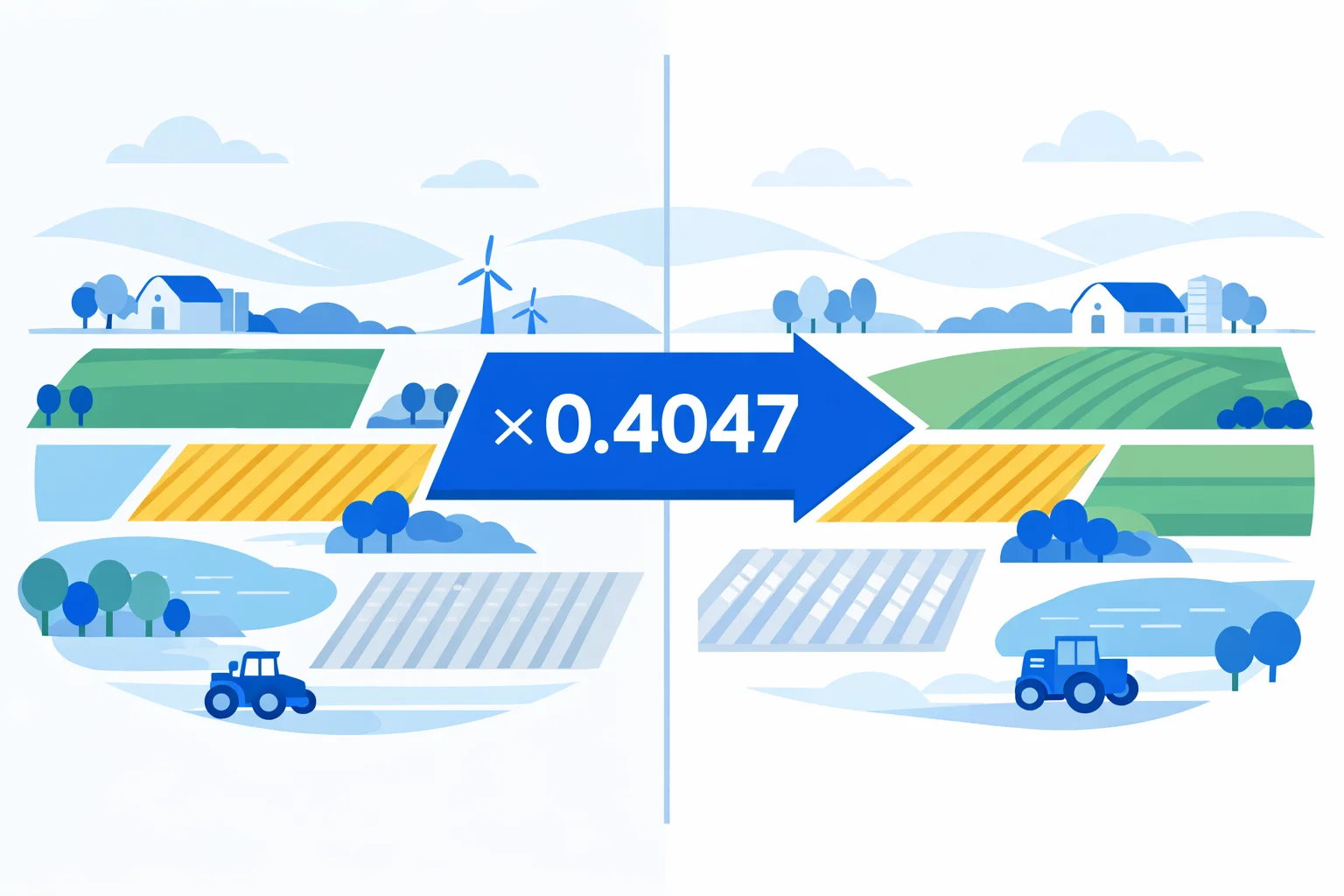
The 0.4047 Factor — Where It Comes From
An acre is defined as 43,560 square feet. A hectare is exactly 10,000 square meters. To get from one to the other, you convert through the meter-to-foot relationship: 1 foot = 0.3048 meters, so 1 square foot = 0.09290304 m². Multiply 43,560 by 0.09290304 and you get 4,046.8564224 m² per acre. Divide that by 10,000 m² per hectare and you land on 0.40468564224 — rounded to 0.4047 for daily use.
That four-digit shortcut is accurate to within 0.004% of the precise value. Even on a 10,000-acre ranch, the rounding error is under half a hectare. For deeds, government filings, or scientific work, use the full constant. For everything else, 0.4047 does the job.
Step-by-Step Conversion with Worked Examples
The formula is straightforward: hectares = acres × 0.404686. Let's walk through four real scenarios.
Example 1 — Suburban lot:You own 0.5 acres. 0.5 × 0.4047 = 0.2023 ha. That's 2,023 m², roughly the area of eight tennis courts.
Example 2 — Quarter section:A traditional U.S. homestead quarter section is 160 acres. 160 × 0.4047 = 64.75 ha. If you're filling out a Canadian land form, that's the number you need.
Example 3 — Mid-size grain farm: 500 acres of wheat in Kansas. 500 × 0.4047 = 202.3 ha. When comparing yields with European farms that report in tonnes per hectare, you now have a like-for-like baseline.
Example 4 — Large cattle ranch:A 12,000-acre ranch in Texas equals 4,856 ha, or about 48.6 km². For perspective, that's roughly the size of the city of San Francisco.
Farm Size Chart: Acres vs. Hectares Around the World
Farm sizes vary enormously by region. This table puts U.S. acre-based figures alongside hectare equivalents so you can compare across countries at a glance.
| Farm Type | Acres | Hectares | Where Common |
|---|---|---|---|
| Smallholding / allotment | 0.25–2 | 0.1–0.8 | UK, Japan, India |
| Market garden | 2–10 | 0.8–4 | EU, Southeast Asia |
| Family farm | 40–160 | 16–65 | U.S. Midwest, Canada |
| Commercial farm | 200–1,000 | 81–405 | U.S., Australia, Brazil |
| Large-scale operation | 1,000–10,000 | 405–4,047 | Australia, Argentina, U.S. West |
| Industrial / corporate | 10,000+ | 4,047+ | Brazil (soy), Australia (cattle) |
Notice how a "small farm" in Australia might be 500 hectares — larger than the average U.S. farm at 180 hectares (445 acres). Context matters. If you need the reverse direction, our square feet to acres converter handles lot-level measurements.
Why Do Acres and Hectares Both Exist?
The acre dates back to medieval England. It originally described the amount of land a yoke of oxen could plough in a single day — roughly a furlong (660 feet) by a chain (66 feet). That product, 43,560 square feet, stuck. British colonies inherited the acre, and it became the standard land unit in the U.S., UK, Ireland, and parts of South Asia.
The hectare came much later. When France established the metric system in 1795, they needed a land unit that related cleanly to meters. A square with 100-meter sides encloses 10,000 m² — one hectare. Because 100 hectares make one square kilometer, it slots neatly into the metric family. The International Bureau of Weights and Measures (BIPM) recognizes the hectare as accepted for use with SI, even though it isn't an official SI unit.
Today, hectares dominate in nearly every country's land records, agricultural statistics, and environmental reports. The U.S. and Myanmar are the main holdouts still using acres for domestic purposes — though even USDA international trade data often includes hectare equivalents.
Mistakes That Misvalue Land
Getting the conversion wrong has real financial consequences. Here are the errors that actually happen.
- Confusing "times 2.5" with "times 0.4": To go from acres to hectares, multiply by 0.4047. To go from hectares to acres, multiply by 2.471. Mixing these up flips the result by a factor of 6. A 100-acre listing reported as 247 hectares instead of 40.5 hectares looks 6× bigger than it is.
- Rounding 0.4047 down to 0.4:On small plots, the difference is trivial. On 5,000 acres, 0.4 gives 2,000 ha while 0.4047 gives 2,023 ha — that's 23 missing hectares, or roughly 57 acres of land that vanished from your spreadsheet.
- Forgetting that "square acres" isn't a thing:An acre is already a unit of area. Don't square it again. If your deed says 40 acres, the conversion is 40 × 0.4047 = 16.19 ha. Not 40² × anything.
- Mixing up hectares with square hectometers:They're the same thing (1 hm² = 1 ha), but some GIS software labels plots in hm² while spreadsheets use ha. No conversion needed — just rename.
Acres to Hectares in Agriculture and Government Data
Crop yields in the U.S. are reported in bushels per acre. The rest of the world uses tonnes (or kilograms) per hectare. To compare, you need both unit conversions: weight and area.
For example, a Kansas wheat field yielding 50 bushels per acre: 50 bu/ac × 0.0272155 tonnes/bu = 1.36 tonnes per acre. Divide by 0.4047 to get tonnes per hectare: 1.36 ÷ 0.4047 = 3.36 t/ha. That's right in line with the global average wheat yield of about 3.4 t/ha according to FAO crop statistics.
Government agencies run into this constantly. The USDA publishes acreage planted and harvested in acres, while the UN Food and Agriculture Organization (FAO) reports exclusively in hectares. Researchers bridging these datasets multiply every U.S. figure by 0.4047 before merging.
Mental Math Shortcuts for Field Estimates
You won't always have a calculator handy — especially standing in a field. Here are three tricks that get you close.
- The "divide by 2.5" trick: Acres ÷ 2.5 gives you hectares within 1.3% accuracy. 100 acres ÷ 2.5 = 40 ha (actual: 40.47 ha). Fast, easy, close enough for conversation.
- The "halve it minus 20%" trick: Take half the acres, then subtract about a fifth of that half. 200 acres → half is 100 → minus 20% (20) = 80 ha (actual: 80.94 ha). Works well up to a few thousand acres.
- The "5 acres ≈ 2 hectares" anchor:For rough estimates, every 5 acres is about 2 hectares. A 250-acre property? That's 50 chunks of 5, so roughly 100 ha (actual: 101.2 ha). Good enough for dinner-table math.
For precise conversions — converting acres to square feet and back — you'll want the full decimal factor rather than mental shortcuts.
Reading International Land Listings
If you're browsing farmland in France, vineyards in Chile, or timber plots in New Zealand, the listing will be in hectares. Here's a quick reference to calibrate your expectations.
| Hectares | Acres | What It Feels Like |
|---|---|---|
| 0.5 ha | 1.24 ac | Large residential lot with garden space |
| 2 ha | 4.94 ac | Small vineyard or hobby farm |
| 10 ha | 24.7 ac | Boutique winery or olive grove |
| 50 ha | 123.6 ac | Mid-size European arable farm |
| 200 ha | 494.2 ac | Substantial commercial farm |
| 1,000 ha | 2,471 ac | Australian sheep station or Brazilian fazenda |
When the listing price is in euros per hectare, multiply by 0.4047 to get the equivalent price per acre for a more intuitive comparison. A property listed at €15,000/ha is about €6,070/ac — or roughly $6,600/ac at current exchange rates.
When You Actually Need This Conversion
Not every land measurement needs converting. Here's when it genuinely matters.
- Cross-border land purchases: Buying property outside the U.S. means working in hectares. Your lender, surveyor, and title company will all expect metric figures.
- Agricultural trade and exports: Commodity markets report in metric tonnes per hectare. U.S. farmers selling grain internationally need to convert both yield and acreage.
- Environmental and carbon reporting: Carbon offset programs, reforestation grants, and biodiversity assessments almost universally use hectares. A 200-acre woodlot is 80.9 ha in your carbon credit application.
- Academic research and publishing: Scientific journals require SI-compatible units. Reporting field trial results in acres will get your paper bounced back for revision.
- Government forms outside the U.S.: Immigration applications, tax filings, and zoning permits in metric countries require land area in hectares or square meters.
For interior spaces or smaller lots where square feet to square meters is the more relevant conversion, we've got that covered too.