Acres to Square Feet: Lot-Size Comparison Table & Step-by-Step Math
Converting acres to sq ft is one of those tasks that sounds trivial until you actually need the number. You know your property is 2.3 acres — but what does that mean in square feet when you're comparing it to a neighbor's 95,000 sq ft listing or checking a zoning minimum? The answer: 2.3 × 43,560 = 100,188 sq ft. This guide walks through the math, gives you a reference chart for the lot sizes people actually search for, and explains the quirks that trip up buyers, sellers, and surveyors.
The Acre Defined: 43,560 Square Feet
One acre is exactly 43,560 square feet. No rounding, no approximation. The number dates back to medieval England, where land was measured in chains and furlongs. A chain stretches 66 feet. A furlong runs 660 feet (ten chains). Multiply 66 × 660 and you get 43,560 — the area one team of oxen could plow in a single day.
That origin story matters because it explains why 43,560 feels random. It's not based on a round number in any modern system. It's a product of practical farming history, codified into law by the British Parliament and inherited by the U.S. Public Land Survey System. The National Institute of Standards and Technology (NIST) still recognizes the acre as a standard unit of land area in the United States.
The Conversion Formula with Worked Examples
The formula is straightforward:
square feet = acres × 43,560
That's it — one multiplication. Here are a few common conversions worked out:
- ¼ acre: 0.25 × 43,560 = 10,890 sq ft. That's a standard suburban lot — think a 104 ft × 105 ft rectangle.
- ½ acre: 0.5 × 43,560 = 21,780 sq ft. Enough for a large home, detached garage, pool, and comfortable yard.
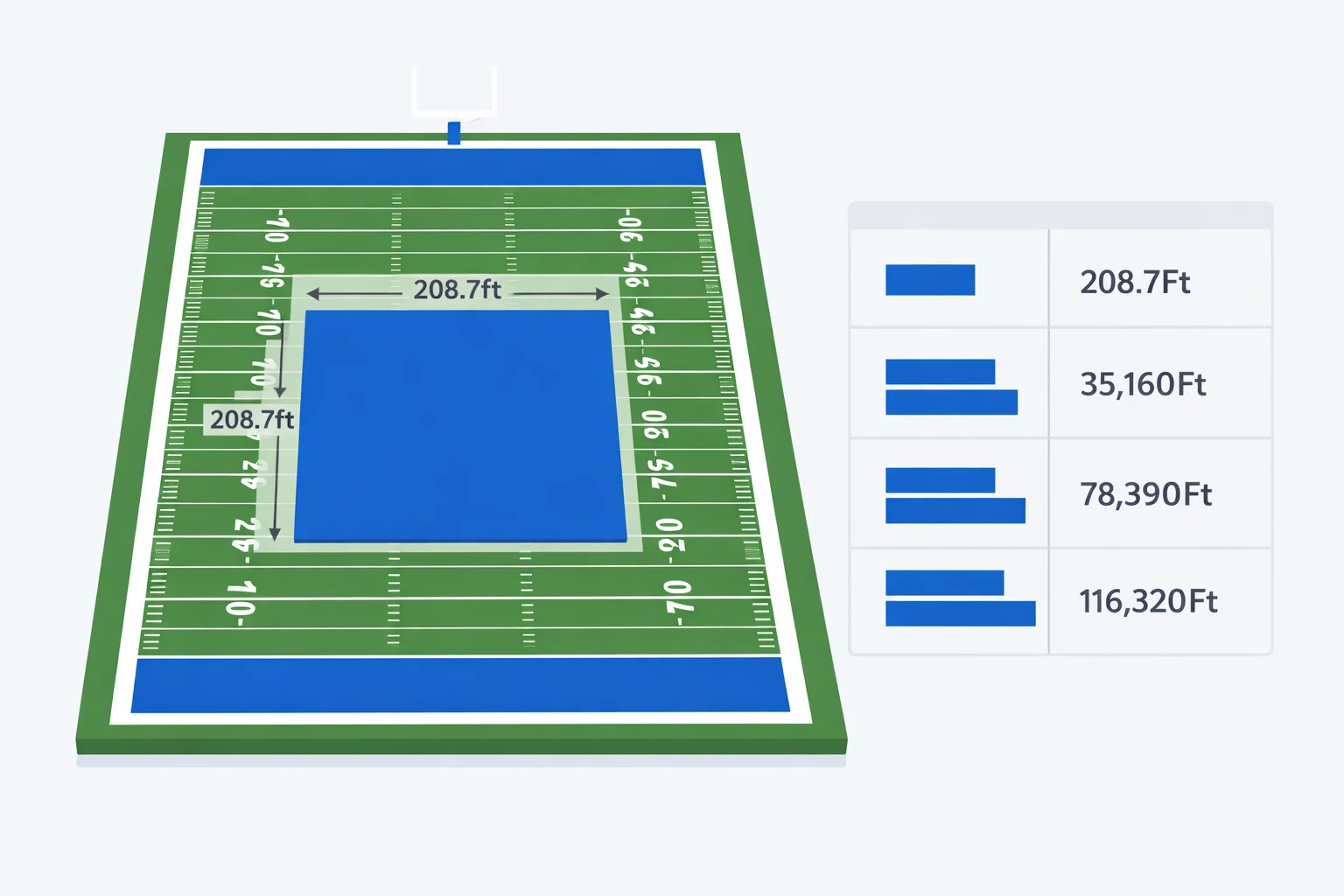
- 1 acre: 1 × 43,560 = 43,560 sq ft. Roughly 75% of a football field (with end zones). A square acre measures about 208.7 ft per side.
- 5 acres: 5 × 43,560 = 217,800 sq ft. Nearly four football fields. Common for hobby farms and rural home sites.
- 10 acres: 10 × 43,560 = 435,600 sq ft. About 10 city blocks in a typical urban grid.
Need to go the other direction? Our square feet to acres converter divides by 43,560 to give you acreage from any square footage value.
Lot-Size Chart: Quarter-Acre to 10 Acres
This reference table covers the acreage values that generate the most search traffic — because they're the sizes people actually buy, sell, and zone for:
| Acres | Square Feet | Square Meters | Typical Use |
|---|---|---|---|
| ⅛ (0.125) | 5,445 | 506 | Dense urban lot |
| ¼ (0.25) | 10,890 | 1,012 | Standard suburban |
| ⅓ (0.333) | 14,520 | 1,349 | Mid-size suburban |
| ½ (0.5) | 21,780 | 2,023 | Large suburban, pool-friendly |
| ¾ (0.75) | 32,670 | 3,035 | Estate lot |
| 1 | 43,560 | 4,047 | Rural residential minimum |
| 2 | 87,120 | 8,094 | Horse property, ranchette |
| 5 | 217,800 | 20,234 | Hobby farm, agricultural |
| 10 | 435,600 | 40,469 | Working farm / large rural |
Visualizing an Acre in Real-World Terms
Numbers alone don't help you picture a piece of land. These comparisons do:
- Football field: a regulation NFL field (including both end zones) is 57,600 sq ft. One acre is about 75.6% of that — picture the field from goal line to the opposite 16-yard line.
- Tennis courts: a standard doubles court is 2,808 sq ft. One acre fits 15.5 tennis courts.
- Basketball courts: an NBA court is 4,700 sq ft. One acre holds 9.3 basketball courts.
- Parking spaces: at 180 sq ft per spot (9 × 20 ft) including drive aisle share, one acre fits roughly 242 parking spaces — close to a mid-size grocery store lot.
- Houses: with standard suburban setbacks and a 2,000 sq ft footprint per home, roughly 4–5 houses fit on one acre.
These benchmarks are more useful than abstract square footage because they give you a gut sense of scale. When someone says "3 acres," you can think "two and a quarter football fields" — and that actually means something.
When Realtors Quote Acres vs. Square Feet
There's an unwritten convention in U.S. real estate. Lots under about half an acre get quoted in square feet. Anything above one acre gets listed in acres. The zone between half an acre and one acre? Agents use whichever number sounds more impressive for the listing.
A 0.45-acre lot is 19,602 sq ft. Listing it as "nearly half an acre" sounds spacious. Listing it as "19,602 sq ft" sounds precise and large. A 0.92-acre lot gets listed as "just under an acre" rather than 40,075 sq ft, because rounding up toward the full-acre mark carries psychological weight for rural buyers.
If you're comparing lots across listings, convert everything to the same unit first. Our sqft to acres calculator handles the reverse direction with a price-per-acre breakdown that's useful for normalizing land deals.
Handling Fractional and Decimal Acreage
Deeds and tax records often list acreage to three or four decimal places — 1.3750 acres, 0.1722 acres. Those trailing digits matter more than you'd think.
Consider the difference between 0.25 acres and 0.2500 acres. They're the same number. But 0.25 acres vs. 0.249 acres? That's a 44 sq ft gap (10,890 vs. 10,846 sq ft). In most contexts, 44 sq ft is irrelevant. But if a zoning ordinance sets the minimum at exactly ¼ acre (10,890 sq ft), a parcel at 0.249 acres fails by 44 sq ft — and you'd need a variance to build.
Rule of thumb: for legal documents, use four decimal places. For casual conversation, one or two is fine. The formula doesn't change — you still multiply by 43,560 regardless of how many decimals you carry.
Three Mistakes People Make Converting Acres
These come up repeatedly in real estate forums and land-buyer groups:
- Dividing instead of multiplying. Going from acres to square feet means you multiply by 43,560. Going from square feet to acres means you divide. Mixing these up turns a 2-acre parcel into 0.0000459 instead of 87,120 sq ft. If your answer seems absurdly small, you probably divided when you should have multiplied.
- Using 43,560 for non-U.S. acres.The "international acre" used in the U.S., UK, and Canada is 43,560 sq ft. But Scotland historically used a different acre (about 1.27 English acres), and Ireland had its own definition too. If you're reading a historical deed from outside the U.S., check which acre the document means.
- Assuming acres describe shape. An acre is purely an area measurement — it says nothing about dimensions. A 1-acre parcel could be a 208.7 ft square, a 100 ft × 435.6 ft rectangle, or a triangular wedge. Two parcels of identical acreage can have wildly different usable layouts depending on frontage, depth, and shape.
How Acres Compare to Metric Land Units
Outside the U.S., land is measured in hectares and square meters. Here's how they relate:
- 1 acre = 4,046.86 square meters— just over 4,000 m². If you're reading European property listings, divide the square meter figure by 4,047 to get acres.
- 1 acre = 0.4047 hectares — roughly 40% of a hectare. Conversely, 1 hectare ≈ 2.471 acres.
- 1 square mile = 640 acres — a section of land in the U.S. Public Land Survey System is exactly one square mile.
For international property comparisons, you can convert square feet to square meters directly. The metric system uses powers of 10, so metric conversions are simpler — but the acre remains the standard for U.S. land transactions, and that isn't changing any time soon. The U.S. Census Bureau still reports lot sizes in square feet and acres, not metric units.