Dollars to Won: Cash Rules in the World's Most Cashless Country
Dollars to won is the conversion most travelers assume they can wing — South Korea is famously the most card-friendly country on Earth, so why change cash at all? Then you land, buy a T-money transit card for ₩2,500, and discover the top-up machine takes only Korean banknotes. Your $100 is about ₩138,500 at today's rate of roughly 1,385 won per dollar, and a surprisingly specific slice of it needs to exist as paper. This guide covers the head math, exactly how much cash to convert (less than you think, but not zero), where Seoul's best exchange rates hide, and the instant tax refund that hands you back 10% at the register.
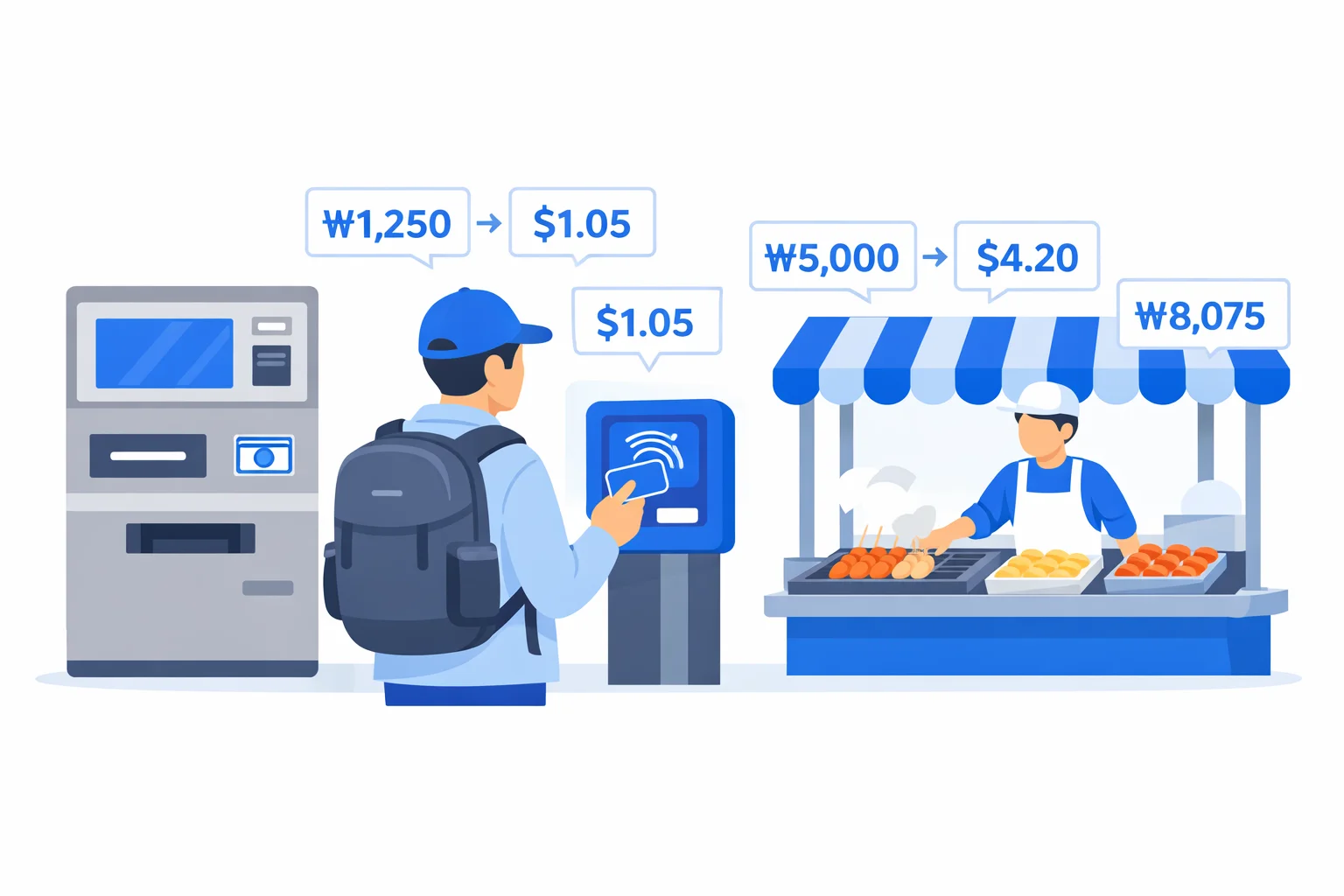
The ×1,400 Shortcut (and Reading Won Tags Backwards)
At 1,385 won per dollar, the practical street math is multiply by 1.4, then add three zeros. $50 becomes 70, becomes ₩70,000 — the exact figure is ₩69,250, so the shortcut runs about 1% high, a rounding error at street-food prices. $20 is roughly ₩28,000, $100 is ₩140,000-ish against an exact ₩138,500, and $500 lands near ₩700,000 versus ₩692,500 exact.
Reading a Korean price tag runs the other way: drop three zeros, then divide by 1.4. A ₩12,000 bibim-naengmyeon becomes 12 ÷ 1.4 ≈ $8.57 (exact: $8.66). A ₩39,000 hanbok-rental upgrade is 39 ÷ 1.4 ≈ $27.86 against $28.16 exact. One warning for anyone hopping between Seoul and Tokyo: won and yen use different math. ₩10,000 is about $7.22 while ¥10,000 is roughly $65 — mixing up the two symbols misprices things by a factor of nine. The South Korean won has carried its wall of zeros since the early 1960s and has never been redenominated, so the five-digit lunch prices are permanent — get the shortcut into muscle memory on day one.
Why the World's Most Card-Friendly Country Still Wants Your Cash
Korea's card culture is real and legally reinforced: merchants who accept cards can't refuse them for small amounts or add surcharges, a rule tied to the tax system, and Bank of Korea payment surveys put cash at well under a fifth of consumer spending. Your hotel, every cafe, Korean BBQ restaurants, taxis, Olive Young, department stores — all of it goes on a foreign Visa or Mastercard without a second thought. This is why converting $500 into won at the airport is a mistake: most of it will come home unspent.
But three cash pockets survive, and they're exactly the ones tourists hit daily. T-money transit top-ups take banknotes only. Street-food carts and the stall alleys of traditional markets like Gwangjang — the bindaetteok and mayak-gimbap you came for — deal in cash at ₩3,000-6,000 a plate. And Korea's home-grown payment rails, Naver Pay and Kakao Pay QR codes, are locked to Korean bank accounts, so the local wallet everyone around you is scanning isn't available to you. The planner in the tool above budgets about ₩30,000 (roughly $22) per dayacross those three buckets: ₩6,000 transit, ₩15,000 street food and markets, ₩9,000 backup. For a week that's ₩210,000 — around $152 — and genuinely everything else can stay on plastic.
T-money: The ₩1,400 Ride With the Cash-Only Top-Up
T-money is Seoul's rechargeable transit card, sold at any convenience store for ₩2,500-3,000. A subway ride starts at ₩1,400 with the card (₩1,500 if you buy a single-journey ticket in cash), buses run ₩1,500, and transfers between subway and bus within 30 minutes are discounted on the integrated fare system. A heavy sightseeing day — four to six rides — costs about ₩5,600-8,400, which is why the cash planner above reserves ₩6,000 a day for transit.
The catch that surprises everyone: top-ups are cash-only. The machines in every station and the convenience-store tills that reload T-money accept won banknotes, not foreign credit cards. Load in ₩10,000 increments rather than one big sum, because refunds have friction: balances under ₩20,000 can be refunded at convenience stores minus a ₩500 service fee, but larger balances mean a trip to the T-money headquarters office. Staying longer? Seoul's Climate Card offers 30 days of unlimited subway and bus for ₩62,000 (about $45), with short-term 1-7 day versions aimed at visitors — it pays off once you're riding more than about 44 times a month.
Skip the Airport Desk — Myeongdong's Changers Beat the Banks
Korea inverts the usual tourist-money rule. In most countries the tourist-district exchange booth is where you get fleeced; in Seoul, the licensed money changers clustered in Myeongdong routinely quote within 0.5-1% of the mid-market rate — often better than Korean bank branches and dramatically better than the airport desks, where spreads run several percent. On a $500 exchange, the gap between a Myeongdong changer and an airport counter is easily ₩20,000-35,000 ($14-25). The sensible pattern: change a small arrival float of ₩50,000-100,000 at Incheon, then do the bulk in the city. Compare any quote against the mid-market baseline in our multi-currency converter before handing over your dollars.
ATMs work, with caveats: look for machines marked "Global ATM" (many domestic-bank machines reject foreign cards), and expect a ₩3,500-5,000 machine fee on top of whatever your home bank charges — so one ₩300,000 pull beats three ₩100,000 pulls, cutting the machine-fee drag from roughly 4% to 1.3%. A newer option built for visitors is WOWPASS, a prepaid card from kiosks at the airports and major subway stations: feed it US banknotes and it loads Korean won at a competitive rate, with a T-money chip built into the same card (topped up separately, still in cash). And everywhere, when a terminal offers to charge your card "in US dollars," decline — that dynamic currency conversion buries a 3-8% markup. Always pay in won. For what moves the rate itself, the KRW to USD converter takes the markets-eye view of the pair.
Korea Hands the VAT Back at the Register
Every Korean price tag already contains 10% VAT, and Korea refunds it to foreign tourists more aggressively than almost anywhere: at participating stores, the refund happens instantly at the register — no forms, no airport queue. Spend at least ₩15,000 on one receipt, show your passport, and the till deducts the VAT on the spot. It works per purchase up to ₩1,000,000, with a total immediate-refund allowance of about ₩5,000,000 per trip; go over a million on a single receipt and you pay full price, then claim at the airport refund kiosk with the goods on hand.
Mind the math, because the refund is not 10% of the tag. The tag includesVAT, so the tax content is price × 10/110 — about 9.09%. A ₩50,000 Olive Young haul refunds ₩4,545, not ₩5,000, so you pay ₩45,455 (about $32.82). A ₩300,000 department-store receipt hands back ₩27,273. Chains display a "Tax Free" sticker at the door, and Olive Young, the big department stores, and most brand retailers participate. It's a smoother system than Japan's, where tax-free shopping happens at separate counters with sealed bags — if Tokyo is your next stop, the yen to dollars guide walks through those rules and the very different yen math.
What a Seoul Day Costs in Dollars
Seoul sits in a pleasant middle band: cheaper than London or Tokyo for food and transit, pricier than Southeast Asia. Typical prices at 1,385 won per dollar:
| Everyday item | Price (KRW) | In dollars |
|---|---|---|
| Subway ride (T-money) | ₩1,400 | $1.01 |
| Hotteok from a street cart | ₩3,000 | $2.17 |
| Gyeongbokgung Palace entry | ₩3,000 | $2.17 |
| Gimbap roll | ₩4,500 | $3.25 |
| Taxi base fare (Seoul, daytime) | ₩4,800 | $3.47 |
| Samgyeopsal (pork belly, per serving) | ₩17,000 | $12.27 |
| Hanbok rental (daytime) | ₩20,000 | $14.44 |
| Chimaek — fried chicken + beer for two | ₩28,000 | $20.22 |
Two quirks make those numbers friendlier than they look to American eyes. First, they're final: VAT is inside the tag, nothing gets added at the register, and Korea has no tipping culture — a ₩34,000 BBQ dinner for two is $24.55 flat, where a $25 US menu total becomes $32 after tax and tip. Second, sightseeing is nearly free: the grand palaces charge ₩3,000 or less, and Gyeongbokgung waives entry entirely if you show up in a rented hanbok — the ₩20,000 rental pays for itself in photos. A comfortable Seoul day of transit, street-food lunch, a palace, and a proper dinner runs about ₩85,000-100,000, or $61-72 before your hotel.
Leftover Won, Dead Coins, and When Not to Convert
The won is a restricted currency that barely trades outside Korea, so leftover banknotes convert poorly once you're home — US banks quote weak rates for won if they handle it at all. Our KRW to USD converter covers why in detail; the practical rule is to change surplus won back to dollars before departure, at the same Myeongdong changers or an Incheon bank counter. Coins are stricter still: no exchange desk abroad takes them, so a pocket of ₩500 coins (36 cents each) is dead money the moment you board. Spend them down, and drain your T-money balance below ₩20,000 so a convenience store can refund it for the ₩500 fee.
Just as important is knowing when notto convert. Don't pre-buy won at a US bank before flying — margins of 4-8% plus shipping delays make it the most expensive option on the table, and Korea is the rare destination where arriving with almost no local cash is completely safe. Don't convert your whole budget to banknotes on arrival either; the ₩30,000-a-day planner figure exists because everything beyond it lives happily on a card. And check your card's foreign-transaction fee before the trip — a 3% fee quietly skims $60 off a $2,000 card-first vacation, which is more than you'd lose to every exchange desk you'll actually visit.