Square Yards to Square Feet: The Multiply-by-9 Rule, Lawn Coverage Chart & Patio Sizing Guide
Sq yd to sq ft conversion comes down to one number: 9. Multiply your square yards by 9 and you've got square feet. It's the simplest area conversion in the Imperial system, but it trips people up constantly — especially when money is on the line. Sod suppliers quote by the square yard. Property deeds in parts of India and Pakistan list plot sizes in square yards. Meanwhile, your tape measure, your contractor, and your home improvement store all speak square feet. Getting the translation wrong by a factor of 3 (confusing linear yards with square yards) can blow a landscaping budget wide open.
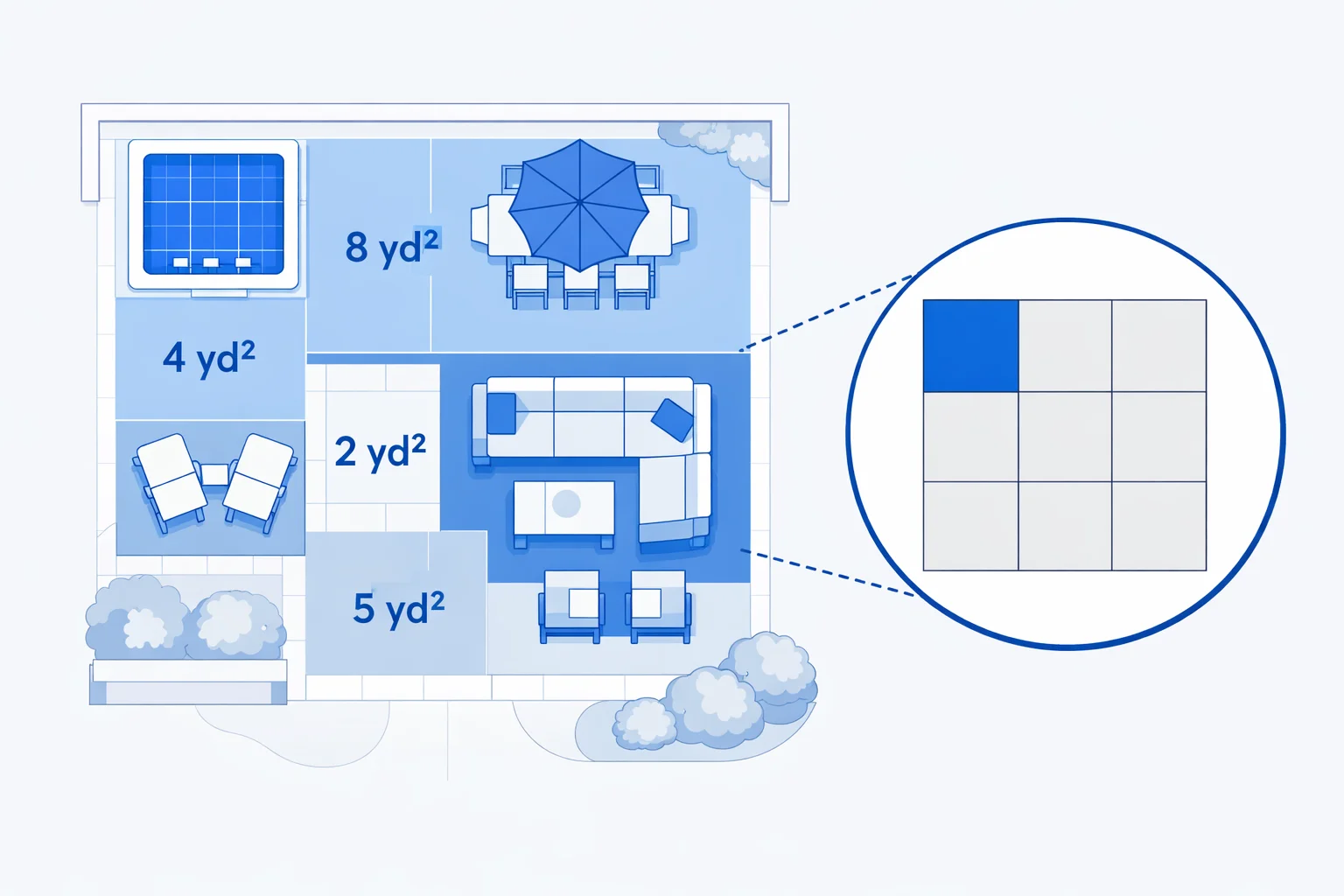
The Multiply-by-9 Rule
One yard is 3 feet. Square that relationship and you get the area factor: 3 × 3 = 9. So 1 square yard = 9 square feet. Always.
Formula: sq ft = sq yd × 9
The reverse? Divide by 9. If you need to go from square feet back to square yards, our square feet to square yards converter handles that. No messy decimals, no irrational conversion factors — just 9. Compare that to converting between metric and Imperial (1 sq yd = 0.836127 m²) and you'll appreciate the simplicity.
Worked Examples with Real Numbers
Example 1: Ordering sod. Your landscape supplier quotes 60 square yards of Bermuda grass sod. How much lawn does that cover? 60 × 9 = 540 square feet — roughly the size of a 20 × 27 ft front yard. At $0.45/sq ft for sod, material cost runs about $243.
Example 2: Property lot in India.A residential plot is listed at 200 square yards (called "gaj"). In square feet: 200 × 9 = 1,800 sq ft. That's enough for a modest two-story home with a small garden. In metric terms, it's about 167 square meters — use our square meters to square feet converter to cross-check.
Example 3: Paver patio.A contractor quotes 15 square yards of stone pavers for your backyard. That's 15 × 9 = 135 square feet — a 12 × 11 ft patio, big enough for a four-person dining set with room to pull chairs back. At $6–12 per square foot installed, budget $810–$1,620.
Lawn & Landscaping: Sod, Mulch, and Gravel
Landscaping materials are one of the most common reasons people convert square yards to square feet. Sod farms sell by the pallet, and each pallet covers a set number of square yards. Mulch and decorative gravel are sold by the cubic yard, but you need the area in square feet to figure out how many cubic yards you actually need.
Here's the process for mulch: first convert your area from square yards to square feet (multiply by 9). Then decide on mulch depth — 3 inches is standard for flower beds, 4 inches for weed suppression. Divide the depth in feet (3 inches = 0.25 ft) into the square footage, then divide by 27 to get cubic yards.
Worked example:40 square yards of garden bed = 360 sq ft. At 3 inches deep: 360 × 0.25 = 90 cubic feet ÷ 27 = 3.33 cubic yards of mulch. Most suppliers sell by the cubic yard, so order 3.5 cubic yards. At $30–50 per cubic yard delivered, that's $105–$175.
For large acreages — say you're looking at a property listed in square yards and want to understand it in terms of acres — our acres to square feet converter is useful. One acre is 4,840 square yards, or 43,560 square feet.
Patio Sizing Guide
Patio dimensions determine what you can actually do with the space. Here's a practical sizing framework based on furniture footprints:
| Patio Use | Min. Size (sq yd) | Square Feet | Typical Dimensions |
|---|---|---|---|
| Bistro set (2 chairs) | 4–5 | 36–45 | 6×6 ft to 6×7.5 ft |
| 4-person dining | 10–14 | 90–126 | 10×10 ft to 10×13 ft |
| Grill station + seating | 16–20 | 144–180 | 12×12 ft to 12×15 ft |
| Full outdoor kitchen | 25–35 | 225–315 | 15×15 ft to 15×21 ft |
| Entertaining / lounge | 35–55 | 315–495 | 18×18 ft to 20×25 ft |
A general rule from landscape architects: allow 25 square feet (about 2.8 sq yd) per seated guest. A dinner party for 8 needs at least 200 square feet (22 sq yd) of patio — before you add the grill, planters, or walkway edges. Undersize by 20% and guests will feel cramped. Better to round up a few square yards than to pour concrete twice.
Square Yards Around the World
Most of the world moved to metric decades ago. But square yards refuse to die in a few key markets. In India, residential plots are routinely listed in square yards — called gaj in Hindi. A typical urban plot in Delhi or Ahmedabad might be 100–300 gaj (900–2,700 sq ft). The unit persists because property registries adopted it during British rule, and changing an entire land record system is politically and logistically expensive.
Pakistan uses the same convention. In Karachi and Lahore, property agents quote plots in square yards while interior designers measure rooms in square feet. This creates a constant need to convert between the two — multiply the plot size in gaj by 9 to compare it with the builder's floor plan.
In the UK, square yards appear in older property descriptions and agricultural contexts. The Weights and Measures Act 1985 still recognizes the yard alongside metric units, so legal property descriptions occasionally mix both systems.
Square Yards to Square Feet Reference Chart
Quick-lookup values you're most likely to need. These cover residential plots, commercial spaces, and landscaping quantities:
| Square Yards | Square Feet | Real-World Equivalent |
|---|---|---|
| 1 | 9 | A bath mat |
| 10 | 90 | A small patio or walk-in closet |
| 25 | 225 | Single-car garage |
| 50 | 450 | Studio apartment |
| 100 | 900 | Large 1-bedroom apartment |
| 200 | 1,800 | Average 3-bedroom home footprint |
| 500 | 4,500 | Large single-story home |
| 1,000 | 9,000 | Large residential lot |
| 4,840 | 43,560 | Exactly 1 acre |
Mistakes That Cost Homeowners Money
Three errors account for nearly every square-yard conversion mistake. Each one sounds silly after the fact, but each one costs real money.
- Multiplying by 3 instead of 9.This is the big one. Confusing linear yards with square yards means your area estimate is off by a factor of 3. If a supplier quotes 40 sq yd and you calculate 120 sq ft instead of 360, you'll order one-third of the material you actually need. The fix: remember that "square" means you square the conversion factor too. 3 feet per yard → 3² = 9 sq ft per sq yd.
- Ignoring waste. Sod, pavers, and tiles all require cutting at edges. Rectangular areas need 5–10% extra. Curved beds and irregular shapes need 10–15%. Ordering the exact calculated amount guarantees a second trip to the supplier.
- Mixing up price units.A paver at $4.50 per sq ft sounds comparable to one at $36 per sq yd — until you realize they're the same price ($4.50 × 9 = $40.50 per sq yd, not $36). Always convert to the same unit before comparing quotes. This mistake alone can lead to choosing a more expensive product while thinking you got a deal.
When You Actually Need This Conversion
You won't need sq yd to sq ft every day. But when you do, the stakes tend to be high — you're about to spend real money on materials, sign a property contract, or commit to a landscaping project. Here are the most common triggers:
- Buying sod or turf. Sod farms price per square yard or per pallet (which covers a set number of square yards). Multiply by 9 to match your lawn measurements.
- Comparing property listings.If you're looking at plots in India, Pakistan, or older UK listings that use square yards, converting to square feet makes them comparable with local listings.
- Patio and hardscape projects.Contractors sometimes quote square yards for large areas. You need square feet to compare with material costs from Home Depot or Lowe's.
- Carpet remnant shopping. Carpet remnants are often labeled in square yards. Converting tells you whether a piece is big enough for your room, measured in square feet.
- Commercial leasing. Some older commercial leases specify usable area in square yards. According to BOMA International standards, modern leases use rentable square feet, but legacy contracts may not.
The conversion itself takes two seconds. Getting it wrong can cost hundreds of dollars in wasted material, or worse — signing a property contract with a misunderstanding of how much space you're actually getting.