Marla to Square Feet: Plot Size Chart for 3–20 Marla, Regional Variations & Kanal Breakdown
A marla to sq ft conversion is essential for anyone buying, selling, or building property in Pakistan, northern India, or Bangladesh. One standard marla equals 272.25 square feet — a number you'll see on virtually every housing society brochure from Lahore to Islamabad. But that single number hides surprising regional differences that can cost you thousands of rupees if you don't verify the local standard before signing a deed.
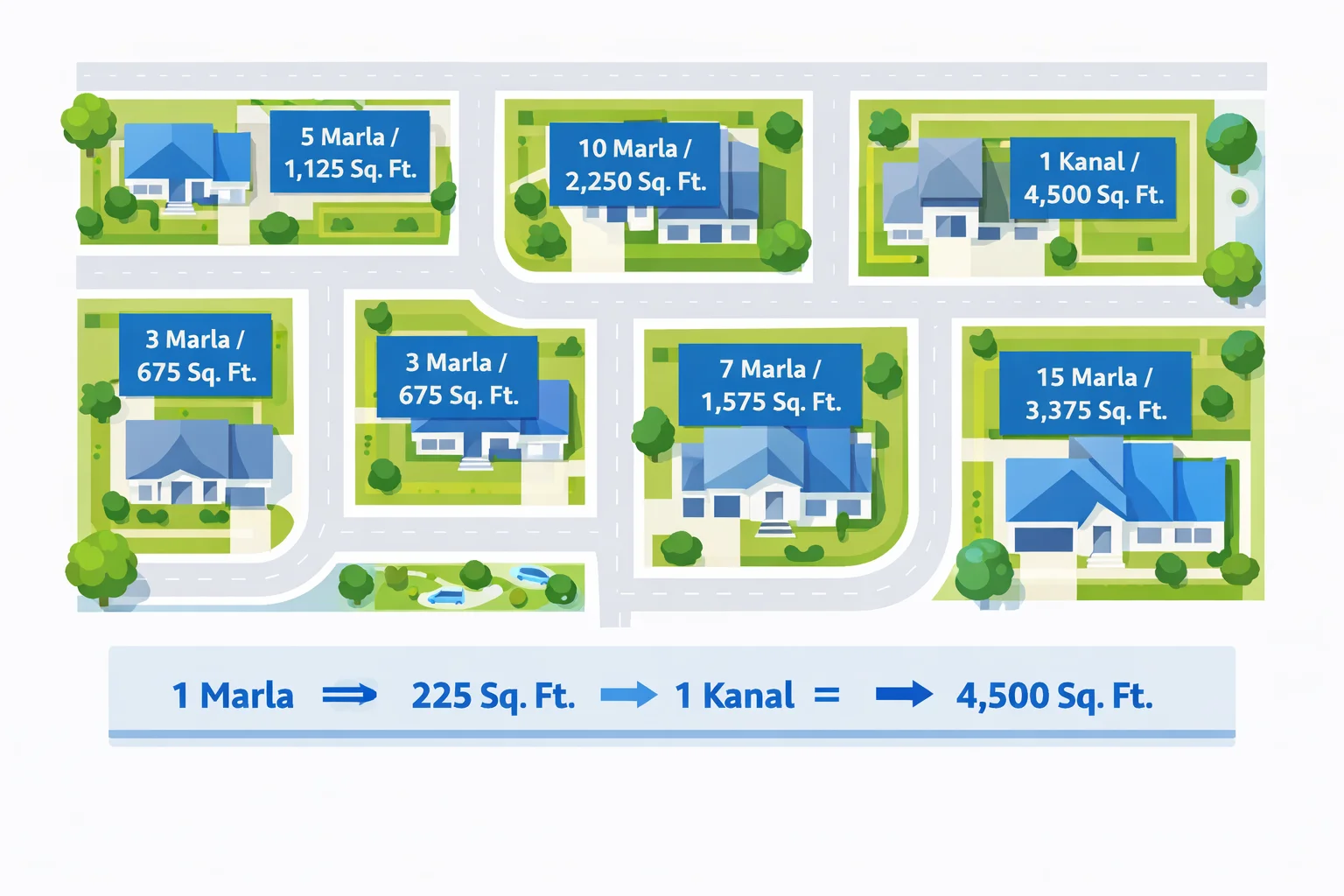
What Is a Marla?
A marla is a traditional South Asian unit of land area inherited from the British colonial revenue system. The word itself comes from the Urdu/Punjabi term for a unit of land. Under the standard definition still used across Pakistan's major cities and housing authorities, 1 marla = 1 square rod, where 1 rod (also called a pole or perch) measures exactly 16.5 feet.
So 16.5 × 16.5 = 272.25 square feet. That's roughly the floor area of a large bedroom — about 5.03 meters on each side. It's a small unit by Western standards, which is why Pakistani property listings stack them: a "5 marla house" or "10 marla plot" gives buyers an instant sense of scale without reaching for a calculator.
The marla sits within a larger hierarchy: 20 marla make 1 kanal, and 8 kanals make 1 acre. This system is codified in the Punjab Land Revenue Act, and virtually every patwari (land records officer) across Pakistan uses it daily.
The Marla to Square Feet Formula
The conversion is straightforward multiplication:
Square Feet = Marla × 272.25
Here's a worked example. Say you're looking at a 7 marla plot in DHA Lahore:
- 7 × 272.25 = 1,905.75 square feet
- In square meters: 1,905.75 × 0.0929 = 177.09 m²
- In kanal: 7 ÷ 20 = 0.35 kanal
To go the other way — square feet back to marla — divide by 272.25. Got a 2,000 sq ft plot? That's 2,000 ÷ 272.25 = 7.35 marla. Need to convert square footage into metric units? Our square feet to square meters converter handles that in one click.
Regional Variations You Need to Know
Here's where things get tricky. Not every marla is 272.25 sq ft.
In some older revenue records — particularly in rural Punjab and parts of Khyber Pakhtunkhwa — a marla is defined as 225 square feet (based on a 15 × 15 ft grid). Certain areas of Indian Punjab use 250.56 sq ft per marla (derived from a different rod length of 15.83 feet).
The difference matters. On a 10 marla transaction:
- Standard (272.25): 2,722.5 sq ft
- Revenue (225): 2,250 sq ft
- Gap: 472.5 sq ft — nearly 2 marla of "phantom" area
That's not a rounding error. On a 10 marla deal at PKR 10 million per marla, the difference between standards could mean PKR 1.7 million in disputed value. Always confirm which marla standard the seller, patwari, and housing authority are using before you sign anything.
Plot Size Chart: 3 to 20 Marla in Square Feet
This reference table covers the most common residential plot sizes in Pakistani housing societies. All figures use the standard 272.25 sq ft per marla:
| Plot Size | Square Feet | Square Meters | Typical Dimensions |
|---|---|---|---|
| 3 Marla | 816.75 | 75.9 | 20 × 40 ft |
| 5 Marla | 1,361.25 | 126.5 | 25 × 50 ft |
| 7 Marla | 1,905.75 | 177.1 | 30 × 60 ft |
| 10 Marla | 2,722.50 | 252.9 | 35 × 70 ft |
| 12 Marla | 3,267.00 | 303.5 | 40 × 75 ft |
| 14 Marla | 3,811.50 | 354.1 | 40 × 90 ft |
| 1 Kanal (20 Marla) | 5,445.00 | 505.9 | 50 × 100 ft |
Notice that "typical dimensions" don't always multiply to the exact square footage. That's because housing societies allocate plots in convenient round dimensions, and the actual area might be slightly more or less than the nominal marla count. A "5 marla" plot of 25 × 50 ft is really 1,250 sq ft — about 111 sq ft short of the true 5 marla (1,361.25 sq ft). The remaining area is usually in service lanes or setbacks managed by the society.
Marla, Kanal, and Acre — How They Connect
The full land unit hierarchy used in Pakistan:
- 1 Marla = 272.25 sq ft = 25.29 m²
- 1 Kanal = 20 marla = 5,445 sq ft = 505.86 m²
- 1 Acre = 8 kanal = 160 marla = 43,560 sq ft
- 1 Murabba = 25 acres = 200 kanal (agricultural land measure)
For agricultural land, farmers and revenue officials typically deal in kanal and acres. Residential property in cities and housing societies uses marla and kanal. Need to check how many acres your land covers? Try our square feet to acres converter after getting the total footage.
One useful shortcut: since 1 acre = 160 marla, a "1 kanal plot" is exactly 1/8th of an acre. Two kanal is a quarter acre. These round fractions make back-of-envelope calculations surprisingly easy once you internalize them.
Common Mistakes When Converting Marla
After helping property buyers for years, here are the errors that come up again and again:
- Assuming all marla are equal. A 10 marla plot in a DHA housing society (272.25 sq ft/marla) is 472 sq ft larger than a 10 marla plot under the old 225 sq ft revenue standard. Always verify before negotiating price.
- Confusing covered area with plot area. A "5 marla house" sits on a 5 marla plot, but the actual built-up area might be 3.5–4 marla (950–1,100 sq ft) after setbacks, parking, and lawn. Building bylaws in most societies allow 65–80% ground coverage.
- Mixing up marla and kanal. 1 kanal = 20 marla, not 10. This is a surprisingly common mistake in informal conversations — double-check written documents against the actual registry number.
- Using the Indian marla for Pakistani transactions. If you're cross-border shopping (expats in India buying Pakistani property or vice versa), the Indian marla at 250.56 sq ft differs from the Pakistani 272.25 sq ft. Don't assume they're the same.
Real-World Plot Dimensions in Housing Societies
Pakistani housing societies like DHA, Bahria Town, and LDA don't always cut plots exactly to marla math. Here's what you'll actually find on the ground:
5 Marla plots are typically 25 × 50 ft (1,250 sq ft) or 30 × 45 ft (1,350 sq ft). The dimensions vary by society and phase — DHA Lahore Phase 6 uses slightly different dimensions than Phase 9 Prism. A 25-foot-wide frontage is the most common layout, giving enough room for a double-story house with two bedrooms per floor.
10 Marla plots usually measure 35 × 70 ft (2,450 sq ft) or 40 × 65 ft (2,600 sq ft). The extra width makes a big lifestyle difference — room for a proper car porch, wider lawn, and more flexible floor plans. This is the sweet spot for families who want space without the 1 kanal price tag.
1 Kanal plots (20 marla) commonly run 50 × 100 ft (5,000 sq ft) or 60 × 90 ft (5,400 sq ft). These are premium residential plots with room for standalone houses, servant quarters, and gardens. If you need international metric comparisons, that's roughly 465–500 m² — comparable to a generous suburban lot in square meters to square feet terms.
Tips for Property Buyers Using Marla Measurements
Practical advice from people who've learned the hard way:
- Get the map number from the patwari. The official land record (fard) shows the exact area in kanal and marla. Compare this against the society's allotment letter — discrepancies between patwari records and society maps are more common than you'd think.
- Physically measure the plot. Bring a 100-foot measuring tape and check the actual dimensions yourself. Corner plots, irregular shapes, and road-facing sides sometimes eat into the marketed area.
- Convert to per-square-foot pricing. When comparing plots of different sizes, divide the total price by total square feet (not by marla). A "cheaper" 5 marla plot at PKR 60 lakh might cost PKR 4,407/sq ft, while a 10 marla plot at PKR 1.1 crore costs PKR 4,042/sq ft — the bigger plot is actually cheaper per unit area.
- Check the covered-area ratio. Society bylaws specify maximum ground coverage. A 5 marla plot with 70% coverage gives you 953 sq ft of buildable footprint per floor. Factor this into your architectural plans before buying.
- Factor in development charges per marla. Societies charge utility connections, development, and maintenance fees on a per-marla basis. A 10 marla plot pays double the development charge of a 5 marla plot — make sure this is in your budget spreadsheet.