Hectares to Square Meters: The ×10,000 Multiplier, Land Planning Use Cases & Worked Examples
Converting hectares to sq m takes exactly one operation: multiply by 10,000. That's it — 1 hectare equals 10,000 square meters, 3.7 hectares equals 37,000 m², and 0.25 hectares equals 2,500 m². No messy decimals, no rounding errors, no imperial-to-metric headaches. But knowing the factor is only half the story. When an architect receives a 2.4-hectare site brief and needs to carve it into building footprints, parking bays, and green space — all dimensioned in meters — the translation from hectares to m² becomes a daily workflow. Below you'll find worked examples drawn from real planning scenarios, a size comparison chart with familiar landmarks, and the kind of practical tips that don't show up in a basic conversion table.
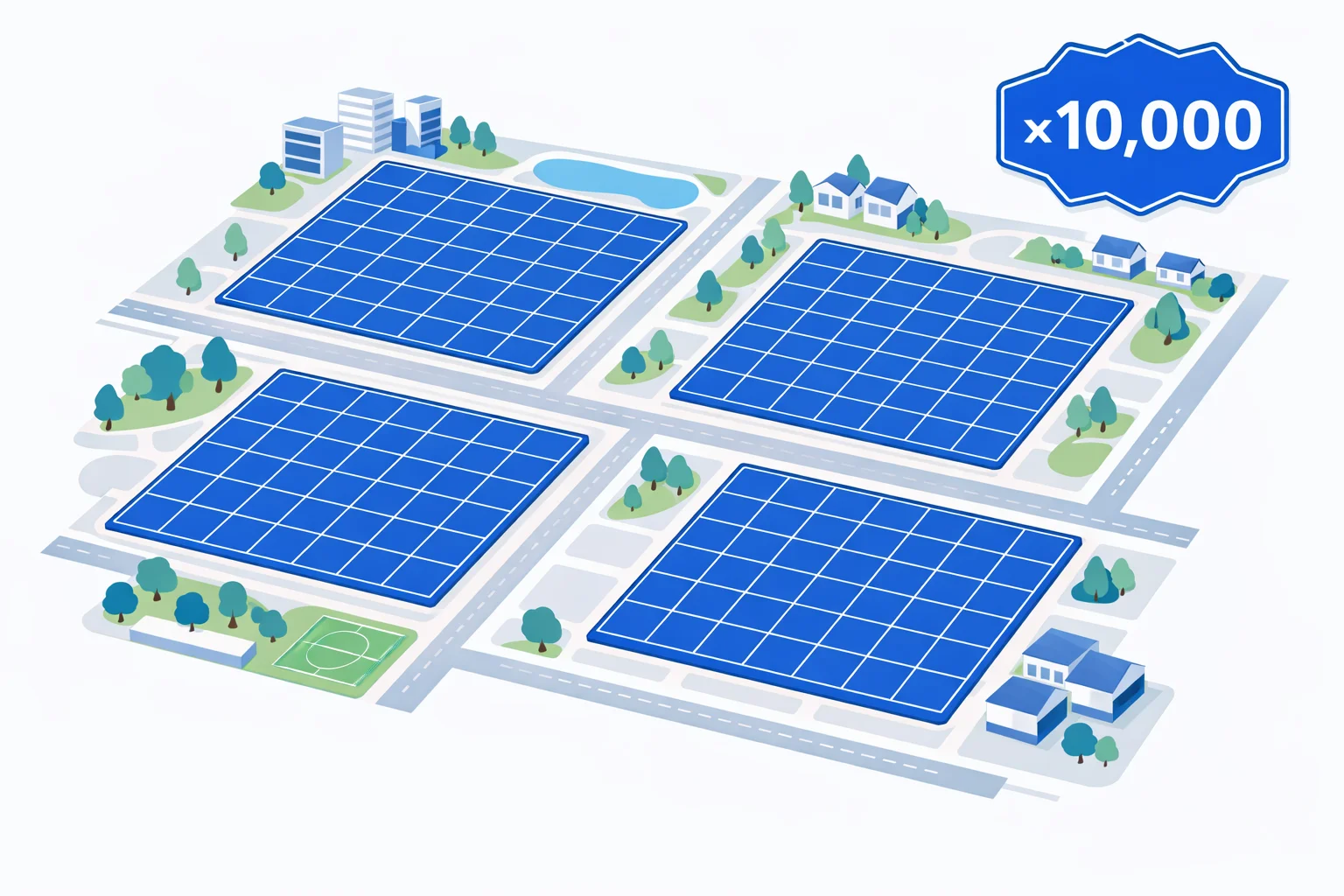
Why Multiply by 10,000?
The hectare isn't an arbitrary unit — it's built from two metric building blocks. The prefix hecto means 100 in the SI system. The base unit are equals 100 m² (a 10 m × 10 m square). Stack those together: 100 × 100 m² = 10,000 m². The International Bureau of Weights and Measures (BIPM) accepted the hectare for use alongside SI units in 1879, and it's remained the global standard for land measurement ever since.
Because 10,000 is 10⁴, the conversion never introduces rounding artifacts. Compare that to converting square feet to square meters (× 0.09290304) or acres to hectares (× 0.40468564224). Those factors are irrational for practical purposes. The ha-to-m² conversion? Just shift the decimal.
Worked Examples With Real Land Parcels
The formula is straightforward:
square meters = hectares × 10,000
Let's walk through four scenarios you'd actually encounter in the field.
Example 1 — Residential subdivision: A developer buys a 1.2-hectare block for townhouses. Multiply: 1.2 × 10,000 = 12,000 m². With local setback rules requiring 120 m² per dwelling, that's roughly 100 townhouse lots before accounting for roads and services — though real-world yields typically land around 65-70 lots after infrastructure.
Example 2 — Commercial warehouse:A logistics company needs 0.85 hectares for a distribution center. That's 0.85 × 10,000 = 8,500 m². A standard Amazon-style sortation facility runs 9,000-14,000 m², so this parcel is a tight fit — the planner would recommend at least 1.2 ha.
Example 3 — Agricultural lease:A grain farmer leases 47 hectares of cropping land. That's 47 × 10,000 = 470,000 m². At typical wheat yields in Northern Europe (around 0.7-0.8 kg per m²), this parcel could produce roughly 330-375 tonnes per harvest.
Example 4 — Solar farm feasibility: An energy company evaluates a 15-hectare site: 15 × 10,000 = 150,000 m². Modern solar panels produce about 150-200 W per m² of panel area, and real installations cover roughly 40-60% of the ground. That puts this site's peak capacity at around 9-18 MW depending on panel density and tilt angle.
Hectare Size Chart: What Does Each Size Look Like?
Numbers alone don't build intuition. Here's how various hectare values translate into things you can picture:
| Hectares | Square Meters | Real-World Reference |
|---|---|---|
| 0.01 | 100 | A large living room |
| 0.1 | 1,000 | A generous suburban garden |
| 0.5 | 5,000 | A FIFA soccer pitch |
| 1 | 10,000 | Two American football fields |
| 5 | 50,000 | A small market garden farm |
| 10 | 100,000 | A mid-size cattle property |
| 50 | 500,000 | Vatican City (44 ha) |
| 100 | 1,000,000 | 1 km² — a small town center |
Notice how quickly the numbers scale. Going from 1 to 10 hectares adds 90,000 m² — enough for an entire housing estate. That exponential feel is why professionals rely on the hectare: it compresses huge numbers into manageable ones.
Hectares in Urban Planning and Development
Zoning codes across Europe, Australia, and much of Asia specify plot densities in dwellings per hectare. A typical low-density suburban zone might allow 15 dwellings/ha, while a high-density urban core could permit 200+. When a planner sees "3.8 hectares zoned R3," they immediately think: 3.8 × 10,000 = 38,000 m² of buildable land, and at 60 dwellings/ha, that's a 228-unit project.
Floor Area Ratio (FAR) is another place this conversion matters. A FAR of 2.0 on a 1.5-hectare site means up to 30,000 m² of gross floor area. But FAR calculations start with the lot area in square meters, not hectares — so the first step in any feasibility study is always the ×10,000 multiplication.
Green space requirements add another layer. Many municipalities mandate that 10-15% of any development over 1 hectare be reserved as public open space. On a 4-hectare (40,000 m²) site, that's 4,000-6,000 m² of parkland — roughly the area of a full-size rugby pitch.
Common Pitfalls When Converting Land Areas
The ×10,000 formula is trivially easy, but mistakes still happen at the edges. Three that come up repeatedly:
- Confusing hectares with acres.A client says "5 acres" and you mentally process it as 5 hectares — that's a 147% overestimate. One hectare is 2.471 acres. Always confirm which unit the source document uses before multiplying by 10,000. If the original is in acres, you need our acres to hectares converter first.
- Dropping or adding a zero.Multiplying by 1,000 instead of 10,000 (or by 100,000) is surprisingly common, especially under time pressure. A quick sanity check: 1 hectare should feel like "two football fields." If your answer doesn't pass that gut test, recount the zeros.
- Mixing up gross and net site area.A title deed might say 6.5 hectares, but the usable (net) area after subtracting roads, easements, and flood zones could be 4.8 ha. Make sure you convert the right number — the ×10,000 formula doesn't fix a wrong input.
Hectares vs. Acres, Square Feet, and Square Kilometers
How does the hectare stack up against other area units? Here's a side-by-side:
| Unit | Equivalent in m² | Hectares | Common usage |
|---|---|---|---|
| 1 Square Foot | 0.0929 | 0.00000929 | US/UK interiors |
| 1 Acre | 4,046.86 | 0.4047 | US/UK land |
| 1 Hectare | 10,000 | 1.0000 | Global metric land |
| 1 Square Kilometer | 1,000,000 | 100 | Cities, regions |
The key takeaway: the hectare fills the gap between "too small to be practical" (square meters for large parcels) and "too large for most properties" (square kilometers). If someone tells you a property is 0.004 km², you'd need a calculator to picture it. Say "4 hectares" and most professionals instantly know the scale.
Mental Shortcuts for Quick Estimates
You won't always have a calculator handy. A few tricks that surveyors and real estate agents use:
- The decimal slide:Move the decimal point four places right. 0.75 ha → 7,500 m². It's literally the same operation as multiplying by 10,000, just framed visually.
- The football test:One hectare is about 1.4 soccer fields. So 3 hectares ≈ 4 soccer pitches. This helps you sanity-check whether the m² figure "feels right" for the physical space.
- The 100 × 100 anchor: One hectare is a square that measures 100 meters on each side. If you can pace out 100 meters (about 130 steps for an average adult), you can physically walk a hectare in four minutes.
- Double for acres: Need a rough acre figure alongside your m² answer? One hectare ≈ 2.5 acres. So 4 ha ≈ 10 acres. Close enough for a phone call — use our hectares to acres converter for the exact number.
When You Actually Need This Conversion
Not every area conversion gets used daily. But hectares to square meters comes up more often than you might expect:
- Construction budgeting:Material costs (concrete, turf, paving) are quoted per m². A landscaper pricing a 0.3-hectare garden needs to know it's 3,000 m² to calculate material volumes and labor hours.
- Agricultural yield calculations:Fertilizer application rates, seed density, and irrigation volumes are all specified per square meter or per 1,000 m². Converting the farm's total hectarage to m² is step one.
- Real estate listings: International property listings often mix units. A Portuguese estate listed at 8.2 hectares needs to be expressed as 82,000 m² for a local building permit.
- Environmental impact reports: Habitat surveys, stormwater calculations, and carbon offset models all work in m². A conservation area of 12 hectares needs to be reported as 120,000 m² of protected habitat.
- GIS and mapping software: Most OGC-compliant spatial tools output areas in square meters by default. You'll toggle between m² and hectares constantly when generating reports from QGIS, ArcGIS, or PostGIS queries.