Square Meters to Hectares: The Divide-by-10,000 Rule, Parcel Sizes & Survey Tips
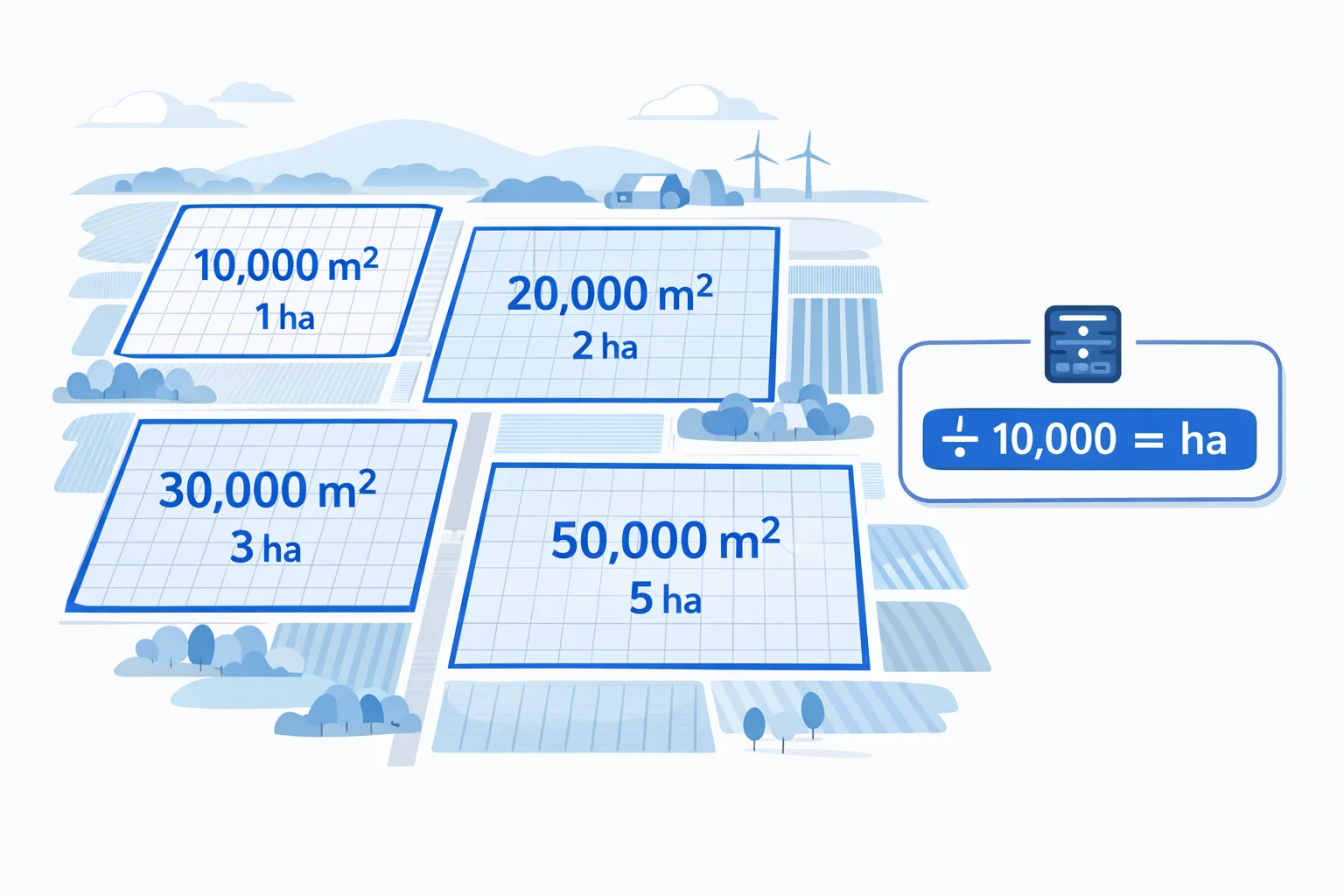
Converting sq m to hectares is one of the simplest area conversions you'll ever do: divide by 10,000. That's it. A 35,000 m² parcel becomes 3.5 hectares. A 7,200 m² lot? 0.72 ha. No messy decimals, no memorizing irrational conversion factors — just shift the decimal point four places to the left. Yet this straightforward relationship sits at the foundation of global land management, from European cadastral registers to Australian farm surveys to UN food production statistics. Below, you'll learn why the factor is exactly 10,000, walk through real worked examples, and pick up a few tricks that surveyors and GIS analysts rely on daily.
The 10,000 Rule and Why It Works
A hectare is defined as a 100 m × 100 m square — exactly 10,000 m². The name breaks down into two parts: hecto (the SI prefix for 100) and are (a unit equal to 100 m²). So one hectare = 100 ares = 10,000 m². The International Bureau of Weights and Measures (BIPM) accepted the hectare for use with the SI system in 1879, and it's been the standard metric land unit ever since.
Because the conversion factor is a clean power of ten, there's zero rounding error. Compare that to converting square feet to square meters (× 0.09290304) or acres to hectares (× 0.40468564224). The m²-to-hectare conversion is as precise as moving a decimal — which is exactly what it is.
Step-by-Step Conversion with Worked Examples
The formula is one division operation:
hectares = square meters ÷ 10,000
Let's run through three real-world scenarios.
Example 1 — Residential lot: A title deed lists a property at 850 m². Divide: 850 ÷ 10,000 = 0.085 ha. That's a modest urban lot, roughly one-twelfth of a hectare.
Example 2 — Vineyard: A wine grower in southern France manages 47,500 m² of vines. Divide: 47,500 ÷ 10,000 = 4.75 ha. In Bordeaux, this would qualify as a small family estate — the average Bordeaux château covers about 15 ha.
Example 3 — Solar farm: A planning application describes a solar installation covering 325,000 m². Divide: 325,000 ÷ 10,000 = 32.5 ha. That's equivalent to about 80 acres — large enough to generate around 25-30 MW of peak capacity at typical panel densities.
For the reverse direction, multiply hectares by 10,000 to get back to square meters. If you need to convert that result further into square meters to square feet, multiply by 10.7639.
Parcel Size Chart: Square Meters vs. Hectares
This reference table puts common land sizes in perspective. Bookmark it for quick lookups when reading survey documents or property listings.
| Description | m² | Hectares | Acres |
|---|---|---|---|
| Parking space | 15 | 0.0015 | 0.0037 |
| Studio apartment footprint | 40 | 0.0040 | 0.0099 |
| Tennis court (doubles) | 261 | 0.0261 | 0.0645 |
| Olympic swimming pool | 1,250 | 0.1250 | 0.3089 |
| Average UK house plot | 460 | 0.0460 | 0.1137 |
| FIFA soccer pitch (max) | 8,250 | 0.8250 | 2.0386 |
| 1 hectare (100 m × 100 m) | 10,000 | 1.0 | 2.5 |
| New York city block | 20,234 | 2.0 | 5.0 |
| Buckingham Palace grounds | 77,000 | 7.7 | 19.0 |
| Vatican City | 440,000 | 44.0 | 108.7 |
| Central Park, NYC | 3,410,000 | 341.0 | 842.6 |
Vatican City at 44 hectares is one of the smallest sovereign states. Central Park stretches across 341 hectares — roughly 8 times that. These comparisons help you gut-check numbers when reading development proposals or news reports.
Where the Hectare Came From
The hectare traces its roots to the French Revolution. When the new Republic adopted the metric system in the 1790s, they needed a practical land unit bigger than the square meter but smaller than the square kilometer. The are (100 m²) was introduced first, but it proved too small for agriculture. The hectare — 100 ares — filled the gap nicely: large enough for farms, small enough for individual parcels.
By contrast, the acre comes from medieval English farming. An acre was the area a yoke of oxen could plow in one day — roughly 4,047 m². There's no clean mathematical relationship between acres and metric units, which is why the acres to hectares conversion involves that awkward 0.4047 factor.
Three Mistakes That Botch Land Calculations
1. Confusing hectares with square hectometers. They're actually the same thing (1 hm² = 1 ha = 10,000 m²), but some GIS software uses "hm²" in exports. If you see "hm²" in a spreadsheet, don't apply an extra conversion — it already is hectares.
2. Dividing by 1,000 instead of 10,000.A surprisingly common slip. If you divide 50,000 m² by 1,000 you get 50 — but that's 50 ares, not hectares. The correct answer is 5 ha. Always count four zeros: 10,000.
3. Mixing up perimeter and area. A plot that measures 100 m on each side has a perimeter of 400 m but an area of 10,000 m² (1 ha). Doubling the side length to 200 m quadruples the area to 40,000 m² (4 ha), not doubles it. Area scales with the square of linear dimensions.
Square Meters in Surveying and GIS Software
Most modern surveying instruments — total stations, GNSS receivers, LiDAR scanners — record measurements in meters. When you compute a polygon area from survey coordinates, the raw output is in m². Software like QGIS, ArcGIS, and AutoCAD Civil 3D will display this natively.
To report in hectares, you divide by 10,000 — or, in many GIS packages, you simply change the area unit in the layer properties. QGIS's field calculator lets you create a new column with $area / 10000 to auto-compute hectares for every polygon in a cadastral dataset. Land registries in Germany, France, and Australia publish parcel areas in both m² and hectares, depending on size: small urban lots typically appear in m², while rural parcels use hectares.
Hectares vs. Acres — When You Need Both
If you're working across borders, you'll encounter both units regularly. The US, UK, and a handful of other countries still use acres for real estate, while nearly everyone else uses hectares. Here's the quick cross-reference:
- 1 hectare = 2.471 acres
- 1 acre = 0.4047 hectares = 4,047 m²
- 1 km² = 100 hectares = 247.1 acres
Our hectares to acres converter handles the messier 2.471 multiplication if you need to go the other direction. For large-scale comparisons — national forests, agricultural census data — square kilometers or hectares are almost always the reported unit in FAO (UN Food and Agriculture Organization) datasets.
Mental Math: Quick Estimates Without a Calculator
Since the factor is exactly 10,000, mental math is trivial: just move the decimal point. But here are a couple of tricks for when the numbers are messy.
- Strip four zeros. 450,000 m² → drop four zeros → 45 ha. Works perfectly for round numbers.
- Think in thousands. 7,500 m² → 7.5 thousands → 0.75 ha. Mentally divide by 10, then move the decimal one more place.
- Acre quick-check. After getting hectares, multiply by 2.5 for a rough acre estimate. 3 ha × 2.5 = 7.5 acres (exact: 7.41). Close enough for conversation.
These shortcuts matter in the field. When a surveyor is standing on a parcel with a GPS readout showing 18,400 m², knowing that's roughly 1.84 ha — about two and a half soccer pitches — is immediately useful context.
When to Use This Converter
This tool is most useful when you're dealing with:
- Land title documents that list area in m² and you need hectares for a listing, report, or comparison
- Agricultural planning — calculating crop yield per hectare from a survey measured in square meters
- Real estate development — converting plot sizes from m² (as recorded in cadastral systems) to hectares for project proposals
- Environmental reporting — translating deforestation data, wetland area, or park boundaries from m² into the hectares that conservation agencies and the public understand