Radians to Degrees: The Complete Conversion Guide with Worked Examples
Converting radians to degreesis one of those skills you'll use hundreds of times if you work with math, physics, or code — and it comes down to a single multiplication. One radian is about 57.3°. π radians is exactly 180°. That's the whole relationship, and everything else follows from it.
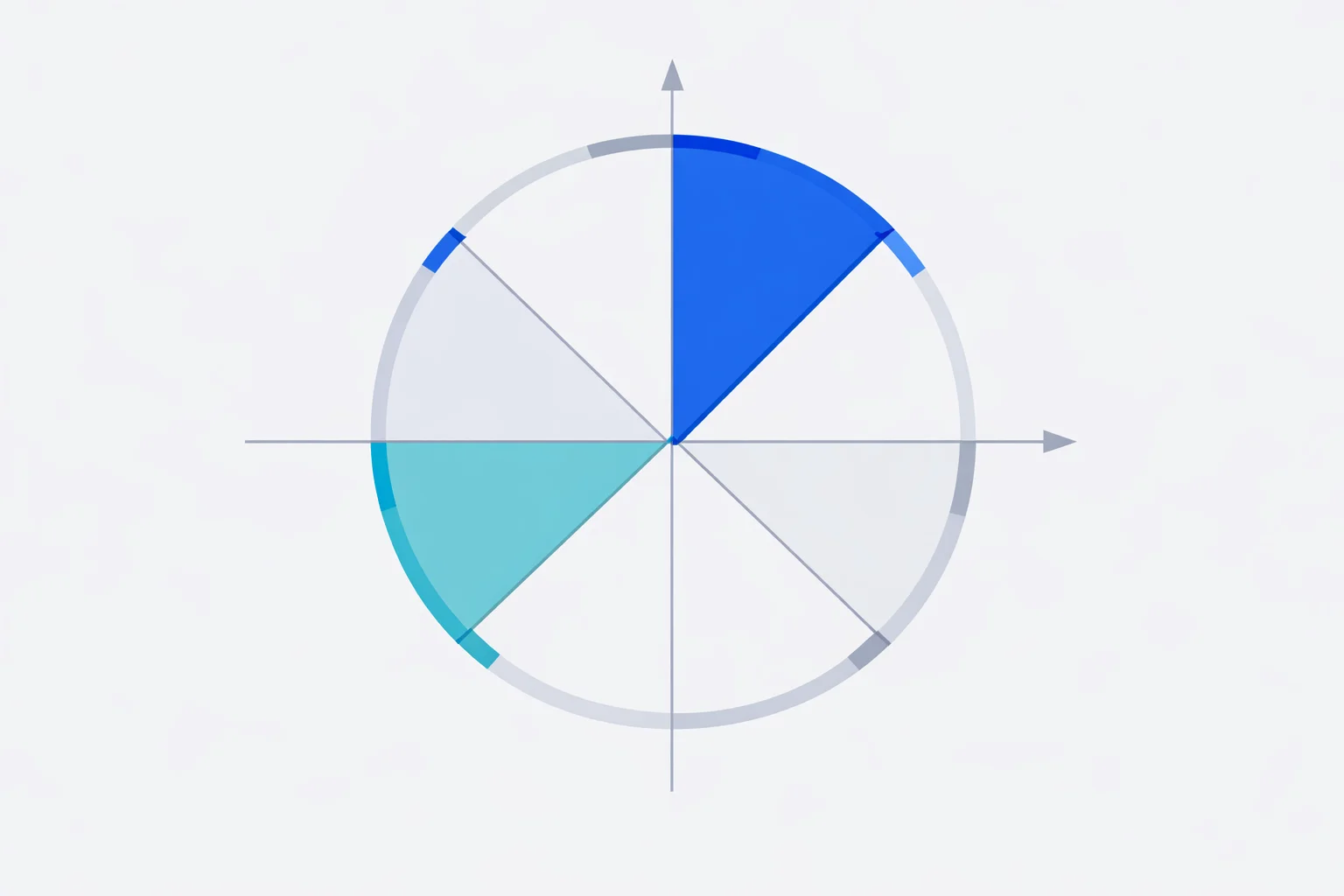
This guide walks through the conversion formula, shows you five worked examples with real numbers, and explains why programming languages insist on radians in the first place. If you need the reverse operation, use our degrees to radians converter.
The Radians-to-Degrees Formula
Multiply the radian value by 180/π. That's it.
degrees = radians × (180 / π)
Since 180/π ≈ 57.29577951, you can also think of it as "multiply by roughly 57.3." But for exact results — especially in programming — always use the full constant.
Where Does 180/π Come From?
A full circle is 360° and also 2π radians. Divide both sides by 2π:
- 360° / 2π = 180/π degrees per radian
- That's ≈ 57.2958° per radian
The factor 180/π is just the number of degrees packed into a single radian. Its inverse, π/180, converts the other way. These two constants are mirrors of each other, and you only need to remember one — the direction tells you which to use.
Five Worked Examples
Let's run through conversions you'll actually encounter in textbooks and code.
Example 1 — π/2 radians: (π/2) × (180/π) = 180/2 = 90°. A right angle. The π symbols cancel cleanly whenever the input is a fraction of π.
Example 2 — 1 radian: 1 × (180/π) = 180/3.14159… ≈ 57.296°. Bigger than most people expect — it's almost a 60° angle.
Example 3 — 2.5 radians: 2.5 × 57.2958 ≈ 143.24°. An obtuse angle, past the midpoint of a half-turn.
Example 4 — π/6 radians: (π/6) × (180/π) = 180/6 = 30°. One of the "special triangle" angles, alongside 45° and 60°.
Example 5 — 6.2832 radians: 6.2832 × (180/π) ≈ 360.0°. That's 2π — a complete lap around the circle. If your result exceeds 360°, you've gone more than one full rotation.
Radian Reference Chart
Bookmark-worthy quick lookup. These twelve values cover virtually every standard-angle problem.
| Radians (exact) | Radians (decimal) | Degrees | sin | cos |
|---|---|---|---|---|
| 0 | 0 | 0° | 0 | 1 |
| π/6 | 0.5236 | 30° | 0.5 | 0.8660 |
| π/4 | 0.7854 | 45° | 0.7071 | 0.7071 |
| π/3 | 1.0472 | 60° | 0.8660 | 0.5 |
| π/2 | 1.5708 | 90° | 1 | 0 |
| 2π/3 | 2.0944 | 120° | 0.8660 | −0.5 |
| π | 3.1416 | 180° | 0 | −1 |
| 3π/2 | 4.7124 | 270° | −1 | 0 |
| 2π | 6.2832 | 360° | 0 | 1 |
Notice the pattern: sin and cos swap at complementary angles (30° and 60°), and the signs flip as you cross quadrant boundaries (90°, 180°, 270°).
Radians in Programming Languages
Almost every language's trig functions expect radians. Here's the quick conversion snippet in four common languages:
- JavaScript:
const deg = rad * (180 / Math.PI); - Python:
deg = math.degrees(rad)— Python has a built-in helper - C / C++:
double deg = rad * (180.0 / M_PI); - Java:
double deg = Math.toDegrees(rad);
Python and Java both provide dedicated methods, so you don't need to type 180/π manually. JavaScript and C require the raw formula. Either way, the underlying math is identical.
A surprisingly common bug: passing degrees directly into Math.sin() or Math.cos(). If you write Math.sin(90)in JavaScript expecting 1, you'll get 0.894 instead — because 90 is treated as 90 radians, not 90 degrees. Always convert first.
Three Pitfalls That Trip People Up
1. Confusing the multiplier direction. To go from radians to degrees, multiply by 180/π (≈ 57.296). To go the other way, multiply by π/180 (≈ 0.01745). Mixing these up inverts your result. Quick sanity check: 1 radian should give roughly 57°. If you get 0.017, you used the wrong factor.
2. Using 3.14 instead of π.Rounding π to 3.14 introduces a 0.05% error. For a single conversion that's negligible, but errors compound. After 100 chained operations, you're off by about 5%. Always use your language's full-precision constant — Math.PI, math.pi, or M_PI.
3. Forgetting to normalize. A value like 8π radians is technically valid (four full rotations), but if you need an angle between 0° and 360°, apply modulo: (degrees % 360 + 360) % 360. The double-modulo trick handles negative inputs cleanly.
Degrees or Radians — Which Should You Use?
There's no universal winner. The right unit depends on context:
- Use degrees for everyday angles — compass bearings, roof pitch, camera rotation, map headings, carpentry cuts. Humans think natively in degrees.
- Use radians for calculus, physics, signal processing, and any formula involving angular velocity (ω = rad/s). Radians keep derivatives clean and avoid stray constants.
- Use gradians for European surveying and some civil engineering contexts. A right angle is exactly 100 gon — handy for certain field calculations. Try our degrees to gradians converter if you work in that space.
In practice, most engineers and programmers keep internal calculations in radians and convert to degrees only for display or user input. This pattern minimizes conversion errors and keeps math expressions compact.
A Brief History of the Radian
The concept of measuring angles by arc-length-to-radius ratio dates to the 1700s, but the word "radian" didn't appear in print until 1873. James Thomson — brother of Lord Kelvin — coined it in an exam paper at Queen's University Belfast. Before that, mathematicians simply wrote "circular measure" and everyone understood.
The International Bureau of Weights and Measures (BIPM) classifies the radian as a "dimensionless derived unit" of the SI system. It's technically unitless — a ratio of two lengths — which is why it drops out of equations so gracefully. No other angle unit has that property. Degrees and gradians always carry a dimensional tag that must be managed.
The beauty of radians goes deeper than convenience. Euler's identity — eiπ + 1 = 0 — only works because the exponent is in radians. Swap π for 180 and the equation falls apart. That single fact explains why mathematicians adopted radians three centuries ago and never looked back.
Interested in how angle conversion fits into GPS and mapping? Our DMS to decimal degrees converter handles the degrees-minutes-seconds format that navigation systems rely on.