Degrees to Gradians: The Metric Revolution That Almost Changed How We Measure Angles
A degrees to gradians conversion takes one multiplication — degree value times 10/9 — but the story behind why you'd ever need it is far more interesting than the arithmetic. The gradian is a product of revolutionary France, born from the same radical impulse that gave us the meter and the kilogram. While those siblings conquered the world, the gradian stayed mostly in surveying offices across Continental Europe. This article digs into that history, explains the design logic behind 400 divisions, and shows where this conversion still matters.
The Degrees-to-Gradians Formula
The math fits on an index card:
gradians = degrees × (10 / 9)
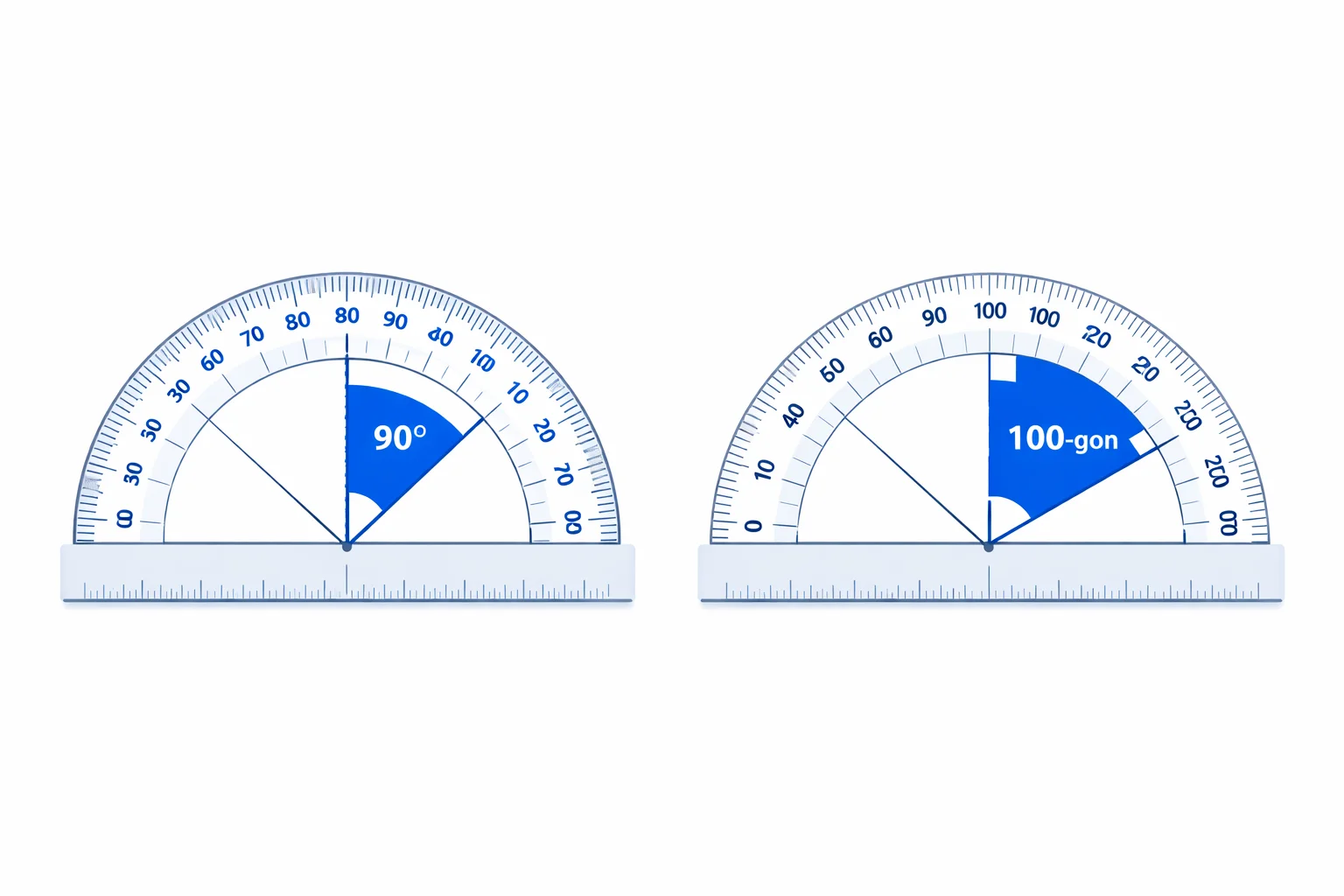
A full rotation is 360° and also 400 gon. Divide 400 by 360 and you get 10/9 — roughly 1.11111. That's the entire conversion factor. To reverse it, multiply gradians by 9/10 — or use our gradians to degrees converter. Unlike the degrees-to-radians conversion (which drags in irrational π), this ratio is perfectly rational. Integer degree values that are multiples of 9 produce terminating decimals; everything else repeats.
France Reinvents the Angle: The 1790s Metric Reform
On 8 May 1790, the French National Assembly voted to create a unified system of weights and measures. The old regime had left France with over 800 different local measurement standards — a bushel in Paris wasn't the same as a bushel in Lyon, and nobody could agree on the length of a foot. The Academy of Sciences was tasked with building everything from scratch, and they went all in on base 10.
Length got the meter (one ten-millionth of the distance from the equator to the North Pole). Mass got the kilogram. Volume got the liter. And angles got the grade — what we now call the gradian or gon. The Commission on Weights and Measures, led by figures like Lagrange, Laplace, and Condorcet, proposed splitting the right angle into 100 new degrees, making the full circle 400. The decree was signed into law on 18 Germinal, Year III of the Republican Calendar (7 April 1795).
They didn't stop at angles. French cartographers actually produced trigonometric tables in the new gradians — the Tables du cadastre, computed under the direction of Gaspard de Prony between 1793 and 1801, ran to 22 decimal places. Those tables were so precise that they weren't fully superseded until electronic calculators arrived in the 1970s. The sheer labor involved — dozens of human "computers" working by hand — underscores how seriously the Revolution took its decimal angle system.
Why 400 and Not 100 or 1000?
If the goal was decimal convenience, why not divide a circle into 100 parts? Or 1000?
The answer is the right angle. Perpendicularity is fundamental — walls meet floors at right angles, road intersections form right angles, and survey grids rely on right angles constantly. The designers needed a right angle to land on a clean round number. With 100 divisions per circle, a right angle would be 25 — workable but odd. With 1000, it'd be 250 — cleaner, but then each gradian would be a tiny 0.36°, making field readings impractically small. Four hundred put the right angle at exactly 100, each degree of arc at roughly 1 gon, and kept the unit large enough to be practical on a surveyor's scale.
There's a bonus. Because a right angle is 100 gon, slope percentages and gradians align perfectly. A slope of 1% (1 meter rise per 100 meters horizontal) corresponds to approximately 1 gon. For road engineers and railway planners, that direct mapping between grade percentage and angular measurement was — and remains — genuinely useful.
The Decimal Time Parallel — What Died vs What Survived
The gradian wasn't the only radical decimalisation the Revolution attempted. Republican decimal time launched on 24 November 1793: a day became 10 hours, each hour 100 minutes, each minute 100 seconds. Clocks were manufactured. Dials were printed. And almost nobody used them.
The problem was social inertia. Every French citizen told time. Replacing 24-hour clocks meant re-educating an entire nation and scrapping millions of existing timepieces. After just 17 months — on 7 April 1795, ironically the same date the gradian was formally adopted — the government suspended decimal time as "optional." It was quietly buried.
The gradian survived for a simple reason: almost nobody except surveyors and artillery officers needed angle units in daily life. Converting a professional community of maybe 10,000 people was vastly easier than converting 28 million French citizens' sense of when lunchtime was. The meter succeeded for different reasons — its decimal subdivisions genuinely made commerce easier, and Napoleon enforced it across conquered territories. The gradian tagged along for the professional ride.
Countries That Adopted Gradians (and Why Most Didn't)
France was first, naturally. But the gradian spread primarily through surveying traditions rather than legislation:
- France: Still the default in cadastral surveys. The French national mapping agency (IGN) publishes in gon.
- Germany: Adopted gon for surveying in the 19th century. German total stations like those from Leica (originally Wild Heerbrugg) ship in gon mode.
- Switzerland: The Swiss national coordinate system (CH1903+) uses gon for all angular measurements. Swiss federal surveying exams test in gon exclusively.
- Scandinavia: Sweden, Norway, and Finland use gon in their national survey systems, a tradition dating to 19th-century adoption of metric standards.
- Belgium and the Netherlands: Gon is standard in land registration and civil engineering projects.
Why didn't the UK or the US adopt gradians? Partly because they were slow to adopt the metric system at all — the UK didn't metricate until the 1960s–70s, and the US still hasn't fully. But the bigger reason is path dependency. British and American surveying traditions built on degrees-minutes-seconds (DMS), and their instruments, training programs, and legal land records were all in degrees. Switching would've required re-graduating every theodolite and retraining every surveyor — with no benefit compelling enough to justify the upheaval. Check our DMS to decimal degrees converter for the format these countries still use.
Famous Angles: Worked Conversions from Iconic Structures
Dry formula practice is forgettable. Converting angles tied to real places sticks better.
Leaning Tower of Pisa — 3.97° tilt: 3.97 × (10/9) = 4.4111 gon. That's the current lean after the 1990–2001 stabilisation project shaved off about 0.5°. Before restoration, the tower leaned at roughly 5.5° (6.1111 gon). In surveying terms, less than 5 gon of tilt — not much, but enough to be visible from a kilometer away.
Great Pyramid of Giza — 51.84° face slope: 51.84 × (10/9) = 57.6 gon. Ancient Egyptian builders achieved this angle with astonishing precision across all four faces. Fun fact: 57.6 gon is close to but not exactly 57.5 — it doesn't simplify to a clean gradian value, which suggests the Egyptians weren't thinking in base 10 any more than the Babylonians were.
Eiffel Tower base legs — 54° angle of inclination: 54 × (10/9) = 60 gon. A clean conversion. The structural angle of the Eiffel Tower's legs was chosen partly for wind resistance, and it happens to land on a round gradian value — a coincidence Gustave Eiffel likely didn't plan for, given that the tower was designed in degrees.
Standard roof pitch — 30° (6:12 pitch): 30 × (10/9) = 33.3333 gon. This is the most common residential roof slope in North America. The repeating decimal shows that not every common degree value converts neatly to gradians.
Degrees vs Gradians for Slope Calculations
Here's where gradians genuinely outperform degrees, and it's the core reason surveyors held onto the unit. A slope percentage describes rise over run: a 12% slope rises 12 meters for every 100 meters of horizontal distance. The angle of that slope in gradians is approximately 12 gon (technically 12.004 gon — the relationship is approximate because it uses the tangent function, not a simple ratio). In degrees, that same slope is 6.843°.
Which is easier to work with in the field? For a surveyor reading a theodolite and computing earthwork volumes by hand — or even punching numbers into a field calculator — the near-identity between slope percentage and gon value saves mental effort on every single reading. Multiply that by hundreds of readings per day, and the gradian's advantage compounds.
| Slope % | Degrees | Gradians (gon) |
|---|---|---|
| 1% | 0.573° | 0.637 gon |
| 5% | 2.862° | 3.180 gon |
| 10% | 5.711° | 6.346 gon |
| 25% | 14.036° | 15.596 gon |
| 45% | 24.228° | 26.920 gon |
| 100% | 45.000° | 50.000 gon |
Notice that 100% slope (a 45° angle) is exactly 50 gon. A vertical surface — 90° — is 100 gon. This base-10 regularity is what road builders and railway engineers across France and Germany rely on daily.
When You'll Encounter This Conversion Today
The gradian's niche has narrowed since the 1790s, but it hasn't disappeared. You'll run into degrees-to-gradians conversion in these situations:
- Importing European survey datasets.If you receive cadastral data from France, Switzerland, or Germany, the angular values will almost certainly be in gon. You'll need to convert if your GIS software is set to degrees.
- Configuring total stations.Instruments from Leica, Trimble, and Topcon can operate in degrees or gon. When a project spec says "gon," you need to verify your reference setup angles by converting known degree values.
- Reading historical maps and surveys. French cadastral maps dating back to the Napoleonic era use gradians. Archival research in European property law often requires fluency in both systems.
- European engineering exams.Civil engineering and geodesy exams in Switzerland, Germany, and Scandinavia test gradian competency. If you studied in degrees and are preparing for a European qualification, you'll convert constantly.
- Debugging calculator and software output.A mismatched angle mode is a classic source of wrong trig results. If your calculation is off by a factor that looks like 10/9, someone's feeding degrees into a function expecting gradians — or vice versa. For situations involving degrees and radians, that mismatch looks very different (off by a factor of about 57.3).
The gradian is a survivor — a product of the most ambitious measurement reform in history, outlasting decimal time, the Republican calendar, and even the original metric standard for temperature (the centigrade thermometer was renamed to Celsius in 1948, but the gradian has kept its name and its niche). Every time a French surveyor reads a bearing in gon, they're using a tool designed by Enlightenment mathematicians who believed — correctly, for some units, and overoptimistically for others — that base 10 could simplify everything.