How to Convert Degrees to Radians: Formula, Unit Circle & Common Angles
Degrees to radians conversion trips up everyone at some point — usually right when you're feeding an angle into Math.sin() and get gibberish back. The fix is simple: multiply degrees by π/180. That single operation converts any degree value into radians, the angle unit that calculus, physics, and every major programming language actually expect. This guide walks through the formula, the reasoning behind it, and the edge cases that catch people off guard.
The Degrees-to-Radians Formula
The conversion is one line of arithmetic:
radians = degrees × (π ÷ 180)
Where does π/180 come from? A full circle is 360° and simultaneously 2π radians. Divide both sides by 360 and you get 1° = 2π/360 = π/180 radians. That ratio — approximately 0.01745329 — is the conversion factor you multiply by any degree value.
To go the other direction, flip the fraction: multiply radians by 180/π. If you need that reverse conversion often, check out our radians to degrees converter.
What Is a Radian, Exactly?
Picture a circle with radius r. Now imagine laying a copy of that radius along the curved edge of the circle. The angle you've swept out — from the center of the circle — is exactly 1 radian. Since a circle's circumference is 2πr, it takes 2π radius-lengths to wrap all the way around. That's why a full revolution equals 2π radians (about 6.2832), not some rounder number.
Degrees, by contrast, exist because ancient Babylonians liked the number 360 — it's divisible by 2, 3, 4, 5, 6, 8, 9, 10, 12, 15, 18, 20, and more. Handy for splitting circles into equal parts, less handy for differential equations. Radians tie angle measurement directly to the geometry of the circle itself, which is why they simplify nearly every formula in higher mathematics.
Worked Examples with Common Angles
Let's walk through several conversions step by step so the formula becomes second nature.
Example 1 — 90 degrees: 90 × (π/180) = 90π/180 = π/2 ≈ 1.5708 rad. This is a right angle, the most fundamental angle in geometry.
Example 2 — 45 degrees: 45 × (π/180) = 45π/180 = π/4 ≈ 0.7854 rad. At π/4, sin and cos are both equal to √2/2. If your trig function returns 0.7071 for both, you know the input was correct.
Example 3 — 60 degrees:60 × (π/180) = π/3 ≈ 1.0472 rad. The interior angle of an equilateral triangle. In physics, 60° appears in projectile motion problems because it produces the same horizontal range as 30° (they're complementary).
Example 4 — 270 degrees: 270 × (π/180) = 3π/2 ≈ 4.7124 rad. This points straight down on the unit circle. The sine is −1 and cosine is 0.
Example 5 — −30 degrees: (−30) × (π/180) = −π/6 ≈ −0.5236 rad. Negative angles go clockwise. In game development, negative rotations are used constantly for camera and sprite movement.
Unit Circle Cheat Sheet
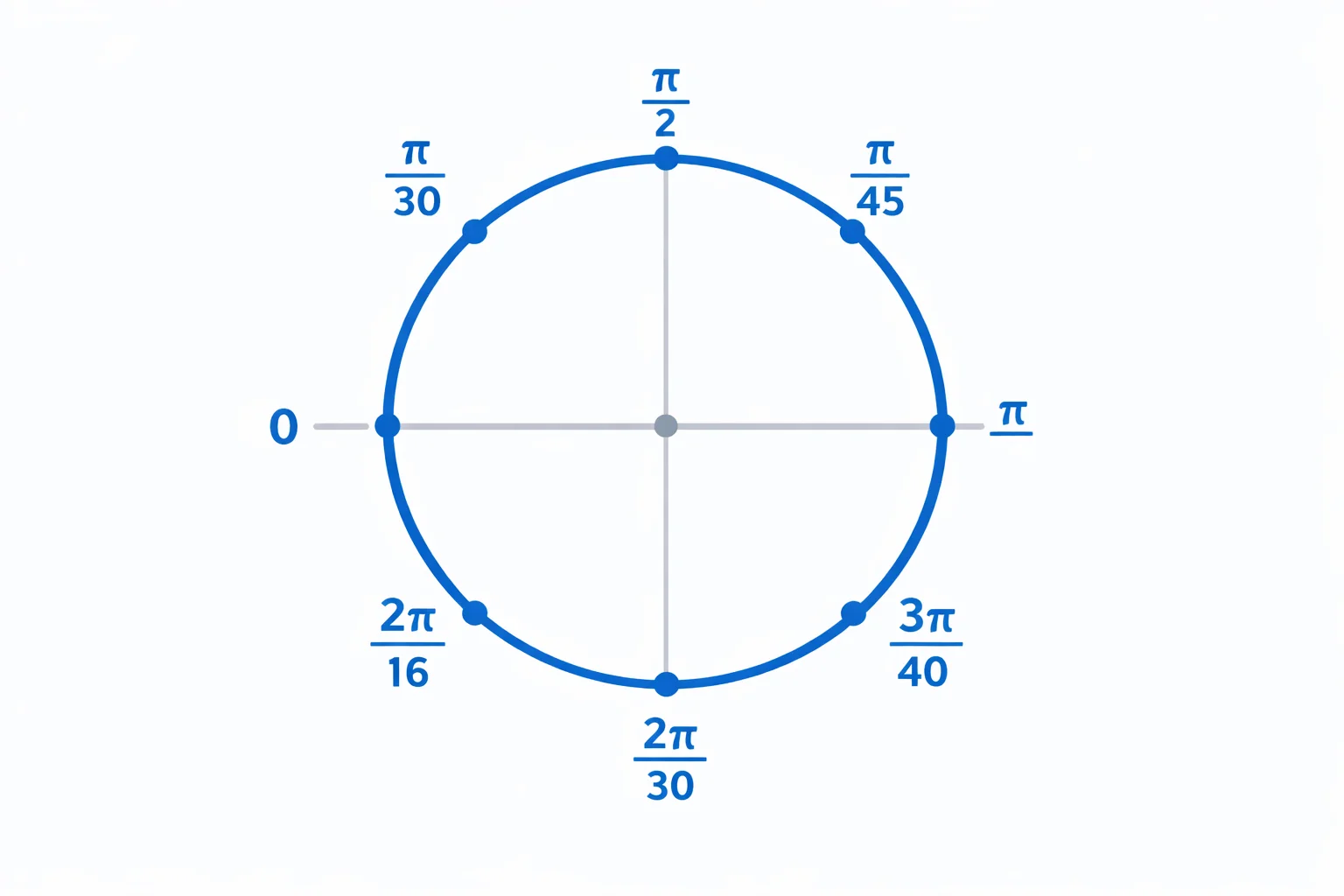
The unit circle is a radius-1 circle centered at the origin. Every point on it has coordinates (cos θ, sin θ). Memorizing the radian values at the 12 standard positions covers most of trigonometry:
| Degrees | Radians | sin θ | cos θ | tan θ |
|---|---|---|---|---|
| 0° | 0 | 0 | 1 | 0 |
| 30° | π/6 | 1/2 | √3/2 | √3/3 |
| 45° | π/4 | √2/2 | √2/2 | 1 |
| 60° | π/3 | √3/2 | 1/2 | √3 |
| 90° | π/2 | 1 | 0 | ∞ |
| 180° | π | 0 | −1 | 0 |
| 270° | 3π/2 | −1 | 0 | ∞ |
| 360° | 2π | 0 | 1 | 0 |
Notice the pattern in the first quadrant: sine values go 0, 1/2, √2/2, √3/2, 1 while cosine values go in reverse. If you remember one column, you know the other.
Why Radians Matter in Math and Code
Radians aren't just an alternative to degrees — they're the "natural" unit of angle. Three concrete reasons:
- Calculus becomes clean. The derivative of sin(x) is cos(x), but only when x is in radians. Use degrees and you need an ugly π/180 correction factor on every derivative and integral.
- Arc length is trivial.Arc length = radius × angle (in radians). With degrees you'd need arc = πr × degrees / 180. One is elegant; the other is a mess.
- Programming functions expect radians. JavaScript's
Math.sin(90)returns 0.894 — not 1 — because it reads 90 as radians, not degrees. Python, C, Java, Swift, Rust: same deal. PassingMath.sin(90 * Math.PI / 180)gives the correct 1.
In physics, NIST's SI unit guidelines define the radian as the SI coherent derived unit for plane angle. It's dimensionless — one radian is literally the ratio of two lengths (arc length / radius) — which is precisely why it slots into equations without extra conversion constants.
Degrees vs Radians vs Gradians
Three systems, three different ways to slice a circle:
| Feature | Degrees | Radians | Gradians |
|---|---|---|---|
| Full circle | 360° | 2π | 400 gon |
| Right angle | 90° | π/2 | 100 gon |
| Origin | Babylonian (base-60) | Geometry (arc/radius) | French metric system |
| Primary use | Everyday, navigation | Math, physics, code | Surveying, civil eng. |
| Symbol | ° | rad | gon or grad |
Gradians split the right angle into exactly 100 parts, which makes slope calculations simpler for surveyors. You can convert degrees to gradians with our degrees to gradians converter. Most scientific calculators include a DRG button to toggle all three modes.
Common Mistakes When Converting
Even experienced developers and students stumble on these:
- Forgetting to convert before calling trig functions. Writing
Math.sin(45)when you meanMath.sin(45 * Math.PI / 180). The first gives 0.8509 — the sine of 45 radians (about 2,578°), not 45°. - Multiplying by 180/π instead of π/180.That's the reverse operation. If your result is a huge number when you expected a small one (or vice versa), you've flipped the fraction.
- Confusing π the number with π the symbol.In formulas, π/4 rad means approximately 0.7854 rad. Some students write "π/4 = 45" and forget to include the degree symbol — leading to confusion about which unit they're working in.
- Rounding too early.If you round π to 3.14 mid-calculation, a 360° conversion gives 6.28 instead of the true 6.2832. That 0.05% error compounds across multi-step problems. Use your language's built-in
Math.PIconstant for full precision.
Quick Mental Math Tricks
You don't always need a calculator. These shortcuts cover 90% of classroom situations:
- Divide by 60, then multiply by π/3. Since 180/60 = 3, angles that are multiples of 60° give clean fractions: 60° = π/3, 120° = 2π/3, 240° = 4π/3.
- For 30° increments, divide the degree by 30 to get the numerator over 6. 30° = 1×(π/6), 60° = 2×(π/6), 90° = 3×(π/6), and so on.
- 1 radian ≈ 57.3°. So 2 radians is about 114.6° and 3 radians is about 171.9°. This rough estimate is enough for sanity-checking your work. If your answer seems way off from these landmarks, recheck.
- π ≈ 3.14159. For quick decimal estimates, 45° ≈ 0.785, 90° ≈ 1.571, 180° ≈ 3.142. Memorize these three and interpolate for angles in between.
When You Actually Need This Converter
A few scenarios where converting degrees to radians isn't just academic busywork:
- Game development and graphics. Rotation functions in WebGL, Unity, Unreal, and canvas APIs expect radians. Artists and designers think in degrees; the GPU thinks in radians. Converting at the boundary keeps everyone sane.
- Physics simulations. Angular velocity (rad/s), torque calculations, and pendulum equations all require radian input. Plugging in degrees silently produces wrong results that are hard to debug.
- Robotics and CNC machining.Stepper motors often track position in encoder counts that map to radians. Converting from a human-readable degree specification to the machine's native radian reference is a daily task.
- Trigonometry homework. Straightforward, but real — textbooks mix degree and radian problems, and getting the conversion wrong loses marks even when the rest of the work is correct.
If your work involves GPS coordinates in DMS format, you'll first convert DMS to decimal degrees, then decimal degrees to radians. That two-step pipeline is common in geolocation code.