USD to MXN: How Remittances and Trade Shape the Dollar-Peso Rate
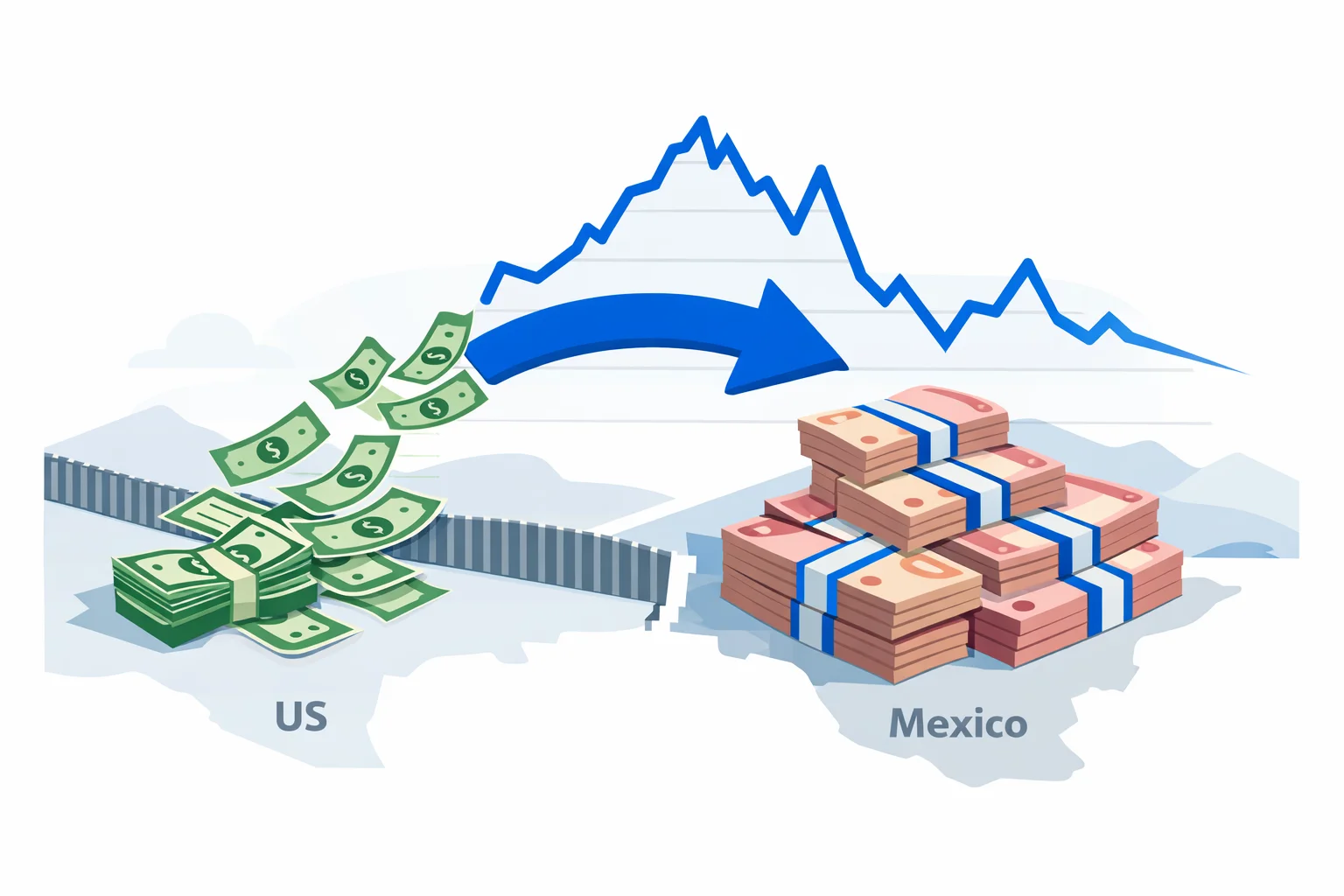
A USD to MXN converter turns dollars into Mexican pesos at a rate shaped by the single busiest money route on Earth: roughly $63 billion flows from the United States to Mexico every year, almost all of it converted into pesos on arrival. That river of remittances, plus a manufacturing boom and one of the highest interest rates in the world, is why the peso has behaved less like a fragile emerging-market currency and more like a headline act. This guide covers the math, what pushes the dollar-peso rate around, and why the same $100 has bought anywhere from 1,000 to 2,500 pesos over the past decade.
Why $100 Becomes 1,850 Pesos, Not $5.40
The rate is quoted as USD/MXN — pesos per dollar. At about 18.5, that number tells you one dollar buys 18.5 pesos, so to convert you multiply.
- $100 → MXN: 100 × 18.5 = 1,850 pesos
- $500 → MXN: 500 × 18.5 = 9,250 pesos
- $2,500 rent → MXN: 2,500 × 18.5 = 46,250 pesos
This is the opposite instinct from converting dollars to euros or pounds, where one unit is worth more than a dollar and you divide. Here the dollar is the bigger unit, so the peso figure balloons. Divide $100 by 18.5 by mistake and you get $5.40 — a nonsense answer that's off by a factor of 342. When you need to run it the other way, from pesos into dollars, our multi-currency converter divides instead of multiplies.
The World's Busiest Remittance Route
Mexico is the world's second-largest recipient of remittances after India, and the US-to-Mexico corridor is the largest single country-to-country money flow anywhere. In 2023 those transfers set a record near $63 billion, and more than 99% arrive electronically rather than as cash. It has become one of Mexico's biggest sources of foreign income, rivaling oil exports and tourism.
Here's why that matters for the rate on your screen. Every dollar a worker in Texas sends to family in Michoacán gets sold for pesos on the receiving end. That's a steady, year-round wall of dollar-selling and peso-buying — structural demand that helps hold the peso up even when textbook logic says an emerging-market currency should sag. The average transfer is only about $390, which is exactly why the remittance panel in the tool matters: on a send that small, a flat $5 fee is 1.3% before the exchange-rate markup even starts. India's corridor is larger in total dollars, and you can see how it compares on our USD to INR converter.
What Actually Moves the Dollar-Peso Rate
Four forces do most of the work. The biggest in recent years has been the interest-rate gap: Banco de México pushed its policy rate to 11.25%and held it there through 2023 and into 2024, more than double the Federal Reserve's. That gap turned the peso into a magnet for the carry trade — borrow cheap dollars, park them in peso deposits, pocket the spread — and carry demand pushes the peso higher. You can cross-check the dollar side of any given day against the Federal Reserve's H.10 release.
Trade is the second force. Mexico overtook China and Canada to become the United States' number-one trading partner in 2023, with well over $800 billion in two-way goods trade under the USMCA agreement that replaced NAFTA in July 2020. "Nearshoring" — companies moving supply chains out of Asia and closer to US customers — has poured investment into Mexican factories and, with it, demand for pesos. Remittances are the third force, and the fourth is raw risk sentiment, which brings us to the peso's split personality.
The Super Peso — and the Round Trip Back
Most currency stories are one-way slides. The peso's is a round trip. In March 2020 the pandemic panic drove USD/MXN to a record near 25 pesos per dollar as investors fled to the safety of cash. Then it reversed hard. Between 2020 and 2023 the peso climbed all the way to about 17, one of the best performances of any currency on the planet, earning the nickname "super peso." High Banxico rates, record remittances, and the nearshoring wave all pulled in the same direction.
Then the round trip. After Mexico's June 2024 general election handed the ruling Morena party a near-supermajority and stoked worries about judicial reform, the peso sold off sharply, sliding back past 18 and toward 20. The lesson isn't that the super peso was a mirage — it's that this is a floating, market-driven currency whose strength is rented, not owned. When the interest-rate gap narrows or politics turn cloudy, the same liquidity that lifted it can leave in a hurry.
Why the Peso Lurches on News That Isn't About Mexico
The Mexican peso is one of the most-traded emerging-market currencies in the world and by far the most liquid in Latin America. It changes hands almost around the clock, which makes it a favorite tool for funds that want to bet on — or hedge against — emerging markets in general. The catch is that this liquidity cuts both ways. Because the peso is easy to sell in size at any hour, it often gets dumped first when global markets turn risk-off, even when the trouble has nothing to do with Mexico.
The clearest recent example came in August 2024, when a surprise Bank of Japan rate hike forced traders to unwind the yen carry trade worldwide. The peso, a top carry-trade destination, dropped several percent in a matter of days — Mexican fundamentals unchanged. If you're timing a large conversion, that's worth knowing: a quiet week for Mexico can still be a volatile week for the peso.
From the Tequila Crisis to a Free Float
The peso you convert today is younger than it looks. In 1993 Mexico launched the "nuevo peso," lopping three zeros off the old currency so 1,000 old pesos became 1 new one. A year later came the December 1994 "Tequila Crisis": the government abandoned its dollar peg, the peso collapsed from about 3.4 to over 7 per dollar within months, and a roughly $50 billion US-led rescue package was needed to stop the bleeding. Mexico has let the peso float freely ever since.
| When | Pesos per USD | What was happening |
|---|---|---|
| 2002 | ~10 | Post-crisis stability |
| 2013 | ~13 | Emerging-market boom years |
| Late 2016 | ~20-21 | NAFTA and US election fears |
| Mar 2020 | ~25 | Pandemic record low |
| 2023 | ~17 | "Super peso" peak |
| Today | ~18.5 | After the 2024 election reversal |
Read that range and the practical point jumps out: on a five-figure transfer, the era you convert in swamps any provider's fee. The same $10,000 bought roughly 130,000 pesos in 2013 and about 250,000 at the 2020 low — a 120,000-peso gulf that no low-fee app can close.
Dollar-to-Peso Mistakes That Cost Real Money
- Reading a "$" tag as dollars.A "$800" hotel rate in Mexico is 800 pesos — about $43 — not $800. The shared symbol is the single most common trap for first-time visitors.
- Dividing instead of multiplying.Turning $1,000 into "54 pesos" by dividing is off by a factor of 342; the correct answer is 18,500 pesos. The peso is the smaller unit, so the number grows.
- Assuming the rate holds steady.This is a floating emerging-market currency that can move 2-4% in a day. Locking a budget to last month's rate on a big transfer can leave you hundreds of dollars short.
- Accepting "charge in USD" at a Mexican terminal. Dynamic currency conversion adds a 3-8% markup. Always choose to be billed in pesos and let your own bank do the conversion.
When the Converter's Rate Isn't the Rate You'll Pay
Treat the number above as a planning baseline, not a receipt. Three things pull your real cost away from mid-market. Spread: most providers bake in a 0.5-4% margin, so budget a couple of percent below what the tool shows. Timing:a card payment settles a day or two later, at that day's rate, not today's. And fees: on remittances especially, the flat fee decides the winner on small sends while the margin decides it on large ones — which is exactly what the remittance panel is built to expose.
Use the mid-market figure as your honest benchmark, pick a provider under about 1.5% all-in, and you'll land close to fair value. To compare markups across more than 160 currencies, the multi-currency converter lets you pressure-test any provider — and run the pair back the other way, from pesos into dollars, when you're on the receiving side.