Sq Km to Square Miles: Country-Size Comparisons, Map Scale Tips & Conversion Table
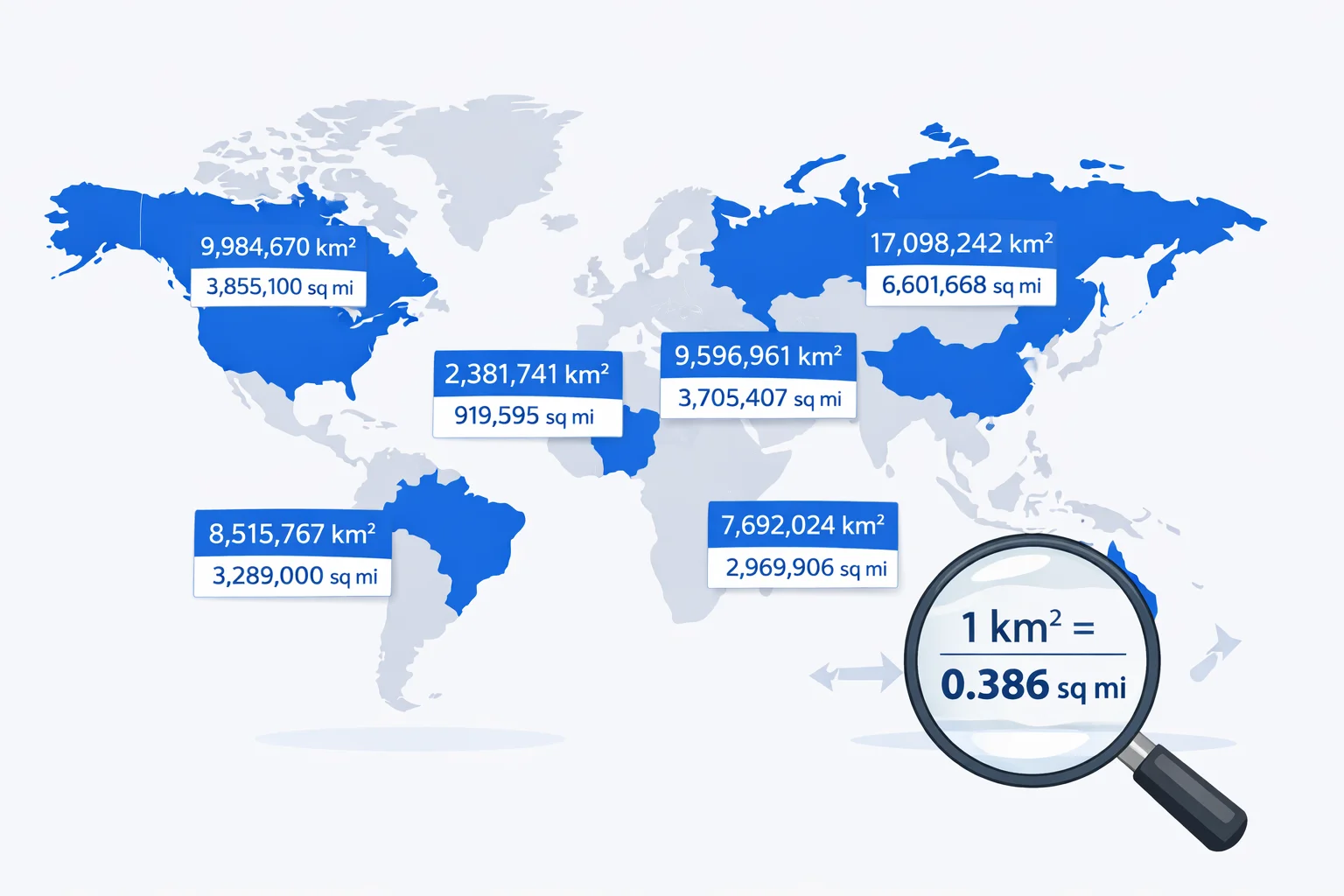
Converting sq km to sq milesis something you'll run into the moment you compare geographic data across metric and imperial systems. Russia's 17.1 million km² sounds abstract until you translate it to 6.6 million square miles — suddenly it's concrete, comparable to the U.S. at 3.8 million mi². Whether you're reading a UN population density report, planning a road trip through Europe with American maps, or settling a geography trivia debate, this conversion bridges the gap between two measurement worlds.
The ×0.386102 Factor — Where It Comes From
One kilometer equals exactly 0.621371 miles. Square both sides and you get the area conversion: 0.621371² = 0.386102. That's the factor. Multiply any value in km² by 0.386102 to get square miles. Going the other way, 1 mi² = 2.58999 km², because 1 / 0.386102 ≈ 2.58999.
The precision matters more than you'd think. At country scale, rounding to 0.39 instead of 0.3861 adds an error of roughly 1% — which on 10 million km² means a 100,000 km² discrepancy. That's bigger than Iceland. For casual comparisons, 0.386 is fine. For GIS work or cartographic calculations, use the full factor: 0.38610215854245.
Step-by-Step: Converting Sq Km to Square Miles
Here's the formula applied to a real example. Japan covers 377,975 km². To convert:
- Start with the area: 377,975 km²
- Multiply by 0.386102: 377,975 × 0.386102 = 145,937 mi²
- Verify with the inverse: 145,937 × 2.58999 = 377,975 km² ✓
Another example: Belgium at 30,528 km². Multiply: 30,528 × 0.386102 = 11,787 mi². For context, that's about the same land area as Maryland (12,406 mi²). Pairing conversions with real-world comparisons makes numbers stick.
Country-Size Comparisons in Both Units
Here's a reference table of well-known countries and territories with their areas in both units. Numbers like these tend to come up in trivia, school projects, and news reporting.
| Country | Area (km²) | Area (mi²) | Comparable U.S. State |
|---|---|---|---|
| Iceland | 103,000 | 39,769 | ≈ Kentucky |
| United Kingdom | 243,610 | 94,058 | ≈ Oregon |
| Germany | 357,022 | 137,847 | ≈ Montana |
| Japan | 377,975 | 145,937 | ≈ Montana |
| France | 640,679 | 247,368 | ≈ Texas (minus 20%) |
| Australia | 7,692,024 | 2,969,907 | ≈ Lower 48 (minus 8%) |
Notice how European countries that feel large on their own maps turn out to be state-sized when compared to the U.S. Germany, at 137,847 mi², fits inside Montana (147,040 mi²). These comparisons are why converting between km² and mi² matters — raw numbers only tell half the story.
Map Scales and Geographic Data
Geographic datasets from the UN, World Bank, and CIA World Factbook almost always report area in square kilometers. If you're pulling data for a report or presentation aimed at an American audience, you'll need the square miles figure. GIS software like QGIS and ArcGIS let you set display units, but exported tables often default to km² since that's the SI standard maintained by the International Bureau of Weights and Measures (BIPM).
Map scale adds another layer. A 1:1,000,000 map means 1 cm on paper = 10 km on the ground. If you measure a region on that map as 4 cm × 3 cm, that's 40 km × 30 km = 1,200 km² = 463 mi². Getting the unit right at the map-reading stage prevents compounding errors downstream.
Metric vs. Imperial in Geography
Almost every country on Earth uses the metric system for official geographic measurements. The three notable holdouts — the United States, Myanmar, and Liberia — still reference square miles in domestic contexts. But even the U.S. uses metric internally for scientific and military mapping. The U.S. Geological Survey (USGS) publishes topographic data in meters, for instance.
The UK sits in a weird middle ground. Ordnance Survey maps use kilometers, but road signs show miles and everyday conversation still references square miles for large areas. So a Brit might say "the Lake District is 2,362 km²" in a formal report and "about 912 square miles" at the pub. Knowing both numbers isn't pedantic — it's practical.
Common Mistakes When Converting Area Units
The biggest trap? Using the linear conversion factor for an area conversion. One kilometer is 0.6214 miles, so people instinctively multiply km² by 0.6214 instead of 0.3861. That error inflates results by 61%. If you convert 1,000 km² using the wrong factor, you get 621 mi² instead of the correct 386 mi² — off by 235 mi², an area bigger than Chicago.
- Wrong: 500 km² × 0.6214 = 310.7 mi² (this converts length, not area)
- Right: 500 km² × 0.3861 = 193.1 mi² (area factor = linear factor squared)
Another common slip: confusing km² with "square km" conceptually. Some people think 1 km² means a strip 1 km long, not a square that is 1 km on each side. One square kilometer is 1,000 m × 1,000 m = 1,000,000 square meters. If you need to convert smaller areas, our square feet to square meters converter handles property-scale measurements.
National Parks and Landmarks in km² and mi²
National parks are a great way to build intuition for area units because most people have visited at least one.
- Yellowstone (U.S.): 8,983 km² / 3,468 mi² — larger than Delaware and Rhode Island combined
- Kruger (South Africa): 19,485 km² / 7,523 mi² — almost the size of New Jersey
- Fiordland (New Zealand): 12,607 km² / 4,868 mi² — about the size of Connecticut
- Banff (Canada): 6,641 km² / 2,564 mi² — roughly the area of Delaware
- Swiss National Park: 170 km² / 66 mi² — compact, but packed with alpine terrain
These comparisons work because park boundaries are well-defined and widely recognized. Saying "an area about the size of Yellowstone" communicates scale instantly to an American audience. For land deals and agricultural comparisons, our hectares to acres converter covers the units more commonly used in farming and real estate.
Quick Estimation Tricks
Don't have a calculator handy? These shortcuts get you close enough for conversation:
- Divide by 2.6: The simplest mental math. 1,000 km² ÷ 2.6 ≈ 385 mi² (actual: 386). Accurate to within 0.3%.
- Take 40% and subtract a hair: 40% of 1,000 = 400. Knock off about 14 → 386. Works well for round numbers.
- Halve it, then subtract 20% of the half: Half of 1,000 = 500. 20% of 500 = 100. 500 − 100 = 400. Close, but overshoots by about 3.6%. Good for ballpark.
For agricultural or property-level plots rather than country-sized areas, the hectares to acres converter handles the smaller scale where km² and mi² would just produce awkward decimals.
When You Actually Need This Conversion
Some specific scenarios where sq km to sq miles comes up:
- News and journalism: International outlets report disaster zones, fire perimeters, and oil spills in km². U.S. readers need the mi² equivalent to gauge scale.
- Academic research: Population density studies often cite people per km². Converting the area denominator lets you recalculate for mi² without rerunning the analysis.
- Travel planning: Comparing island sizes for vacation planning. Bali at 5,780 km² (2,232 mi²) vs. Hawaii's Big Island at 10,430 km² (4,028 mi²) helps set expectations for driving distances.
- Real estate and land investment: Large-scale international land purchases — think ranches in Patagonia or development zones in Africa — are quoted in km² but compared against U.S. county sizes in mi².
- Trivia and education: Geography bees, school quizzes, and pub trivia frequently test area comparisons across countries. Having both numbers ready wins points.