Gradians to Radians: Why Surveyors and Programmers Need This Conversion
Converting gradians to radians is straightforward: multiply by π/200. That single operation takes a surveying-friendly angle and turns it into the format every programming language's trig functions demand. Sounds simple, and it is — once you know why the factor is π/200 and not some rounder number. The catch is that gradians and radians were invented centuries apart for completely different audiences, and mixing them up can silently wreck calculations from bridge bearings to 3D game rotations.
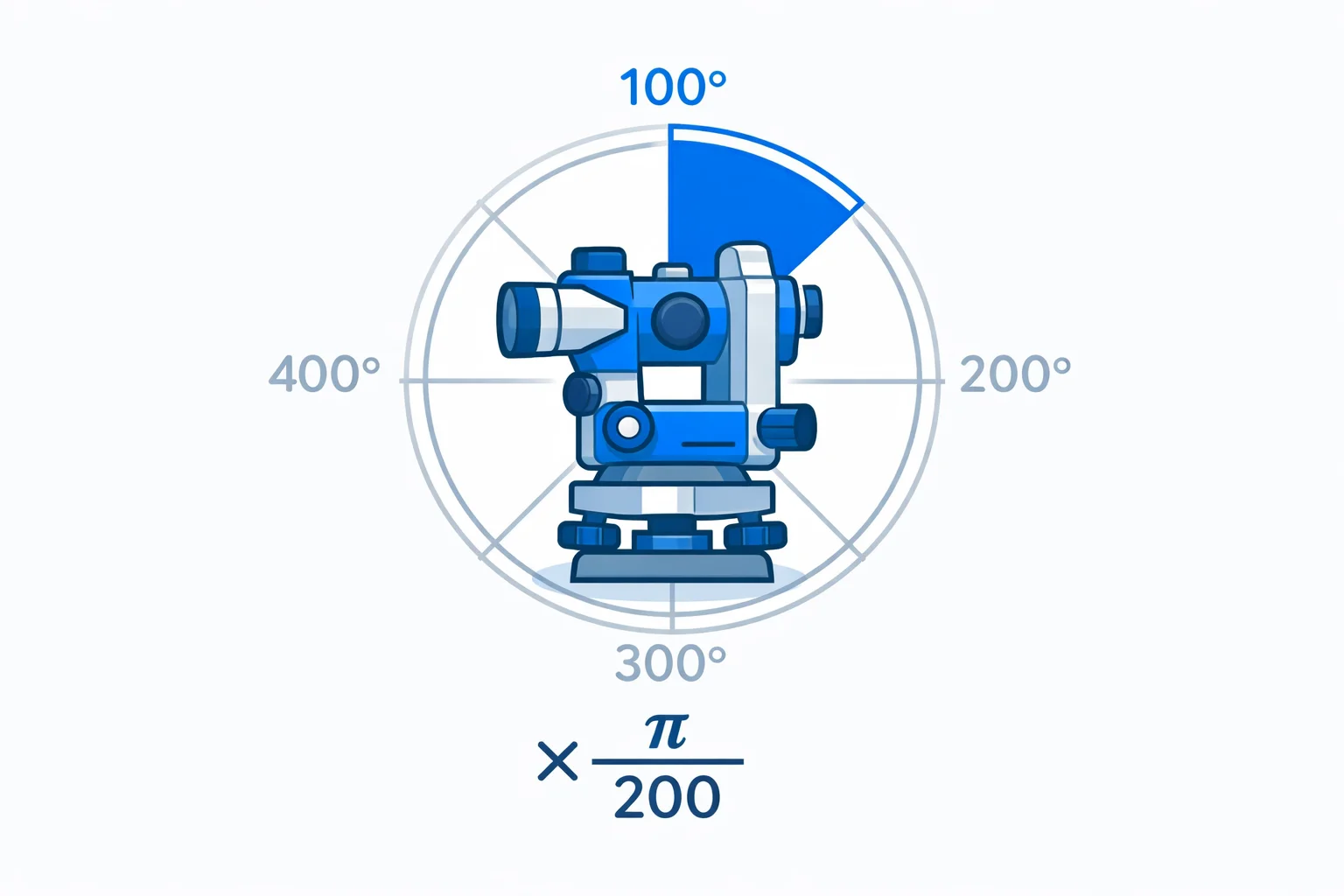
The Gradians-to-Radians Formula
Here's the complete formula:
radians = gradians × (π / 200)
Where does π/200 come from? A full circle equals 400 gradians and also equals 2π radians. Dividing 2π by 400 gives π/200, or roughly 0.015708. That's your multiplier. Every gradian is worth about 0.0157 radians — a tiny sliver of arc.
For the reverse direction — radians back to gradians — flip the fraction and multiply by 200/π. Our radians to gradians converter handles that direction if you need it.
Where Gradians Come From
France, 1790s. The Revolutionary government wanted to decimalize everything: the calendar, the clock, and angular measurement. Their solution split a right angle into 100 parts instead of 90, making a full circle 400 "grades." The name evolved into "gradian" (or "gon" in German-speaking countries).
The decimal calendar and clock died within a decade. Gradians survived — but only in one niche: land surveying. European geodetic agencies adopted gon because bearing arithmetic became trivially easy when right angles are a clean 100. A surveyor turning 137.50 gon doesn't have to deal with degrees-minutes-seconds notation. The number is already decimal, ready for addition and subtraction on a pocket calculator.
Radians, by contrast, emerged from 18th-century mathematics. Roger Cotes first described the concept around 1714, though the term "radian" wasn't coined until 1873. The unit is defined by geometry: one radian is the angle at which the arc length equals the circle's radius. That definition makes calculus work cleanly — the derivative of sin(x) is cos(x) with no scaling factor — which is why every programming language from C to Python uses radians for trig functions.
Step-by-Step Worked Examples
Let's walk through three conversions to make the formula concrete.
Example 1: Convert 100 gradians to radians.
- 100 × (π / 200) = 100π / 200 = π/2
- π/2 ≈ 1.5708 radians
- This is a right angle — exactly 90°
Example 2: Convert 250 gradians to radians.
- 250 × (π / 200) = 250π / 200 = 5π/4
- 5π/4 ≈ 3.9270 radians
- That's 225° — deep into the third quadrant, pointing southwest on a compass rose
Example 3: Convert 63.66 gradians to radians.
- 63.66 × (π / 200) ≈ 63.66 × 0.015708 ≈ 0.9999 radians
- Almost exactly 1 radian (57.3°)
- This shows that ~63.66 gon is the gradian equivalent of one radian — a handy benchmark to remember
Gradian–Radian–Degree Comparison Table
This three-way table covers the angles you'll encounter most often. Bookmark it — it saves a calculation every time.
| Gradians | Radians (exact) | Radians (decimal) | Degrees |
|---|---|---|---|
| 0 gon | 0 | 0 | 0° |
| 50 gon | π/4 | 0.7854 | 45° |
| 100 gon | π/2 | 1.5708 | 90° |
| 150 gon | 3π/4 | 2.3562 | 135° |
| 200 gon | π | 3.1416 | 180° |
| 300 gon | 3π/2 | 4.7124 | 270° |
| 400 gon | 2π | 6.2832 | 360° |
Notice the pattern: multiples of 50 gon always produce clean π fractions. That's because 50 gon is exactly 1/8 of a circle (π/4 radians). Any gradian value divisible by 50 will yield an exact π fraction.
The Surveying-to-Code Pipeline
Here's a scenario that plays out daily in civil engineering firms. A survey crew shoots bearings with a Leica TS16 total station set to gon mode — standard practice across most of Continental Europe. Back at the office, an engineer imports those bearing values into a Python or MATLAB script to compute coordinates, design road curves, or run finite element analysis.
The script's trig functions (sin, cos, atan2) all expect radians. Feed them raw gon values and the output is wrong — not obviously wrong, just subtly off by a factor that compounds through the calculation chain. A 100-gon bearing treated as 100 radians would be off by about 5,630% from the intended direction. That's not a rounding error. That's a bridge pointed the wrong way.
The fix is a one-liner at the import boundary: multiply every gon value by π/200 before passing it to any trig function. If you work with degrees instead, our degrees to radians converter covers that path.
Mistakes That Break This Conversion
These errors crop up regularly, especially when switching between angle systems mid-project.
- Using 180 instead of 200. The factor π/180 converts degreesto radians, not gradians. Confusing the two gives you a result that's 10% too large. If you get 1.7453 radians from 100 gon, you used the wrong denominator — the correct answer is 1.5708.
- Forgetting your calculator mode.Scientific calculators have DEG, RAD, and GRAD modes. If you're in GRAD mode, entering sin(100) returns sin(100 gon) = sin(90°) = 1. But in RAD mode, sin(100) ≈ −0.506. Same keystrokes, wildly different answers. Always check the mode indicator before trusting trig output.
- Assuming 1 gon ≈ 1 degree.They're close (0.9° per gon), but the 10% difference accumulates. Over a 360-degree sweep, treating gon as degrees creates a 40-gon gap. For navigation or surveying, that's catastrophic.
- Rounding π/200 too early.Using 0.016 instead of 0.015708 introduces a 1.86% error. For a 300-gon angle, that's a 0.088 radian discrepancy — about 5 degrees. Keep at least 5 significant digits in the conversion factor.
Quick Mental Estimation Trick
Don't have a calculator? Here's how to estimate gradians to radians in your head. Remember that 63.66 gon ≈ 1 radian. So divide the gradian value by ~64 and you've got a decent approximation.
For example: 200 gon. Divide 200 by 64 ≈ 3.125. The exact answer is π ≈ 3.1416. Your estimate is off by less than 0.6% — close enough for a sanity check before plugging into code.
For more precision, divide by 63.7 instead of 64. That narrows the error to under 0.1% for any angle. Not bad for mental math.
When You Actually Need This Converter
Not everyone will use this conversion. But a few groups depend on it regularly:
- Civil engineers importing European survey data (recorded in gon) into computational tools that use radians
- GIS professionals converting between coordinate systems where some layers use gon and others use radians internally
- Students working through geodesy or surveying textbooks that switch between gon and radian notation chapter by chapter
- Game developers who receive rotation data from European CAD exports in gradians and need radians for engine functions like Quaternion.Euler()
If your angles already come in degrees, you probably don't need this page at all — head to our gradians to degrees converter instead. Different starting point, different formula.
For the authoritative definition of the gon (gradian) unit and its relationship to SI units, see the SI Brochure published by the International Bureau of Weights and Measures (BIPM), which classifies the gon as a non-SI unit accepted for use with the SI.